Native Plants

Q. Who is Mr. Smarty Plants?
A: There are those who suspect Wildflower Center volunteers are the culpable and capable culprits. Yet, others think staff members play some, albeit small, role. You can torture us with your plant questions, but we will never reveal the Green Guru's secret identity.

Did you know you can access the Native Plant Information Network with your web-enabled smartphone?

Ask Mr. Smarty Plants
Ask Mr. Smarty Plants is a free service provided by the staff and volunteers at the Lady Bird Johnson Wildflower Center.

rate this answer

Wednesday - August 15, 2012
From: Pendleton, SC
Region: Southeast
Topic: Plant Lists, Water Gardens, Edible Plants, Trees
Title: Landscaping with water garden from Pendleton SC
Answered by: Barbara Medford
QUESTION:
Searching for native plants in SC. Your results miss some plants listed on your site. I noticed this reading the Mr. Smarty Plants response to "Edible Plants for North GA" We aren't far apart. I'm trying to choose native plants for our new residence. We have a couple of huge water oaks and I plan a water garden inside the drip line. I also have a black walnut and 2 pecan trees in the back. How far from the walnut tree do I need for a garden? Do pecans cause similar problems with other plants? ThanksANSWER:
First, let us refer you to our How-to Article Water Gardening. Don't forget, a water garden under big trees is going to need frequent cleaning of twigs, leaves, acorns, etc.
Then, from a previous Mr. Smarty Plants question, commenting on the allelopathy of both your black walnut and pecan trees.
"Your Carya illinoinensis (Pecan) may be defending its space—that could contribute to why you are having trouble getting any other plants to grow underneath it. With this defense mechanism (called allelopathy) pecans and all members of the Family Juglandaceae (Walnut Family)—walnuts, hickories, butternuts, and pecans—make and release a chemical called juglone that adversely affects many other (but not all) plants growing near them. The Juglans nigra (Black walnut) appears to produce the most, or at least, strongest dose of juglone. It can be found in all parts of the black walnut tree—in the roots, the leaf litter and fruit on the ground. The juglone in pecans doesn't seem to be as strong as that of black walnut and juglone doesn't seem to affect grasses or sedges, but it still might be a factor. One thing you might do to lessen any possible effect is to remove leaf litter from the ground. I have found several lists for plants that are resistant to juglone from the Northeast but haven't had any luck with lists for Texas or the Southwest. Here is information for reducing the effects of juglone and a list of plants from Auburn University that are susceptible to and plants that are resistant to juglone."
Members of the Quercus (oak) genus also exhibit allelopathy, trying to eliminate competition from other plants beneath them.
We are not quite clear about your comment that some plants from our site were missing on a previous answer. We couldn't find the previous answer, but we are assuming we made a plant list in that answer for North Georgia. Obviously, we have thousands of plants in our Native Plant Database, all native to North America. However, when we are offering examples, it will be a selection of plants native to the area from which the question came, habit requested (herbaceous blooming plants, trees, grasses, etc.), and appropriate amount of sunlight and water available for the site. Since there can easily be 1000 of more of herbaceous blooming plants native to a specific state, you're right, lots of those will be omitted from our lists.
To help you with the rest of your question, we will demonstrate how to use our Native Plant Database. Since you are looking at several different parts of your property, including shady and sunny sites (we assume), we will not specify in our sample search the characteristics of soil moisture or light requirement. When you make your own custom search, you can tailor your specifications by those or even so far as bloom color and time, mature height, etc. Just remember, the more numerous the custom specifications, the fewer (or none) plants will fit them and be listed. We suggest you make a map of your property-no surveyors tools required-just sketch in areas with already existing plants and structures, and then watch for several days noting the total amount of sunlight each area gets. As you will note when you are making your search, we quantify "sun" as 6 hours of more of sun a day, "part shade" 2 to 6 hours of sun, and "shade" as 2 hours or less. We selected "part shade" for grass/grass-like, ferns and vines, since you obviously will have a lot of shady areas to plant. We specified no light requirement for the rest, which means you get more choices, but you will have to read the webpage each link takes you to in order to know the growing conditions.
Herbs (herbaceeous blooming plants) for South Carolina: (1,145 possibilities) Amaranthus hybridus (Slim amaranth)
Shrubs for South Carolina: (161 possibilities) Amelanchier arborea (Common serviceberry)
Trees for South Carolina:(193 possibilities) Cercis canadensis (Eastern redbud)
Cacti/succulents for South Carolina: (4 possibilities) Yucca filamentosa (Adam's needle)
Grass/grass-like part shade in South Carolina: (107 possibilities) Chasmanthium latifolium (Inland sea oats)
Ferns for part shade in South Carolina: (25 possibilities) Adiantum capillus-veneris (Southern maidenhair fern)
Vines for part shade in South Carolina: (72 possibilities) Ampelopsis cordata (Heartleaf peppervine)
From the Image Gallery
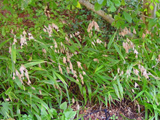
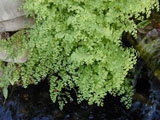
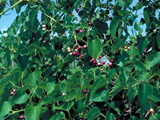
More Plant Lists Questions
Plants for a bare clay slope in North Carolina
December 22, 2011 - Hi - I live near Raleigh North Carolina (border of the coastal plain and Piedmont). I have about 1/2 acre that was excavated for a geothermal heating/cooling system and now I need to stabilize it a...
view the full question and answer
Native plant list for Haltom City, TX
September 12, 2013 - We're planning a native plant demonstration garden and need help. Can you email me a list of plants that will grow well in North Central Texas. We need to include those that will grow in full sun, sh...
view the full question and answer
Nitrogen Fixing plants for Austin Texas
September 22, 2014 - I recently saw a piece on Central Texas Gardener recommending winter covers to fix nitrogen such as elbow rye, hairy vetch, and crimson clover. Can you recommend a native plant that will grow through...
view the full question and answer
Trees for home in Kansas
April 01, 2012 - I am needing help planting trees in my yard. It's a new construction home and I would like a tree that won't get into the septic system easily. Also, I have to plant 3 other trees as well due to the...
view the full question and answer
Long Island Barrier Beach Plants
April 22, 2013 - I live on the south shore of Long Island on a barrier beach and am landscaping my property as a result of Sandy damage. I am going with a sand base, and I am looking for suitable trees and shrubs for...
view the full question and answer
| Support the Wildflower Center by Donating Online or Becoming a Member today. |