Native Plants

Plant Database
Search for native plants by scientific name, common name or family. If you are not sure what you are looking for, try the Combination Search or our Recommended Species lists.
Marcus, Joseph A.
Chasmanthium latifolium
Chasmanthium latifolium (Michx.) Yates
Inland Sea Oats, Indian Wood Oats, Wild Oats, River Oats, Flathead Oats, Upland Oats, Upland Sea Oats
Poaceae (Grass Family)
Synonym(s): Uniola latifolia
USDA Symbol: chla5
USDA Native Status: L48 (N)
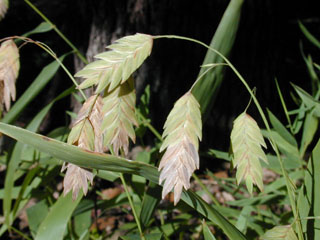
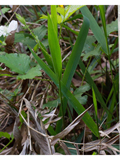
This is a 2-4 ft., clump-forming, perennial grass bearing large, drooping, oat-like flower spikelets from slender, arching branches. The blue-green, bamboo-like leaves often turn a bright yellow-gold, especially in sunnier sites, in fall.
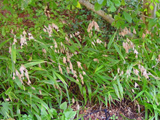
Very popular as a low-maintenance shade grass, Inland sea oats is notable for its large, graceful seedheads. Sending up blue-green basal leaves in earliest spring, it can be 2 feet tall and a vivid green by May, with translucent green seedheads swaying in the breeze. By mid-summer, the seeds will have turned an attractive ivory and will turn brown in a few months before dropping off. It passes through most of winter a soft brown, but becomes tattered and gray by February, a good time to cut it back to the basal rosette. It reseeds easily and can expand aggressively within a couple of years, making a solid mat in moist loams. It has been used to prevent soil erosion along streams. The seed stalks are attractive in flower arrangements.


Plant Characteristics
Duration: PerennialHabit: Grass/Grass-like
Root Type: Fibrous
Leaf Retention: Deciduous
Leaf Arrangement: Alternate
Leaf Complexity: Simple
Leaf Venation: Parallel
Inflorescence: Spikelet
Fruit Type: Caryopsis
Size Notes: 2 to 4 feet tall
Leaf: Green
Fruit: Tan
Bloom Information
Bloom Color: GreenBloom Time: Jun , Jul , Aug , Sep
Distribution
USA: AL , AR , AZ , DC , DE , FL , GA , IA , IL , IN , KS , KY , LA , MD , MI , MO , MS , NC , NJ , NM , OH , OK , PA , SC , TN , TX , VA , WI , WVNative Distribution: Eastern North America, from PA south to n. FL, west as far as s. IL, e. KS, and central TX and south to Nuevo Leon in northeastern Mexico
Native Habitat: Shaded slopes; low thickets; stream banks
Growing Conditions
Water Use: MediumLight Requirement: Part Shade , Shade
Soil Moisture: Moist
Soil pH: Acidic (pH<6.8)
CaCO3 Tolerance: Low
Soil Description: Moist sands, loams, and clays. Poorly drained okay.
Conditions Comments: Avoid planting in continuous full sun, as its leaves turn yellowish without adequate shade. The more water it receives, the more tolerant it will be of intense sun, but it still prefers shade.
Benefit
Use Ornamental: An attractive, dense-covering grass for shade, with decorative seedheads. Also good in pots.Use Wildlife: Seeds eaten by small mammals and granivorous birds. Leaves provide graze for mammals. Stems and leaves used as nesting material by birds.
Use Other: Cut seed stalks decorative in dried arrangements.
Interesting Foliage: yes
Attracts: Butterflies
Larval Host: Pepper & salt skipper butterfly, Bell's road side skipper butterfly, Bronzed roadside skipper butterfly
Deer Resistant: High
Propagation
Propagation Material: Root Division , SeedsDescription: Propagate by seed or root division.
Seed Collection: Collect seed in fall.
Seed Treatment: Germinates and grows easily at any time.
Commercially Avail: yes
Maintenance: For a neat appearance, cut dead stalks back to the basal rosette in mid- to late winter. If leaves exceed 2 feet tall by spring and you'd like to keep it shorter, cut them in half in May or June (Texas schedule). If a colony expands too aggressively, remove unwanted clumps. Very easy to transplant them.
Find Seed or Plants
Order seed of this species from Native American Seed and help support the Wildflower Center.
Find seed sources for this species at the Native Seed Network.
Mr. Smarty Plants says
Austin Shade Plants for Pots
March 28, 2010
I live in a condo in Austin Texas so I don't have any flower beds or yard space. I would like to put a few large pots of plants and flowers on my front patio but it's mostly shaded during the day. W...
view the full question and answer
Native grasses for shade in Dallas
November 30, 2008
What native grasses can be grown under large Live Oaks in the Dallas Area? The combination of shade and black gumbo soil seem to keep all plant life, except for poison ivy and ferns, out. I would lo...
view the full question and answer
Plants for a steep lot in Tennessee
August 07, 2008
I have built a home on a very steep lot (approx 1 1/2 acres)in Northern Central Tenn in Jackson County. The lot is too steep to mow and some of it is too steep to stand on comfortably. My question is...
view the full question and answer
Groundcover for sunny yard in New Jersey
July 23, 2008
Hi. I'm looking for ground cover for a mostly sunny section of my yard. The ground we are looking to cover is next to a slight hill with in a few feet of an in ground pool. I would like something tha...
view the full question and answer
Native plants for container gardens in Central Texas
March 11, 2008
Dear Mr. Smarty Plants: I moved to TX last year, for now living in an apartment with a good-size but shady deck; my garden in VA was full of VA native plants. What TX natives, if any, can I grow in ...
view the full question and answer
National Wetland Indicator Status
| Region: | AGCP | AK | AW | CB | EMP | GP | HI | MW | NCNE | WMVE |
| Status: | FAC | FAC | FACU | FACU | FACW | FACW |
From the National Organizations Directory
According to the species list provided by Affiliate Organizations, this plant is on display at the following locations:Lady Bird Johnson Wildflower Center - Austin, TX
Pineywoods Native Plant Center - Nacogdoches, TX
Texas Discovery Gardens - Dallas, TX
Delaware Nature Society - Hockessin, DE
Brackenridge Field Laboratory - Austin, TX
United States Botanic Garden - Washington, DC
NPSOT - Native Plant Society of Texas - Fredericksburg, TX
Nueces River Authority - Uvalde, TX
Stengl Biological Research Station - Smithville, TX
Texas Parks and Wildlife Department - Austin, TX
NPSOT - Fredericksburg Chapter - Fredericksburg, TX
Texas Master Naturalists - Lost Pines Chapter - Bastrop, TX
NPSOT - Austin Chapter - Austin, TX
Native Seed Network - Corvallis, OR
Jacob's Well Natural Area - Wimberley, TX
NPSOT - Williamson County Chapter - Georgetown, TX
Mt. Cuba Center - Hockessin, DE
Wildflower Center Seed Bank
LBJWC-218 Collected 2008-10-06 in Travis County by Lady Bird Johnson Wildflower CenterBibliography
Bibref 1620 - Gardening with Native Plants of the South (Reprint Edition) (2009) Wasowski, S. with A. WasowskiBibref 293 - Manual of the Vascular Plants of Texas (1979) Correll, D. S. & M. C. Johnston
Bibref 841 - Native Alternatives to Invasive Plants (2006) Burrell, C. C.
Bibref 318 - Native Texas Plants: Landscaping Region by Region (2002) Wasowski, S. & A. Wasowski
Bibref 291 - Texas Wildscapes: Gardening for Wildlife (1999) Damude, N. & K.C. Bender
Bibref 1294 - The Midwestern Native Garden: Native Alternatives to Nonnative Flowers and Plants An Illustrated Guide (2011) Adelman, Charlotte and Schwartz, Bernard L.
Search More Titles in Bibliography
Research Literature
Reslit 582 - Growth and macronutrient accumulation of Chasmanthium latifolium (Michx.) Yates and Hakonechloa macra makino 'Aureola' in response to temperature (2002) M. P. Harvey and M. H. BrandReslit 1383 - Ornamental Landscape Performance of Native and Nonnative Grasses under Low-input Conditions (2009) M. Thetford, J. G. Norcini, B. Ballard and J. H. A...
This information was provided by the Florida WIldflower Foundation.
Search More Titles in Research Literature
Additional resources
USDA: Find Chasmanthium latifolium in USDA PlantsFNA: Find Chasmanthium latifolium in the Flora of North America (if available)
Google: Search Google for Chasmanthium latifolium
Metadata
Record Modified: 2013-09-12Research By: TWC Staff, GDG