Native Plants

Q. Who is Mr. Smarty Plants?
A: There are those who suspect Wildflower Center volunteers are the culpable and capable culprits. Yet, others think staff members play some, albeit small, role. You can torture us with your plant questions, but we will never reveal the Green Guru's secret identity.

Did you know you can access the Native Plant Information Network with your web-enabled smartphone?

Ask Mr. Smarty Plants
Ask Mr. Smarty Plants is a free service provided by the staff and volunteers at the Lady Bird Johnson Wildflower Center.

rate this answer

Thursday - September 01, 2011
From: Austin, TX
Region: Southwest
Topic: Compost and Mulch, Planting, Soils, Watering, Drought Tolerant, Shrubs, Trees
Title: Landscaping plant for Austin
Answered by: Barbara Medford
QUESTION:
Great site! Have gotten lots of ideas. We're about to start construction on a fairly major landscaping project: raised beds/privacy screen. We're at the top of a hill in the Hill Country just west of Austin. The soil is of course very thin -- either caliche within 12 inches of the surface or thick rock slabs, often 3-4 layers thick. At best the ground is less than half soil and in many places less than 10%. The plan is to build a couple large raised beds to serve as the basis for a privacy screen and barrier that will divide the livable portion of the back yard from the rest of the land. The beds will be 3-4 feet high, 8-10 feet wide, and in total some 170 feet long. We plan to dig out what rock and caliche we can without affecting the structural integrity of the the to-be-built walls of the beds. Preliminary work suggests that we'll be going down 2-3 feet in a trench about 3-4 feet wide. We plan to stock the beds with a mix of shrubs, grasses and small trees to give a variety of colors, textures, shapes and foliage densities to provide year-round activity and privacy. So, questions: 1) What's the largest tree you think would be sustainable in that sort of contained environment? Because of poor soil I'm starting to view this as a sort of large planter. (The rock/caliche layers are not solid, so I believe that drainage won't be a significant problem.) 2) Is there any reason that we couldn't put a layer of larger trees on the outside edge of the bed (away from the house) to provide another layer of green? If so, any recommendations as to what specific trees would do well in our poor soil? Because of the light irrigating we plan to do in the beds themselves I figure such outlying trees will get more water than they would normally in our environment, but we'd rather not treat them to regular direct watering. 3) The current plan for the beds' fill dirt is a mix of chocolate loam, sand and dillo dirt. Would love to hear anything you think would do particularly well in that. 4) I've pulled about 40 candidates off of your database (HANDY that thing is!), but of course would love any advice as to any specific items that you think would do particularly well (or any part of the plan in general you think we should amend). Whew! Think that's it! Thanks ahead of time!ANSWER:
Thanks for the nice words. It sounds like we will not have to give you our usual tutorial on using the database. We are first going to give you some general cautions and tips and then answer your 4 questions, as best we can.
Have you been noticing the Light Requirements in the plants you have been choosing? It sounds to us like you will have full sun, which we consider to be 6 hours or more of sun a day. Part shade (2 to 6 hours a day) and shade (2 hours or less) are possible around structures or walls. Planting something that needs lots of sun in the shade could mean few blooms and/or something needing shade but growing in the sun can cause shriveling up and dying of plants. Going to all the work and expense of planting the wrong plant in the wrong place is a waste of resources.
Maybe we should have said this first, but don't plant anything now! The end of August in a record-setting heat wave and drought will only lead to grief and dead plants. You mentioned lighter watering of trees outside the main perimeter of your garden. Any new plant needs a good water supply in the first few months of its life, especially woody plants. A newly planted tree should have a hose pushed down into the soft soil around that tree and allowed to dribble slowly until water comes to the surface. This should happen at least twice a week, and sprinkling is not effective. This also brings us to the subject of drainage; you mentioned that the caliche is not solid so drainage should not be a problem. Actually, the type of soil you have also determines the drainability of that soil. The native soils in Central Texas are predominantly alkaline clays. Clay has lots of nutrients in it, but its very small particles swell when water is applied, basically making the water and nutrients in the soil inaccessible to the new little rootlets.
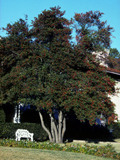
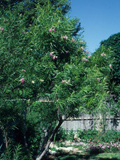
So, your Question 1: We suggest that the largest tree sustainable in your "raised bed" situation still can't be very big. Remember that the roots of a tree may extend 2 to 3 times as far out as the shadeline or dripline of the tree. We would suggest some smaller trees or shrubs that can be trained as trees, such as Ilex vomitoria (Yaupon), Cercis canadensis var. texensis (Texas redbud), Chilopsis linearis (Desert willow) and Sapindus saponaria var. drummondii (Western soapberry).
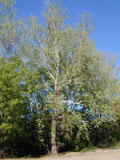
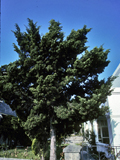
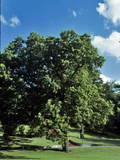
Question 2: Larger trees for farther back (but still within range of deep watering): Juniperus virginiana (Eastern red cedar), Platanus occidentalis (American sycamore), Quercus macrocarpa (Bur oak).
Question 3: We have no experience with gardening with any of the soil amendments you mentioned, and investigated them for ourselves. We don't want to prejudice you against any recommendations you have received from professionals, but just want you to know our opinion.
Chocolate loam-Basic soil, used for fill material, compacts fairly easily. This sounds like what used to be called "topsoil" and could have been anything from anywhere, and not necessarily including signicant nutrients. Since we have already mentioned you need to provide for good drainage in your clay soil, we don't feel that easily compacted soil is particularly desirable.
Dillo Dirt - recycled sewage product from City of Austin. Excuse us: Eeugghh! No doubt this has been allowed to cure for some time, and certainly must pass some sanitation tests, but we are not crazy about it. Sewage can contain damaging metals or other materials that don't "cure" out.
Sand - this would apparently be masonry sand, which might help with drainage if properly mixed with dirt, but water drains out of it very quickly.
Obviously, you are going to need to import some dirt for your "raised bed," but we would like to see it mixed with generous amounts of compost, followed by mulching with a good quality hardwood mulch. This would protect the roots of your plants from heat and cold and, as it decomposes, adds more organic material to the soil.
Question No. 4: Suggestions for plants. This is something we hope everyone in Central Texas heeds - the dreadful heat and drought, along with the unexpected cold snaps last winter, are probably not going to get much better. We are in the midst of almost catastrophic drought conditions, and any plant not suited by centuries of experience to these conditions does not belong in your garden. You must be prepared, although we hope not, to face years of low rainfall, water shortages, and watering restrictions. Gardeners should select plants native to their area, drought tolerant and pest resistant, in order that the considerable investment in resources will not be wasted.
From the Image Gallery

More Soils Questions
Apartment Landscaping
September 13, 2005 - I live in an apartment and have a small patch filled with rocks and an ugly plant I don't know the name of. I want to take out the existing plants and put something else in. It has to be hearty,low m...
view the full question and answer
Flowers for sunny and shady gardens in Cedar Hill TX
March 30, 2010 - Last year I spent way too much on flowers for my sunny and shady flower beds. They all died from the heat, even after constant watering. What flowers could I plant in sunny and shady flower beds that ...
view the full question and answer
Erosion control on slope from Columbia SC
April 25, 2013 - We are in the process of having a new home built in Columbia South Carolina. Part of the front yard has a steep slope starting approximately four feet from the corner of the house and running to the ...
view the full question and answer
Failure to thrive of Hamelia patens in Laredo
September 19, 2008 - I have a question regarding Hamelias patens(firebush)that I have been trying to grow for 2 years. I live in Laredo, Texas and this area should be an excellent climate for this plant. I planted 12 of t...
view the full question and answer
Death of Texas Betony and Blackfoot Daisy from Austin
April 18, 2013 - I have one small area that there are two plants - Texas Betony and Blackfoot Daisy withered and died eventually. Same kinds of plants are doing fine close by. It is my front yard close to walk way.I w...
view the full question and answer
| Support the Wildflower Center by Donating Online or Becoming a Member today. |