Native Plants

Plant Database
Search for native plants by scientific name, common name or family. If you are not sure what you are looking for, try the Combination Search or our Recommended Species lists.
Marcus, Joseph A.
Chilopsis linearis
Chilopsis linearis (Cav.) Sweet
Desert Willow, Flowering Willow, Willow-leaved Catalpa, Willowleaf Catalpa, Bow Willow, Flor De Mimbre, Mimbre
Bignoniaceae (Trumpet-Creeper Family)
Synonym(s):
USDA Symbol: chli2
USDA Native Status: L48 (N)
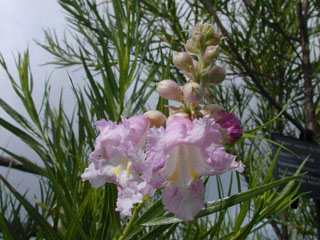
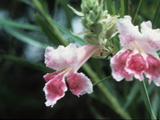
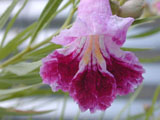
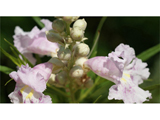
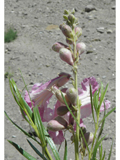
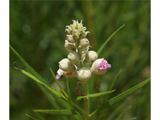
Desert-willow is a 15-40 ft., slender-twigged, small tree or large shrub, often with leaning, twisting trunk and open, spreading crown. Leaves are deciduous, willow-like, light green, both opposite and alternate, 4-12 inches long and 1/3 inch wide. The blossom is funnel-shaped, 1-1 1/2 inches long, spreading at the opening into 5 ruffled, petal-like lobes. The flower is dark pink or purple, often with white or yellow and purple streaks within the throat. The catalpa-like flowers are borne in terminal racemes. By early autumn, the violet-scented flowers, which appear after summer rains, are replaced by slender seedpods, 6-10 inches long, which remain dangling from the branches and serve to identify the tree after the flowers are gone.
Named for its resemblance to willows, this popular ornamental tree is actually related to catalpa trees, Yellowbells (Tecoma stans), and Trumpet vine (Campsis radicans). Its exotic-looking blooms, rapid growth, drought tolerance, and ease of maintenance have made it a sought-after plant within its range, which in nature is from south-central Texas south to Nuevo Leon and Zacatecas in Mexico and west all the way to southern California and Baja California. Adapted to desert washes, it does best with just enough water to keep it blooming and healthily green through the warm months. Many cultivars have been selected, with varying flower colors, leaf sizes, and amounts of seed pods.
Plant Characteristics
Duration: PerennialHabit: Tree
Leaf Retention: Deciduous
Leaf Arrangement: Alternate , Opposite
Leaf Complexity: Simple
Leaf Shape: Lanceolate , Linear
Leaf Venation: Pinnate
Leaf Pubescence: Glabrous
Leaf Margin: Entire
Breeding System: Flowers Unisexual , Monoecious
Inflorescence: Panicle
Fruit Type: Capsule
Size Notes: Up to about 40 feet tall.
Leaf: Green.
Flower: Flowers 1-1.5 inch, in 2-4 inch panicles.
Fruit: Green to brown, 4-12 inches.
Bloom Information
Bloom Color: White , Pink , Purple , VioletBloom Time: Apr , May , Jun , Jul , Aug , Sep , Oct
Bloom Notes: Mostly blooms heaviest May to June but will continue to bloom sporadically throughout the warm season after rains. Flower color ranges from solid white or muted pink to darker rose and purple, as well as two-toned combinations of those colors. Throat often yellow-tinged. Many cultivars available with varying flower colors.
Distribution
USA: AZ , CA , NM , TXNative Distribution: South-central Texas south to Nuevo Leon and Zacatecas, west to southern California and Baja California
Native Habitat: Ditches, ravines, depressions, streams, river banks, arroyos, swales, and washes in desert areas
Growing Conditions
Water Use: LowLight Requirement: Sun
Soil Moisture: Dry , Moist
CaCO3 Tolerance: Medium
Drought Tolerance: High
Cold Tolerant: yes
Heat Tolerant: yes
Soil Description: Well-drained limestone soils preferred, but also does well in sands, loams, clays, caliches, granitic, and rocky soils. Minimal organic content the norm.
Conditions Comments: Allow to dry out between waterings, as this will encourage more extensive waves of blooms. Avoid excessive water and fertilizer, as that can lead to overly rapid growth, fewer blooms, and a weaker plant. Prolonged saturation can result in rot. Won't grow as fast or get as large in clay soil but won't suffer there either. Can be drought-deciduous in some regions. Can survive temperatures as low as 10 degrees F.
Benefit
Use Ornamental: A showy, fast-growing, drought-tolerant ornamental tree with very decorative bloomsUse Wildlife: Nectar-hummingbirds, Nectar-insects, Seeds-granivorous birds
Use Medicinal: Floral decoctions taken for coughs and bronchial problems in Mexico
Use Other: Erosion control. Bows and basketry made from its wood by indigenous people. A good honey plant.
Conspicuous Flowers: yes
Fragrant Flowers: yes
Interesting Foliage: yes
Attracts: Birds , Butterflies , Hummingbirds
Larval Host: White-winged moth
Nectar Source: yes
Deer Resistant: Moderate
Value to Beneficial Insects
Provides Nesting Materials/Structure for Native BeesThis information was provided by the Pollinator Program at The Xerces Society for Invertebrate Conservation.
Propagation
Propagation Material: Seeds , Semi-hardwood CuttingsDescription: Propagate by fresh seed, dormant cuttings, or semi-hardwood cuttings in late summer.
Seed Collection: Gather seeds from late summer through autumn when the pods have dried and turned brown but before they split open to release feathery seeds. Seeds may be stored dry in the refrigerator over winter (other references suggest storage in wet sand) but germinate best if sown fresh.
Seed Treatment: No treatment is necessary.
Commercially Avail: yes
Maintenance: Prune frequently during its first few years to encourage minimal or single trunks. Water occasionally during prolonged drought. Remove spent flowers and seed pods to encourage continued blooming. To encourage branching and blooming, cut back during winter dormancy by a third.
Find Seed or Plants
Find seed sources for this species at the Native Seed Network.
Mr. Smarty Plants says
Name of the rough-barked mimosa (Albizia kalkora)
February 12, 2008
I read two years ago that there was two different mimosa trees one that is common and has the smooth bark and the other one had a rough bark. I am Interested in the one who has the rough bark and the ...
view the full question and answer
Native plants for butterfly garden in Waco, TX
February 03, 2008
Few weeks ago I sent you a letter but never got an answer back.
I would like to have your suggestions of native plants for a butterfly garden (30'x 30') here in Waco. The plants must be (1)drought ...
view the full question and answer
Mountain Laurel and Desert Willow in pots or ground in Brady, TX
May 09, 2006
I would really appreciate your advice if a Texas Mountain Laurel (now a 1 gal. size) and a Desert Willow (now a 3 gal.) are good candidates for planting in containers and, if so, what size for each? ...
view the full question and answer
National Wetland Indicator Status
| Region: | AGCP | AK | AW | CB | EMP | GP | HI | MW | NCNE | WMVE |
| Status: | FACU | FACU | FACU | FAC |
From the National Organizations Directory
According to the species list provided by Affiliate Organizations, this plant is on display at the following locations:Naval Air Station Kingsville - Kingsville, TX
Texas Discovery Gardens - Dallas, TX
Sibley Nature Center - Midland, TX
Patsy Glenn Refuge, c/o Wimberley Birding Society - Wimberley, TX
NPSOT - Native Plant Society of Texas - Fredericksburg, TX
Nueces River Authority - Uvalde, TX
Texas Parks and Wildlife Department - Austin, TX
NPSOT - Fredericksburg Chapter - Fredericksburg, TX
NPSOT - Austin Chapter - Austin, TX
Native Seed Network - Corvallis, OR
NPSOT - Williamson County Chapter - Georgetown, TX
Bibliography
Bibref 298 - Field Guide to Texas Trees (1999) Simpson, B.J.Bibref 481 - How to Grow Native Plants of Texas and the Southwest: Revised and Updated Edition (2001) Nokes, J.
Bibref 841 - Native Alternatives to Invasive Plants (2006) Burrell, C. C.
Bibref 995 - Native Landscaping from El Paso to L.A. (2000) Wasowski, S. and A. Wasowski
Bibref 318 - Native Texas Plants: Landscaping Region by Region (2002) Wasowski, S. & A. Wasowski
Bibref 248 - Texas Wildflowers: A Field Guide (1984) Loughmiller, C. & L. Loughmiller
Bibref 291 - Texas Wildscapes: Gardening for Wildlife (1999) Damude, N. & K.C. Bender
Bibref 297 - Trees of Central Texas (1984) Vines, Robert A.
Bibref 286 - Wildflowers of the Texas Hill Country (1989) Enquist, M.
Search More Titles in Bibliography
From the Archive
Wildflower Newsletter 1987 VOL. 4, NO.3 - Fall Planting Highlights the Season, Jubilee Celebration Commences December 1987...Additional resources
USDA: Find Chilopsis linearis in USDA PlantsFNA: Find Chilopsis linearis in the Flora of North America (if available)
Google: Search Google for Chilopsis linearis
Metadata
Record Modified: 2022-10-03Research By: TWC Staff, GDG