Native Plants

Plant Database
Search for native plants by scientific name, common name or family. If you are not sure what you are looking for, try the Combination Search or our Recommended Species lists.
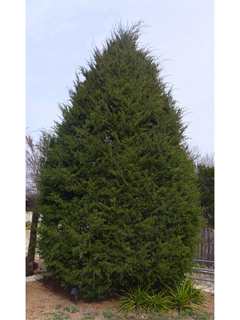
Mathews, Ray
Juniperus virginiana
Juniperus virginiana L.
Eastern Red Cedar, Eastern Redcedar, Virginia Juniper, Red Juniper, Pencil Cedar, Carolina Cedar, Red Savin
Cupressaceae (Cypress Family)
Synonym(s):
USDA Symbol: juvi
USDA Native Status: L48 (N), CAN (N)
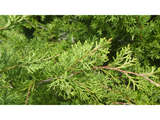
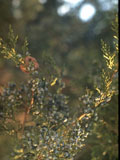
Evergreen, aromatic tree with trunk often angled and buttressed at base and narrow, compact, columnar crown; sometimes becoming broad and irregular. Pyramidal when young, Eastern Red Cedar mature form is quite variable. This evergreen usually grows 30-40 ft. but can reach 90 ft. Fragrant, scale-like foliage can be coarse or fine-cut, and varies in color from gray-green to blue-green to light- or dark-green. All colors tend to brown in winter. Pale blue fruits occur on female plants. Soft, silvery bark covers the single trunk.
The most widely distributed eastern conifer, native in 37 states, Eastern Red Cedar is resistant to extremes of drought, heat, and cold. Red Cedar can be injurious to apple orchards because it is an alternate host for cedar-apple rust, a fungal disease. First observed at Roanoke Island, Virginia, in 1564, it was prized by the colonists for building furniture, rail fences, and log cabins.
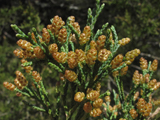
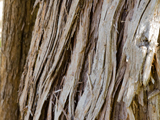
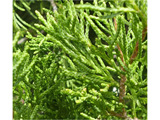
Plant Characteristics
Duration: PerennialHabit: Tree
Leaf Retention: Evergreen
Leaf Complexity: Simple
Fruit Type: Cone
Size Notes: Up to about 90 feet tall.
Leaf: Green
Fruit: Seed cones bluish black to brownish blue. Though technically incorrect, the seed cones are often referred to as berries.
Bloom Information
Bloom Color: Green , Purple , BrownBloom Time: Mar , Apr , May
Distribution
USA: AL , AR , CO , CT , DC , DE , FL , GA , IA , IL , IN , KS , KY , LA , MA , MD , ME , MI , MN , MO , MS , NC , ND , NE , NH , NJ , NY , OH , OK , OR , PA , RI , SC , SD , TN , TX , VA , VT , WI , WVCanada: MB , NS , ON , QC
Native Distribution: N.S. to SD, s. to n. FL & c. TX
Native Habitat: Fence rows, Woodlands' edge, Opening, Prairie, Plains, Meadows, Pastures, Savannas
Growing Conditions
Water Use: LowLight Requirement: Sun , Part Shade , Shade
Soil Moisture: Dry
Soil pH: Circumneutral (pH 6.8-7.2)
CaCO3 Tolerance: High
Drought Tolerance: High
Cold Tolerant: yes
Heat Tolerant: yes
Soil Description: Dry, limestone soils (adaptable). Sandy, Sandy Loam, Medium Loam Clay Loam, Clay, Rocky, Limestone-based, Caliche type.
Benefit
Use Ornamental: Grown for Christmas trees, shelterbelts, and in many cultivated varieties for ornament.Use Wildlife: The juicy "berries" are consumed by many kinds of wildlife, including the cedar waxwing, named for this tree. The fruits are a staple for many birds and small mammals. Also provides nesting material and cover.
Use Food: Juniper tea can be made by placing a dozen young berryless twigs in a quart of cold water; bring to a boil then allow to simmer for 10 minutes. Strain and use as regular tea, in small quantities. (Poisonous Plants of N.C.) The earliest colonists recognized the value of the Virginia Juniper from the start - for fences and shingles, benches and tables, coffins and the superstructures of boats. (Peattie)
Use Medicinal: Tea of fruits and leaves for coughs and colds. Berries chewed for canker sores in mouth. (Kindscher) Creeks and Choctaws drank oil from red cedar berries for dysentery. Boiled fruit and leaves make a drink for colds and coughs. Smoke from smoldering leafy twigs inhaled for head colds. Kiowas chewed berries and held liquid in mouth as a mild antiseptic rinse. An unnamed part of this juniper was used by Natchez as a specific for mumps.(Weiner) Zuni women took juniper berries to promote uterine recovery after childbirth. Treated wound infections and arthritis. (Castleman) Smoke from the leaves as was used as an inhalant to treat Colds, Bronchitis and Rheumatism. It is thought to contain an anticancer agent, podophyllocotoxin. Fruit tea used for colds, worms, rheumatism, coughs, induce sweating. Leaf smoke or steam inhaled for colds, bronchitis, rheumatism.
Use Other: The aromatic wood is used for fenceposts, cedar chests, cabinetwork, and carvings. Cedar oil for medicine and perfumes is obtained from the wood and leaves. The heartwood was once almost exclusively the source of wood for pencils; Incense Cedar ( Calocedrus decurrens Torr.) is now used instead. Incense for purification and ritual.
Warning: POISONOUS PARTS: Fleshy cones (resembles berries), leaves. Low toxicity when ingested; large amounts may cause diarrhea. Toxic Principle: Volatile oils including thujone.
Interesting Foliage: yes
Fragrant Foliage: yes
Attracts: Birds , Butterflies
Larval Host: Olive butterfly.
Propagation
Propagation Material: SeedsDescription: Seed can be sown outdoors in fall or stratified and sown in spring. Seed germination is often poor, so a large quantity of seeds should be sown. Selected forms have been rooted from cuttings.
Seed Collection: Collect seeds from late summer through fall when it has turned its ripe color. Thoroughly dry and clean seeds to avoid mold and overheating. If not planting immediately, air dry before storing. Store in sealed containers at 20-40 degrees.
Seed Treatment: Stratify at 41 degrees for 30-120 days.
Commercially Avail: yes
Find Seed or Plants
Find seed sources for this species at the Native Seed Network.
View propagation protocol from Native Plants Network.
Mr. Smarty Plants says
Tree for sound block near Houston
April 24, 2010
I live in Pearland, just south of Houston and am looking for a tree that I can plant along my fenceline between my neighbor and me that will block noise. We have a pool and entertain a lot, but they a...
view the full question and answer
Eucalyptus tree for Spring, Texas
October 31, 2008
I've heard eucalyptus trees do not lose their leaves in the winter and grow considerably tall. I want to replace a decaying pine tree with a eucalyptus tree. Do you recommend that for the Spring, T...
view the full question and answer
Shrub to hide chain link fence
August 12, 2008
Mr. Smarty Plants, Please recommend a tall, thick shrub to conceal the 6 foot chain link fence around the perimeter of our property. The fence is located down a hill from our home with western exposur...
view the full question and answer
Evergreen privacy hedge and drought-resistant garden
July 21, 2008
I am looking for a hardy evergreen hedge for privacy in Northern Michigan. I have sandy soil. Also am interested in planting a drought garden with mostly sun in same sandy soil.
view the full question and answer
Evergreen shrubs for Michigan
June 17, 2008
I'm seeking a small-medium, ornamental, fairly compact, evergreen shrub to complement my front yard woodland wildflower garden. I want a shrub that will flank both sides of my front porch steps. I wa...
view the full question and answer
National Wetland Indicator Status
| Region: | AGCP | AK | AW | CB | EMP | GP | HI | MW | NCNE | WMVE |
| Status: | FACU | FACU | FACU | UPL | FACU | FACU | FACU |
From the National Organizations Directory
According to the species list provided by Affiliate Organizations, this plant is on display at the following locations:Pineywoods Native Plant Center - Nacogdoches, TX
Texas Discovery Gardens - Dallas, TX
Sibley Nature Center - Midland, TX
Delaware Nature Society - Hockessin, DE
Brackenridge Field Laboratory - Austin, TX
Stengl Biological Research Station - Smithville, TX
Texas Parks and Wildlife Department - Austin, TX
Georgia Native Plant Society - Atlanta, GA
Texas Master Naturalists - Lost Pines Chapter - Bastrop, TX
NPSOT - Austin Chapter - Austin, TX
Native Seed Network - Corvallis, OR
NPSOT - Williamson County Chapter - Georgetown, TX
Mt. Cuba Center - Hockessin, DE
Wellspring Organic Farm and Education Center - West Bend, WI
Bibliography
Bibref 1207 - Earth Medicine, Earth Food (1990) Michael A. WeinerBibref 610 - Edible wild plants of the prairie : an ethnobotanical guide (1987) Kindscher, K.
Bibref 417 - Field Guide to Medicinal Plants and Herbs of Eastern and Central North America (2000) Foster, S. & J. A. Duke
Bibref 298 - Field Guide to Texas Trees (1999) Simpson, B.J.
Bibref 1620 - Gardening with Native Plants of the South (Reprint Edition) (2009) Wasowski, S. with A. Wasowski
Bibref 946 - Gardening with Prairie Plants: How to Create Beautiful Native Landscapes (2002) Wasowski, Sally
Bibref 355 - Landscaping with Native Plants of Texas and the Southwest (1991) Miller, G. O.
Bibref 354 - Native & Naturalized Woody Plants of Austin & the Hill Country (1981) Lynch, D.
Bibref 841 - Native Alternatives to Invasive Plants (2006) Burrell, C. C.
Bibref 318 - Native Texas Plants: Landscaping Region by Region (2002) Wasowski, S. & A. Wasowski
Bibref 400 - Natural History of Trees of Eastern & Central North America (1991) Peattie, D.C. & P. H. Landacre
Bibref 291 - Texas Wildscapes: Gardening for Wildlife (1999) Damude, N. & K.C. Bender
Bibref 1208 - The New Healing Herbs (1995) Michael Castleman
Bibref 297 - Trees of Central Texas (1984) Vines, Robert A.
Search More Titles in Bibliography
Web Reference
Webref 38 - Flora of North America (2019) Missouri Botanical Garden, St. Louis, MO & Harvard University Herbaria, Cambridge, MA.From the Archive
Wildflower Newsletter 1998 VOL. 15, NO.5 - Native Shrubs Providing Landscape Heritage and Habitat, Executive Director\'s Re...Additional resources
USDA: Find Juniperus virginiana in USDA PlantsFNA: Find Juniperus virginiana in the Flora of North America (if available)
Google: Search Google for Juniperus virginiana
Metadata
Record Modified: 2023-03-23Research By: TWC Staff