Native Plants

Plant Database
Search for native plants by scientific name, common name or family. If you are not sure what you are looking for, try the Combination Search or our Recommended Species lists.
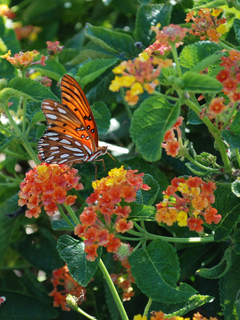
Henry, Lisa
Lantana urticoides
Lantana urticoides Hayek
Texas Lantana, Calico Bush
Verbenaceae (Verbena Family)
Synonym(s): Lantana hispida, Lantana horrida, Lantana horrida var. latibracteata, Lantana notha, Lantana scorta, Lantana urticoides var. hispidula
USDA Symbol: laur2
USDA Native Status: L48 (N)
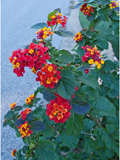
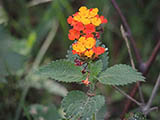
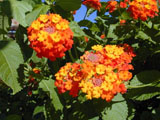
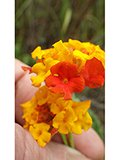
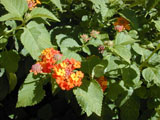
A spreading shrub, much branched from the ground upward, branches sometimes with prickles. Frequent in brushy places and in woodlands. Bark light gray to light brown, tending to flake off. Young twigs nearly square in cross section, covered with short hairs visible under a 10x hand lens. Leaves opposite, up to 2 1/2 inches long, broadly ovate, pointed at the tip, flattened at the base, upper surface rough to the touch; margins coarsely toothed, teeth broad, pointed or rounded. Flowers colorful, red, orange, and yellow, tubular with four flared lobes; in dense, rounded clusters with a leafy bract subtending each flower, at the ends of long paired stems (peduncles) usually extending beyond the leaves, appearing from April to October. Fruit round, fleshy, dark blue to black.
This species is a member of the verbena family (family Verbenaceae), which includes about 75 genera and 3,000 species of herbs, shrubs, and trees, mostly of tropical and warm temperate regions. Among them, teak is a highly prized furniture wood, and Vervain, Lantana, Lippia or Frog Fruit, and Chaste Tree or Vitex are grown as ornamentals.
Plant Characteristics
Duration: PerennialHabit: Shrub
Leaf Arrangement: Opposite
Leaf Shape: Ovate
Fruit Type: Drupe
Size Notes: Up to about 6 feet tall, often shorter.
Fruit: Black
Bloom Information
Bloom Color: Red , Orange , YellowBloom Time: Apr , May , Jun , Jul , Aug , Sep , Oct , Nov
Distribution
USA: AZ , NM , TXNative Distribution: East Texas west to southern Arizona, south to Oaxaca in southern Mexico
Native Habitat: Fields, thickets, swamps, rich sandy woods, scrub, gravelly hills, flats. Chaparral and roadsides, almost throughout Texas. Well-drained sand, loam, clay, caliche. Fields; thickets; sandy woods; gravelly hillsides
Growing Conditions
Water Use: LowLight Requirement: Sun
Soil Moisture: Dry
Heat Tolerant: yes
Soil Description: Poor, well-drained soils.
Conditions Comments: Lantana provides summer color. In winter, some gardeners prune back lantana to keep the plants from getting too large. The stems become thorny especially with age, so caution is necessary when cutting them back. The blue-black fruit clusters are poisonous. Used as a low to medium, flowering ground cover for dry, exposed, poor sites. Crinkly leaves give off a sharp aroma when touched and they can cause a skin rash. Mature plants tend to form large mounds that may be separated into smaller plants in the winter.
Benefit
Use Wildlife: Attracts butterflies. Deer-proof.Conspicuous Flowers: yes
Attracts: Birds , Butterflies
Nectar Source: yes
Deer Resistant: High
Propagation
Seed Collection: Collect seeds as soon as the fruit has filled out and turned dark. Air dry with pulp on or clean before storage. Store in sealed, refrigerated containers.Commercially Avail: yes
Find Seed or Plants
Order seed of this species from Native American Seed and help support the Wildflower Center.
Mr. Smarty Plants says
Small shrub to plant in Austin Texas
March 11, 2009
Hi..
I live in Southwest Austin and I am looking for a shrub that I can plant against the back of my house, which faces the north. I want something native, fairly low maintenance and not too large,...
view the full question and answer
Spring blooming plants for spring sun and summer shade
July 03, 2007
I live in San Antonio. I'm faced with a dilemma. I've got mature native pecans. In the summer they provide beautiful full shade. However, in the winter and even into the late spring, my yard is ...
view the full question and answer
Deer resistant, sun tolerant plants for landscaping
April 19, 2007
I live in Driftwood and am looking for flowering, deer-resistant plants for the northern side of my house; however the house turn just enough to the west that the flowerbed receives about 3 hours of a...
view the full question and answer
List of native perennial Texas flowers
March 13, 2006
Good day, I am searching for a list of native Texas flowers (preferably perennials) for a flower garden.
Thank you.
view the full question and answer
National Wetland Indicator Status
| Region: | AGCP | AK | AW | CB | EMP | GP | HI | MW | NCNE | WMVE |
| Status: | FACU | FACU | UPL | FACU | FACU |
From the National Organizations Directory
According to the species list provided by Affiliate Organizations, this plant is on display at the following locations:Naval Air Station Kingsville - Kingsville, TX
Lady Bird Johnson Wildflower Center - Austin, TX
Sibley Nature Center - Midland, TX
Brackenridge Field Laboratory - Austin, TX
Patsy Glenn Refuge, c/o Wimberley Birding Society - Wimberley, TX
NPSOT - Native Plant Society of Texas - Fredericksburg, TX
Texas Parks and Wildlife Department - Austin, TX
NPSOT - Fredericksburg Chapter - Fredericksburg, TX
Texas Master Naturalists - Lost Pines Chapter - Bastrop, TX
NPSOT - Austin Chapter - Austin, TX
National Butterfly Center - Mission, TX
NPSOT - Williamson County Chapter - Georgetown, TX
Herbarium Specimen(s)
NPSOT 0854 Collected Apr 29, 1994 in Bexar County by Harry CliffeNPSOT 0218 Collected May 11, 1992 in Comal County by Mary Beth White
NPSOT 0451 Collected Jun 5, 1987 in Bexar County by Harry Cliffe
Bibliography
Bibref 841 - Native Alternatives to Invasive Plants (2006) Burrell, C. C.Bibref 318 - Native Texas Plants: Landscaping Region by Region (2002) Wasowski, S. & A. Wasowski
Search More Titles in Bibliography
Web Reference
Webref 23 - Southwest Environmental Information Network (2009) SEINet - Arizona ChapterWebref 1 - Texas Native Shrubs (2002) Texas A&M University Agriculture Program and Leslie Finical, Dallas Arboretum
Additional resources
USDA: Find Lantana urticoides in USDA PlantsFNA: Find Lantana urticoides in the Flora of North America (if available)
Google: Search Google for Lantana urticoides
Metadata
Record Modified: 2023-02-15Research By: TWC Staff