Native Plants

Q. Who is Mr. Smarty Plants?
A: There are those who suspect Wildflower Center volunteers are the culpable and capable culprits. Yet, others think staff members play some, albeit small, role. You can torture us with your plant questions, but we will never reveal the Green Guru's secret identity.

Did you know you can access the Native Plant Information Network with your web-enabled smartphone?

Ask Mr. Smarty Plants
Ask Mr. Smarty Plants is a free service provided by the staff and volunteers at the Lady Bird Johnson Wildflower Center.

rate this answer

Tuesday - October 25, 2011
From: Austin, TX
Region: Southwest
Topic: Compost and Mulch, Watering, Drought Tolerant, Erosion Control, Grasses or Grass-like
Title: Water eroding corner in Austin
Answered by: Barbara Medford
QUESTION:
I live close to the Wildflower Center. My yard slopes - as do my neighbors' yards to one corner in my yard. The result is constant moisture in one corner. The rest of the yard is caliche, rocks (many rocks) and little soil. What can I put in the damp area that would be evergreen or flower all the time?ANSWER:
Bet you still believe in the Easter Bunny, too, don't you? Evergreen and ever-blooming and survival in our alkaline soil and awful drought? Isn't going to happen, not that we wouldn't like to be able to provide you with the name and address of such a plant, if there were one. Let's call it a "Whatzit," and if it existed we would likely be the Lady Bird Johnson Whatzit Center.
Obviously, we are familiar with your area, since we are there, too. We know this is not rainwater, so it has to be the possibility of over-watering. It sounds a little weird to talk about overwatering in the midst of no rain and water rationing, but we have had several questions in which that has been our diagnosis. If you are watering, even on designated watering days, that water is draining naturally to that corner. Rather than try to find native plants that will do well in that extra water, we would suggest you make some changes in the soil to catch and use that water for plants that will like the area.
The best thing you can do is build a raised bed there, using good, well-draining amendments to make the soil more hospitable to soaking up water that flows there, and using it on plants suited to drought and heat. We addressed a similar situation in a previous question, which you might find informative.
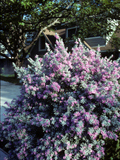
Another question, actually from the Austin area, answers several of your questions, and has another excellent link on raised beds. To repeat ourselves somewhat, the best plants for an eroding area are native grasses. The last Mr. Smarty Plants answer we referred you to lists some native plants for Central Texas. One more possibility that occurs to us, depending on how much sun you have in in the area, is Leucophyllum frutescens (Cenizo). This is a medium-size shrub that comes very close to your specified plant in being evergreen and, under the right conditions, can bloom most of the year. Follow the plant link to our page on this plant in our Native Plant Database. If you choose to go this route, get your area amended, bordered, if necessary, and get your shrub(s) when the weather is cooler. The plant definitely needs good drainage, so don't forget compost and decomposed granite for the amendments, and don't fertilize. This is one of those plants that really doesn't like fertilizing.
From the Image Gallery
More Drought Tolerant Questions
Small to medium drought-tolerant trees for Southern California
June 01, 2012 - I am looking for drought tolerant trees to line one side of our 70 foot driveway. We live in Southern California. Currently, we have queen palms, but I would like something more native or drought to...
view the full question and answer
Plants for a Narrow, Dry, Shaded Site in Georgia
April 03, 2014 - I am writing from Valdosta, GA. Could you please suggest three perennial shrubs and/or plants that flower at different times of the spring and summer? Also ones that can be planted in a 2 ft. wide s...
view the full question and answer
Hardy plants for Oklahoma raised garden at Oklahoma school
February 12, 2014 - I am planting a raised flower bed with fifth graders. It will have a little shade in the morning and evening possibly. What plants are durable and can withstand OK summer heat. We will be planting ...
view the full question and answer
Low evergreen drought-resistant shrubs for area in partial shade
January 03, 2014 - I promised my mom to help her with some new plants for her house, so here goes. She lives near Waco on Blackland clay soil. The problem area is right in front of the house. It only receives a few hour...
view the full question and answer
Privacy screen for Sedona AZ
August 02, 2013 - I live In Sedona Az. A builder just built a house next to my house and the new house is ugly to look at. What plant or tree would grow fast and reach 18 foot in height fast. It can be about 5 to 6 foo...
view the full question and answer
| Support the Wildflower Center by Donating Online or Becoming a Member today. |