Native Plants

Plant Database
Search for native plants by scientific name, common name or family. If you are not sure what you are looking for, try the Combination Search or our Recommended Species lists.
Mathews, Ray
Leucophyllum frutescens
Leucophyllum frutescens (Berl.) I.M. Johnst.
Cenizo, Purple Sage, Texas Ranger, Texas Barometer Bush, Texas Silverleaf, Texas Sage, Silverleaf
Scrophulariaceae (Figwort Family)
Synonym(s): Terania frutescens
USDA Symbol: lefr3
USDA Native Status: L48 (N)
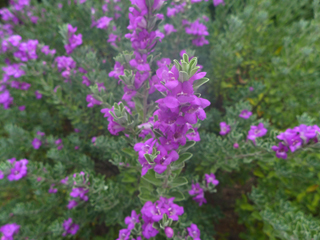
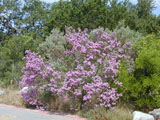
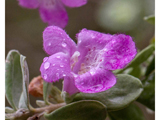
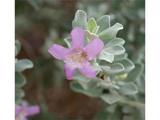
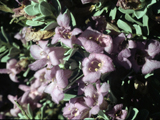
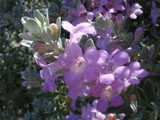
A gray shrub with leaves densely covered with stellate, silvery hairs and bright pink-lavender, bilaterally symmetrical flowers borne singly in crowded leaf axils. Typically a compact shrub, 2-5 ft. tall, Texas Barometer Bush or Cenizo occasionally reaches 10 ft. in height, and 4-6 ft. in width. Leaves silvery gray to greenish, soft to the touch, up to 1 1/4 inches long but mostly 1 inch or less, tapering more gradually to the base than to the rounded tip, margins smooth. Flowers violet to purple, sometimes pink, nearly bell shaped, and up to 1 inch in length and width, appearing intermittently from spring to fall. Fruit a small capsule.
As one travels east across southern Texas near the Mexican border, the olive green of Creosote Bush (Larrea tridentata) gives way to the gray of this species, with its display of bright pink-lavender flowers. These burst into bloom for only a few days at a time, in the summer and fall, depending on rainfall. The ashy appearance of the leaves, also described as silvery, white, or gray, is due to the millions of tiny hairs covering them. A grouping of several individuals makes a good screen or hedge. There are many nice color selections and cultivars. This and other Leucophyllum species are popular water-conserving ornamentals in the Southwest.
Plant Characteristics
Duration: PerennialHabit: Shrub
Root Type: Tap
Leaf Retention: Evergreen
Leaf Arrangement: Alternate , Opposite
Leaf Complexity: Simple
Leaf Shape: Elliptic , Obovate
Leaf Pubescence: Stellate , Tomentose
Leaf Margin: Entire
Leaf Apex: Obtuse
Leaf Base: Cuneate
Breeding System: Flowers Unisexual , Monoecious
Inflorescence: Axillary
Fruit Type: Capsule
Size Notes: Up to about 10 feet tall, often shorter.
Leaf: Blue-gray, green, whitish gray, silvery
Flower: Flowers 1 inch wide
Bloom Information
Bloom Color: White , Pink , Purple , VioletBloom Time: Jan , Feb , Mar , Apr , May , Jun , Jul , Aug , Sep , Oct , Nov , Dec
Bloom Notes: Several months of periodic flowering. Often flowers after a few summer showers, or in periods of high humidity, which is why one of its common names is Barometer Bush.
Distribution
USA: TXNative Distribution: In TX, Rio Grande Plain, s. Trans-Pecos, & Edwards Plateau, south to Nuevo Leon in Mexico
Native Habitat: Ditches, Ravines, Depressions, Hillsides, Slopes
Growing Conditions
Water Use: LowLight Requirement: Sun , Part Shade
Soil Moisture: Dry
Cold Tolerant: yes
Heat Tolerant: yes
Soil Description: Rocky, well-drained soils. Limestone-based, Sandy, Sandy Loam, Medium Loam, Clay Loam, Clay, Caliche type
Conditions Comments: According to legend, cenizo tends to bloom in conjunction with rainfall. Cenizo is easy to grow so long as it has good drainage. Though this species is the most irrigation-tolerant of the genus, it is susceptible to cotton root rot if soil does not have good drainage and remains moist. Humidity and high night temperatures are lethal. Cenizos should not be fertilized or over-watered. Drought- and heat-tolerant. During very cold winters, may lose a few leaves.
Benefit
Use Ornamental: A hedgeable evergreen shrub with attractive foliage and long-lasting, ornamental blooms.Use Wildlife: Nectar-insects, Nesting site, Cover.
Conspicuous Flowers: yes
Interesting Foliage: yes
Attracts: Butterflies
Larval Host: Theona Checkerspot, Calleta silkmoth
Deer Resistant: High
Butterflies and Moths of North America (BAMONA)
|
Calleta silkmoth (Eupackardia calleta) 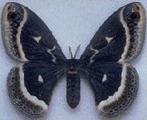 Larval Host |
Theona Checkerspot (Chlosyne theona) 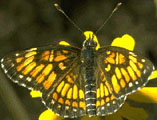 Larval Host |
Propagation
Propagation Material: Seeds , Semi-hardwood Cuttings , Softwood CuttingsDescription: Plant seeds in greenhouse immediately after summer collection or store over winter in a cool, dry place and plant outside in spring, after final frost. Cuttings should be semi-hardwood and of the current season's growth.
Seed Collection: Seeds are very tiny and must be collected before the capsule dries and splits open. Collect after each blooming period. Store in a cool, dry place.
Commercially Avail: yes
Maintenance: Prune plants to keep compact. The best time for planting most shrubs and trees is during the dormant period of fall and winter. As with any shrub or tree, the first year requires regular deep watering for successful root establishment. Once established, does not require fertilization or watering beyond average rainfall. Cultivated cenizos tend to become leggier with fewer blooms than in nature; tip prune to increase density.
Mr. Smarty Plants says
Small shrub to plant in Austin Texas
March 11, 2009
Hi..
I live in Southwest Austin and I am looking for a shrub that I can plant against the back of my house, which faces the north. I want something native, fairly low maintenance and not too large,...
view the full question and answer
Evergreen native shrubs for poor drainage area in Cedar Hill, TX
March 21, 2008
Hi! I have one (big!) bed in on the front of my house. Due to the way the house/motorcourt is built, that area (when it rains as much as it did last year!) doesn't drain well. I now have to replac...
view the full question and answer
Drought-tolerant shrub for privacy screen
November 23, 2007
Is there some kind of drought resistant bush or thorny plant we can rim our property with to stop all the foot traffic through our yard? We don't care if it's pretty, just something thick and/or th...
view the full question and answer
From the National Organizations Directory
According to the species list provided by Affiliate Organizations, this plant is on display at the following locations:Naval Air Station Kingsville - Kingsville, TX
Lady Bird Johnson Wildflower Center - Austin, TX
Texas Discovery Gardens - Dallas, TX
Sibley Nature Center - Midland, TX
Brackenridge Field Laboratory - Austin, TX
NPSOT - Native Plant Society of Texas - Fredericksburg, TX
Nueces River Authority - Uvalde, TX
Texas Parks and Wildlife Department - Austin, TX
NPSOT - Fredericksburg Chapter - Fredericksburg, TX
NPSOT - Austin Chapter - Austin, TX
National Butterfly Center - Mission, TX
NPSOT - Williamson County Chapter - Georgetown, TX
Bibliography
Bibref 1186 - Field Guide to Moths of Eastern North America (2005) Covell, C.V., Jr.Bibref 1185 - Field Guide to Western Butterflies (Peterson Field Guides) (1999) Opler, P.A. and A.B. Wright
Bibref 355 - Landscaping with Native Plants of Texas and the Southwest (1991) Miller, G. O.
Bibref 293 - Manual of the Vascular Plants of Texas (1979) Correll, D. S. & M. C. Johnston
Bibref 354 - Native & Naturalized Woody Plants of Austin & the Hill Country (1981) Lynch, D.
Bibref 841 - Native Alternatives to Invasive Plants (2006) Burrell, C. C.
Bibref 995 - Native Landscaping from El Paso to L.A. (2000) Wasowski, S. and A. Wasowski
Bibref 318 - Native Texas Plants: Landscaping Region by Region (2002) Wasowski, S. & A. Wasowski
Bibref 281 - Shinners & Mahler's Illustrated Flora of North Central Texas (1999) Diggs, G. M.; B. L. Lipscomb; B. O'Kennon; W. F...
Bibref 248 - Texas Wildflowers: A Field Guide (1984) Loughmiller, C. & L. Loughmiller
Bibref 291 - Texas Wildscapes: Gardening for Wildlife (1999) Damude, N. & K.C. Bender
Bibref 286 - Wildflowers of the Texas Hill Country (1989) Enquist, M.
Search More Titles in Bibliography
Web Reference
Webref 38 - Flora of North America (2019) Missouri Botanical Garden, St. Louis, MO & Harvard University Herbaria, Cambridge, MA.Webref 23 - Southwest Environmental Information Network (2009) SEINet - Arizona Chapter
Additional resources
USDA: Find Leucophyllum frutescens in USDA PlantsFNA: Find Leucophyllum frutescens in the Flora of North America (if available)
Google: Search Google for Leucophyllum frutescens
Metadata
Record Modified: 2023-02-15Research By: TWC Staff, GDG