Native Plants

Q. Who is Mr. Smarty Plants?
A: There are those who suspect Wildflower Center volunteers are the culpable and capable culprits. Yet, others think staff members play some, albeit small, role. You can torture us with your plant questions, but we will never reveal the Green Guru's secret identity.

Did you know you can access the Native Plant Information Network with your web-enabled smartphone?

Ask Mr. Smarty Plants
Ask Mr. Smarty Plants is a free service provided by the staff and volunteers at the Lady Bird Johnson Wildflower Center.

rate this answer

Tuesday - March 02, 2010
From: Houston, TX
Region: Southwest
Topic: Wildflowers
Title: Mixed wildflower seeds in pots in Houston
Answered by: Barbara Medford
QUESTION:
Hello - I live in Houston, TX and was recently given a few seed packets of mixed wildflowers. Unfortunately, I live in an apartment and I'm limited to a large balcony with a container garden. The balcony is not covered and gets full sun pretty much all day. Is it possible to grow the wildflowers in pots?ANSWER:
First, read our How-To Article on Container Gardening with Native Plants, which will help you get started.
It is certainly possible to grow wildflowers in pots. At the Lady Bird Johnson Wildflower Center many wildflowers are grown for our Gardens and for the Plant Sales. However, this is one seed, of known parentage, to one small pot or a number sprinkled in a flat for sprouting, first in a greenhouse and next in a covered shade yard. Finally, they will be transplanted to a 4" pot and thence into the ground or sold at the Sale. In an apartment, you probably don't have room for greenhouse, shade yard or pots. In a mixed packet, you normally have no idea which seed is which, and discovering you have planted a 10-ft. tall sunflower in a small pot will be discouraging. The gift was a kind thought, but perhaps you might find a children's group, a school or a church garden that would like to try sowing the seeds into the ground, and just see what comes up.
Since you have full sun, you have a good locale for growing native wildflowers, but you would do better to purchase small 4 in. bedding plants to transplant into your larger pots, or try getting a packet of one seed that you know is native to your area and sprinkling several seeds into larger pots with potting soil in them, and giving them a chance to germinate there. You will then need to thin them out to make sufficient room for the individual plants to grow. Ordinarily, we recommend planting wildflower seeds at the same time they would be dropping their seeds, usually Fall. If you obtain a packet of just one kind of seeds, they should have instructions on the packet on time of planting, amount of sun and water needed and so forth. There are wildflowers that are perennials or biennials, but these seldom bloom until the second season; again, the package should give you that information.
If you are willing to experiment, read this article from the Austin American-Statesman newspaper, Lady Bird's Legacy, quoting some experts including one from the Lady Bird Wildflower Center. From American Meadows, here is an article about someone who plants seeds, even mixed seeds, in containers, as she also lives in an apartment. However, she plants her seeds in the Spring, because she is in Vancouver, Canada. Don't make the mistake of planting yours in the Spring in Houston, the little baby plantlet will emerge just in time to be fried by the heat!
The seed packets you have been given should have the names of the plants the seeds of which are contained therein. We would strongly recommend you stick to flowers that are native to your area. You can go to our Native Plant Database, type in the name of each flower in the"Search" box at the top of the page, and it will take you to our page on that plant, if it is native to North America. On that page you will also find the states to which it is native, when it blooms and what colors, usually something about propagation, light requirements, etc. To give you some experience with this detective work, we will select some wildflowers that propagate well from seed and grow natively in the Houston area, and you can follow each plant link to see the page and information available.These are just examples of the many wildflowers you could grow.
Annual Wildflower Seeds for Houston:
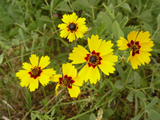
Coreopsis tinctoria (golden tickseed) - 1-2 ft. tall, blooms yellow, brown, April to June, seeds sown outside in late Fall or following Spring
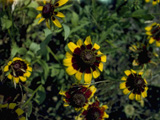
Dracopis amplexicaulis (clasping coneflower) -2-3 ft., blooms yellow April to July
Gaillardia pulchella (firewheel) - 1-2 ft., blooms yellow, red, brown May to August, plant in Fall
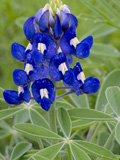
Lupinus texensis (Texas bluebonnet) - 6-18", blooms blue, white March to May, sow seeds in Fall
Perennial Wildflower Seeds for Houston:
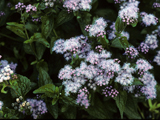
Conoclinium coelestinum (blue mistflower) - 1 to 3 ft. tall, blooms blue, purple July to November
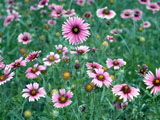
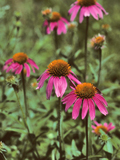
Echinacea purpurea (eastern purple coneflower) - 2 to 5 ft., blooms pink, purple April to September
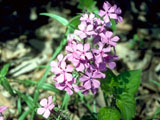
Phlox divaricata (wild blue phlox) - 8 to 18", evergreen, blooms white, red, pink, purple March to May
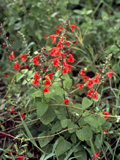
Salvia coccinea (blood sage) - 1 to 3 ft., blooms white, red, pink February to October
From our Native Plant Image Gallery:
More Wildflowers Questions
Possibility of survival of Genus Castilleja in Wisconsin
April 04, 2005 - In traveling through Texas last week we noticed many many little orange
flowers which are absolutely fascinating. I found a picture of that flower
in your website for Wildflower Days 2005 in the to...
view the full question and answer
Wildflowers for decorating for a wedding from San Marcos TX
June 16, 2011 - I am in the early stages of planning my wedding for next year. I would like to decorate with wildflowers in mason jars. I need to set a date! What is the peak season for wildflowers blooming in centra...
view the full question and answer
Jack-in-the-pulpit (Arisaema sp.) blooms
May 06, 2008 - My jack in the pulpit bloomed last year with the back of the spathe showing and the spadix facing away, similar to a child standing in a corner. I read on a site why this happens but now I can't find...
view the full question and answer
Mowing Bluebonnets
March 20, 2004 - When is it safe to mow Bluebonnets?
view the full question and answer
Current forecast for wildflowers from Colorado Springs
February 24, 2012 - What is your current forecast for wildflowers this spring?
view the full question and answer
| Support the Wildflower Center by Donating Online or Becoming a Member today. |