Native Plants

Plant Database
Search for native plants by scientific name, common name or family. If you are not sure what you are looking for, try the Combination Search or our Recommended Species lists.
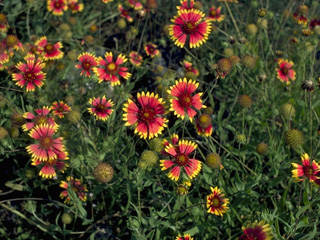
Flaigg, Norman G.
Gaillardia pulchella
Gaillardia pulchella Foug.
Indian Blanket, Firewheel, Girasol Rojo
Asteraceae (Aster Family)
Synonym(s):
USDA Symbol: gapu
USDA Native Status: L48 (N), AK (I), HI (I), CAN (I)
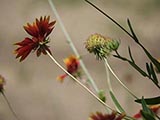
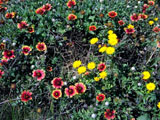
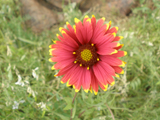
Firewheel or Indian Blanket is a popular annual growing 1-2+ ft. tall. The hairy stem is usually much-branched and becomes woody at the base late in the season. Branched stems, mostly leafy near the base, have showy flower heads with rays red at base, tipped with yellow, each with 3 teeth at broad end. The well-known flower heads are 1-2 in. across with a red center and a yellow outer band. Occasionally the three-cleft rays are solid orange or yellow. The disc flowers in the center are brownish red.
Frequent along roadsides in the Southwest, these wildflowers stand like hundreds of showy Fourth of July pinwheels at the top of slender stalks. Varieties are popular in cultivation, for they tolerate heat and dryness. Among several species in the Southwest, some flowers are entirely yellow.
Plant Characteristics
Duration: AnnualHabit: Herb
Size Notes: Up to about 2 feet tall, often shorter.
Leaf: Green
Fruit: Fruit is a cypsela (pl. cypselae). Though technically incorrect, the fruit is often referred to as an achene.
Bloom Information
Bloom Color: Red , Yellow , BrownBloom Time: Jan , Feb , Mar , Apr , May , Jun , Jul , Aug , Sep , Oct , Nov , Dec
Bloom Notes: Flowers mostly May - August. May flower year-round if rains are plentiful.
Distribution
USA: AL , AR , AZ , CA , CO , CT , FL , GA , HI , IA , IL , IN , KS , LA , ME , MI , MN , MO , MS , NC , NE , NH , NM , NV , NY , OH , OK , PA , SC , SD , TN , TX , VA , VT , WINative Distribution: W. SD to KS & LA, w. to CO & AZ; naturalized east to the Atlantic states & west to CA, south to Oaxaca in southern Mexico. The following native range is sometimes recognized: Sporadic distribution from NC to FL, w. to SD, CO & AZ; a casual migrant or escape northeastward.
Native Habitat: Dry plains & open areas, Widespread in calcareous and sandy-calcareous prairies in the western two-thirds of the state. Well-drained sand, loam, calcareous soils.
Growing Conditions
Water Use: MediumLight Requirement: Sun , Part Shade
Soil Moisture: Dry
Soil pH: Circumneutral (pH 6.8-7.2)
CaCO3 Tolerance: High
Soil Description: Sandy or calcareous soils, often disturbed places, mostly in grasslands or open places.
Conditions Comments: Indian blanket is a major wildflower of the prairies and meadows. It reseeds readily and is easy to grow; good drainage is the only requirement. Rich soils will produce large, floppy plants with few flowers. Indian blanket is very easy to grow and is commonly used in roadside & meadow plantings. This species is a short-lived perennial in warm, coastal areas. The bloom period can be prolonged by deadheading and supplemental summer watering.
Benefit
Use Ornamental: Wildflower meadow, Color, Long-blooming, Easily grown, Pocket prairieUse Medicinal: Tea of root for gastroenteritis, chewed powdered root applied to skin disorders. Sore nipples of nursing mothers bathed in tea made from the plant, also used for sore eyes. Kiowa considered it good luck.
Conspicuous Flowers: yes
Attracts: Butterflies
Deer Resistant: Moderate
Value to Beneficial Insects
Special Value to Native BeesThis information was provided by the Pollinator Program at The Xerces Society for Invertebrate Conservation.
Propagation
Propagation Material: SeedsDescription: Plant in the fall and rake the seed into loose topsoil to ensure good seed/soil contact. With moisture from rain or watering, G. pulchella will germinate in 1 – 2 weeks and establish a healthy taproot system before the winter frost. If sowing seed indoors in late winter, allow 8 weeks for well-rooted seedling before transplanting at start of frost-free period.
Seed Collection: After flowering ceases, allow seeds to completely mature before mowing for reseeding or collecting to plant in a new area. Look for heads with no dried petals persisting. Since G. pulchella is an annual, it is essential that this species be allowed to reseed for an abundant display the following year.
Seed Treatment: Dried seeds can be stored refrigerated up to four years.
Commercially Avail: yes
Maintenance: One of the easiest wildfowers to establish. Although Indian blanket will grow in a variety of soil types, for best results, choose an open to lightly shaded site having loose, well-drained soil. G. pulchella frequently exhibits blanket-like density, which combines with the blending of bright reds and yellows to form a striking tapestry of color.
Find Seed or Plants
Order seed of this species from Native American Seed and help support the Wildflower Center.
Find seed sources for this species at the Native Seed Network.
Mr. Smarty Plants says
Wildlife uses of wildflowers in Central Texas
May 01, 2006
How are wildflowers in Central Texas used by wildlife?
view the full question and answer
National Wetland Indicator Status
| Region: | AGCP | AK | AW | CB | EMP | GP | HI | MW | NCNE | WMVE |
| Status: | UPL | UPL | FACU | UPL | UPL | FACU | FACU | UPL | UPL |
From the National Organizations Directory
According to the species list provided by Affiliate Organizations, this plant is on display at the following locations:Naval Air Station Kingsville - Kingsville, TX
Fredericksburg Nature Center - Fredericksburg, TX
Lady Bird Johnson Wildflower Center - Austin, TX
Sibley Nature Center - Midland, TX
Brackenridge Field Laboratory - Austin, TX
Nueces River Authority - Uvalde, TX
Stengl Biological Research Station - Smithville, TX
Texas Parks and Wildlife Department - Austin, TX
Texas Master Naturalists - Lost Pines Chapter - Bastrop, TX
Native Seed Network - Corvallis, OR
Jacob's Well Natural Area - Wimberley, TX
NPSOT - Williamson County Chapter - Georgetown, TX
Herbarium Specimen(s)
NPSOT 0350 Collected May 19, 1993 in Bexar County by Louise MorrellNPSOT 0666 Collected May 21, 1991 in Bexar County by Harry Cliffe
NPSOT 0074 Collected Oct. 19, 1990 in Bexar County by Mollie Walton
NPSOT 0213 Collected May 4, 1992 in Comal County by Mary Beth White
NPSOT 0447 Collected Jun 4, 1987 in Bexar County by Harry Cliffe
NPSOT 0011 Collected April 25,1990 in Bexar County by Judith C. Berry
NPSOT 0173 Collected Apr. 28, 1991 in Bexar County by Judith C. Berry
Wildflower Center Seed Bank
LBJWC-543 Collected 2007-07-30 in Travis County by Lady Bird Johnson Wildflower CenterLBJWC-3 Collected 0000-00-00 in Travis County by Lady Bird Johnson Wildflower Center
Bibliography
Bibref 610 - Edible wild plants of the prairie : an ethnobotanical guide (1987) Kindscher, K.Bibref 946 - Gardening with Prairie Plants: How to Create Beautiful Native Landscapes (2002) Wasowski, Sally
Bibref 355 - Landscaping with Native Plants of Texas and the Southwest (1991) Miller, G. O.
Bibref 318 - Native Texas Plants: Landscaping Region by Region (2002) Wasowski, S. & A. Wasowski
Bibref 281 - Shinners & Mahler's Illustrated Flora of North Central Texas (1999) Diggs, G. M.; B. L. Lipscomb; B. O'Kennon; W. F...
Bibref 248 - Texas Wildflowers: A Field Guide (1984) Loughmiller, C. & L. Loughmiller
Bibref 291 - Texas Wildscapes: Gardening for Wildlife (1999) Damude, N. & K.C. Bender
Bibref 1294 - The Midwestern Native Garden: Native Alternatives to Nonnative Flowers and Plants An Illustrated Guide (2011) Adelman, Charlotte and Schwartz, Bernard L.
Bibref 328 - Wildflowers of Texas (2003) Ajilvsgi, Geyata.
Bibref 286 - Wildflowers of the Texas Hill Country (1989) Enquist, M.
Search More Titles in Bibliography
Web Reference
Webref 38 - Flora of North America (2019) Missouri Botanical Garden, St. Louis, MO & Harvard University Herbaria, Cambridge, MA.Research Literature
Reslit 477 - The effect of combined Azospirillum inoculation and nitrogen fertilizer on plant growth promotion and yield response of the blanket flower Gaillardia pulchella (2004) R. S. Gadagi, P. U. Krishnaraj, J. H. Kulkarni and...Reslit 462 - Establishment and management of native wildflowers on Florida roadsides and former pastures (2008) A. L. Frances
Reslit 559 - Growth, flowering, and survival of firewheel (Gaillardia pulchella Foug.) based on seed source and growing location (2007) H. E. Hammond, J. G. Norcini, S. B. Wilson, R. K. ...
Reslit 560 - Differing blanketflower cultivar and ecotype responses to plant growth regulators (2007) H. E. Hammond, R. K. Schoellhorn, S. B. Wilson and...
Reslit 624 - Blackland tallgrass prairie vegetation dynamics following cessation of herbicide application (2007) K. R. Hickman and J. D. Derner
Reslit 869 - Taxonomy and biogeography of Gaillardia (Asteraceae): A phylogenetic analysis (2007) K. Marlowe and L. Hufford
Reslit 1072 - Growth and nutrient content of herbaceous seedlings associated with biological soil crusts (2003) R. L. Pendleton, B. K. Pendleton, G. L. Howard and...
Reslit 1289 - Bullying the bullies: The selective control of an exotic, invasive annual (Rapistrum rugosum) by oversowing with a competitive native species (Gaillardia pulchella) (2005) M. T. Simmons
Reslit 1869 - Invitro Regeneration of Gaillardia pulchella Foug (1989) J. E. Bourque, S. Tanner and T. J. Mabry
Reslit 2012 - Growth, flowering, and survival of Gaillardia pulchella Foug. based on seed source and growing location (2006) J. G. Norcini, H. E. Danielson, S. B. Wilson, R. S...
This information was provided by the Florida WIldflower Foundation.
Search More Titles in Research Literature
From the Archive
Wildflower Newsletter 1984 VOL. 1, NO.2 - Lady Bird Finds Wildflower Lovers Everywhere, Center Expands With New Building, ...Wildflower Newsletter 1987 VOL. 4, NO.2 - Wildflowers Provide Activity in Summer, Beautiful Colorado Beckons, What is Rese...
Wildflower Newsletter 1987 VOL. 4, NO.4 - Wildflower Center Sows Seeds for the Country, Hotline for Texas, New Goals Plans...
Wildflower Newsletter 1997 VOL. 14, NO.4 - Pollination and Pollinators, Big Bugs Exhibit, A Taste of Honey, Executive Direc...
Additional resources
USDA: Find Gaillardia pulchella in USDA PlantsFNA: Find Gaillardia pulchella in the Flora of North America (if available)
Google: Search Google for Gaillardia pulchella
Metadata
Record Modified: 2022-12-27Research By: TWC Staff