Native Plants

Plant Database
Search for native plants by scientific name, common name or family. If you are not sure what you are looking for, try the Combination Search or our Recommended Species lists.
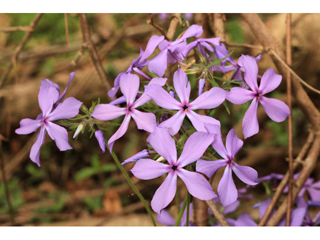
Cressler, Alan
Phlox divaricata
Phlox divaricata L.
Wild Blue Phlox, Louisiana Phlox, Blue Woodland Phlox, Sweet William, Wild Sweet William
Polemoniaceae (Phlox Family)
Synonym(s):
USDA Symbol: phdi5
USDA Native Status: L48 (N), CAN (N)
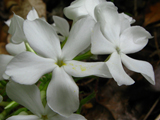
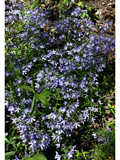
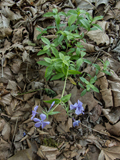
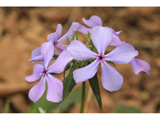
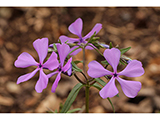
The decumbent stems of Wild Blue Phlox root at the nodes sending up erect branches 8-20 in. Loose, flat clusters of fragrant, lavender to pink to violet flowers with notched petals occur at the top of these stems. The leaves on decumbent stems are broader than those on flowering stems.
This beautiful species is most common in midwestern woods and fields. It is sometimes known as "Wild Sweet William," a name also given to P. maculata. The mature plants in the eastern part of the range have notched petals; those in the western do not. The basal runners of the lovely Creeping Phlox (P. stolonifera) form large patches; it has fewer stem leaves and fewer flowers in its clusters; it occurs from Pennsylvania and Ohio south to northern Georgia.
Plant Characteristics
Duration: PerennialHabit: Herb
Leaf Retention: Evergreen
Fruit Type: Capsule
Size Notes: Up to about 20 inches tall.
Leaf: Green.
Flower: Flowers up to 1 inch across.
Bloom Information
Bloom Color: White , Pink , Purple , VioletBloom Time: Mar , Apr , May , Jun
Bloom Notes: Occasionally white.
Distribution
USA: AL , AR , CT , DC , DE , FL , GA , IA , IL , IN , KS , KY , LA , MD , MI , MN , MO , MS , NC , NE , NJ , NY , OH , OK , PA , SC , SD , TN , TX , VA , VT , WI , WVCanada: ON , QC
Native Distribution: S.w. Que. to MI, s. to NC & AL
Native Habitat: Moist, rich, deciduous woods and bluffs
Growing Conditions
Water Use: MediumLight Requirement: Part Shade , Shade
Soil Moisture: Moist
Soil pH: Alkaline (pH>7.2) , Acidic (pH<6.8)
CaCO3 Tolerance: High
Soil Description: Rich, moist, acid soils, but also found in calcareous areas. Sandy, Sandy Loam, Medium Loam, Clay Loam, Clay.
Benefit
Use Ornamental: Showy, attractive, colorful blooms for the perennial garden.Use Wildlife: Flowers attract butterflies, including swallowtails, gray hairstreaks, and western pygmy blues. Roots consumed by rabbits and voles.
Conspicuous Flowers: yes
Attracts: Butterflies
Nectar Source: yes
Propagation
Propagation Material: Root Division , SeedsDescription: Propagate by root division, seed, layering, or "softwood" cuttings (rooted stem) taken in late spring.
Seed Collection: Mature in late spring.
Seed Treatment: Cold-moist stratification.
Commercially Avail: yes
Maintenance: Remove spent inflorescences to encourage more flowering. Prevent complete soil dryness. Add compost to enrich the soil as needed.
Mr. Smarty Plants says
Ground cover for trails in Northeast Texas
January 09, 2008
I have several acres of wooded land in Northeast Texas, Southern Lamar County. Both sandy and black land. I have created trails through the woods and would like to plant a native ground cover or gras...
view the full question and answer
Michigan native plants for shady, low traffic area
May 10, 2006
Hello, I am looking for a recommendation for a Michigan native groundcover. I live adjacent to the Rouge River watershed and want to buy the right thing. The location is shady, infrequently walked ...
view the full question and answer
National Wetland Indicator Status
| Region: | AGCP | AK | AW | CB | EMP | GP | HI | MW | NCNE | WMVE |
| Status: | FACU | FACU | FACU | FACU | FACU |
From the National Organizations Directory
According to the species list provided by Affiliate Organizations, this plant is on display at the following locations:Texas Discovery Gardens - Dallas, TX
Delaware Nature Society - Hockessin, DE
Mt. Cuba Center - Hockessin, DE
Bibliography
Bibref 766 - Dale Groom's Texas Gardening Guide (2002) Groom, D.Bibref 1620 - Gardening with Native Plants of the South (Reprint Edition) (2009) Wasowski, S. with A. Wasowski
Bibref 841 - Native Alternatives to Invasive Plants (2006) Burrell, C. C.
Bibref 318 - Native Texas Plants: Landscaping Region by Region (2002) Wasowski, S. & A. Wasowski
Bibref 291 - Texas Wildscapes: Gardening for Wildlife (1999) Damude, N. & K.C. Bender
Bibref 1294 - The Midwestern Native Garden: Native Alternatives to Nonnative Flowers and Plants An Illustrated Guide (2011) Adelman, Charlotte and Schwartz, Bernard L.
Search More Titles in Bibliography
Web Reference
Webref 23 - Southwest Environmental Information Network (2009) SEINet - Arizona ChapterResearch Literature
Reslit 2746 - Pollinator importance and temporal variation in a population of Phlox divaricata L. (Polemoniaceae) (2005) S. Wiggam, C. J. FergusonReslit 2747 - The eastern short-styled Phloxes (1931) E. T. Wherry
Reslit 2748 - Craspedolepta eas: Distribution, hosts, and habits of a Phlox specialist (Homoptera: Psylloidea: Aphalaridae) (1994) A. G. Wheeler
Reslit 2749 - Effects of experimental shifts in flowering phenology on plant-pollinator interactions. (2010) N. E. Rafferty, A. R. Ives
Reslit 2750 - Pollen exchange as a function of species proximity in Phlox (1972) D. A. Levin
Reslit 2751 - Variation in Phlox divaricata (1967) D. A. Levin
Reslit 2752 - Cercospora omphakodes infection and disease development in Phlox divaricata (1974) R. W. Judd, J. L. Peterson
Reslit 2753 - Premergence herbicides for transplanted herbaceous perennials." Proceedings, Northeastern Weed Science Society (1981) J. F. Ahrens
Reslit 2754 - Germination and emergence of understorey and tall canopy forbs used in naturalistic sowing mixes. A comparison of performance in vitro v the field (2007) H. Ahmad, J. D. Hitchmough
This information was provided by the Florida WIldflower Foundation.
Search More Titles in Research Literature
Additional resources
USDA: Find Phlox divaricata in USDA PlantsFNA: Find Phlox divaricata in the Flora of North America (if available)
Google: Search Google for Phlox divaricata
Metadata
Record Modified: 2023-02-22Research By: TWC Staff