Native Plants

Q. Who is Mr. Smarty Plants?
A: There are those who suspect Wildflower Center volunteers are the culpable and capable culprits. Yet, others think staff members play some, albeit small, role. You can torture us with your plant questions, but we will never reveal the Green Guru's secret identity.

Did you know you can access the Native Plant Information Network with your web-enabled smartphone?

Ask Mr. Smarty Plants
Ask Mr. Smarty Plants is a free service provided by the staff and volunteers at the Lady Bird Johnson Wildflower Center.

rate this answer

Wednesday - June 04, 2008
From: Katy, TX
Region: Southwest
Topic: Propagation, Transplants
Title: Propagation of Ashe junipers
Answered by: Barbara Medford
QUESTION:
I am trying to re-build what man has destroyed in the Kingsland/Marble Falls area on a property we own out there. I would LOVE to plant a couple ashe junipers for several reasons, a couple being: 1. Wildlife use and 2. Privacy screening for cleared lot on property next to me. My problem is I can't find it available for sale any where. Any ideas on where I can find a few of these. I tried to transplant a young plant, but it didn't make it even with regular watering from a sprinkler on a timer. Thank you.ANSWER:
Your property would appear to be in Burnet County, which, according to this USDA Plant Profile for Juniperus ashei (Ashe's juniper), should be a good place for the Ashe juniper to grow. According to our website, propagation should be by seeds; that is, the blue berries that appear on the female bushes and are collected in late Summer to Fall. The propagation information is near the bottom of the page for this plant on our website.
One problem in obtaining transplants commercially is that a lot of people right now are trying to remove the Ashe juniper instead of propagating it. In the course of our research to answer your question, we ran across this article from the Lower Colorado River Authority on reduction and removal of the Ashe juniper in the Marble Falls area. Another problem is that the tree has a long taproot which, if damaged, can result in the death of the tree, which you have apparently already discovered. Your chances are better with a very small tree. If you have the patience, you might go the seed route. Go to our Suppliers section, put your city and state in the Location Search Area box, and you will get a list of plant suppliers in your area, with websites or phone numbers so you can check to see if they stock this plant.
Failing that, perhaps you would like to try some alternatives for your purposes, wildlife and privacy. We are going to go to Recommended Species on our website, select for Central Texas, tree, perennial, and sun, and get a list of possibilities to recommend to you. Here are four possibilities:
Cercis canadensis var. mexicana (Mexican redbud)
Chilopsis linearis (desert willow)
Diospyros texana (Texas persimmon)
Sophora secundiflora (Texas mountain-laurel)
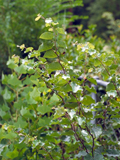
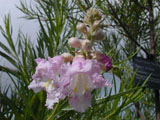
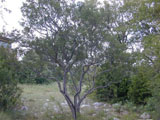
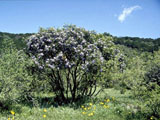
More Propagation Questions
Propagation of an agave from Dripping Springs TX
April 30, 2014 - Hi there, I have a Century Agave in my backyard. It is over 6 feet tall and is now producing the center stalk. I understand that means the plant is going to die. My question is how to harvest the pups...
view the full question and answer
Pollination of blackberries in Lake Winnebago, MO
May 27, 2010 - Not sure if blackberries are native, but my daughter got a start of one at a plant exchange at the nature center. Do we need more than one for it to pollinate correctly? We have strawberries growing i...
view the full question and answer
Deadheading Asclepias tuberosa in Fishers IN
August 19, 2009 - My Asclepias tuberosa plants are flowering well in their second year and also have formed many seed pods. Since I don't need the seeds, will they bloom more if I remove them or is it unnecessary?
view the full question and answer
Propagation of Lime Prickly Ash in Austin
March 22, 2010 - We found only one small what we think is Zanthoxylum fagara or Lime Prickly Ash, Colima on our 8 acres, and the deer had apparently recently broken the main stem. I quickly made 6 or 7 cuttings, dippe...
view the full question and answer
Propagation of skunk cabbage
December 18, 2003 - Where can I purchase root stock for a start of skunk cabbage to plant?
in my wetland?
view the full question and answer
| Support the Wildflower Center by Donating Online or Becoming a Member today. |