Native Plants

Plant Database
Search for native plants by scientific name, common name or family. If you are not sure what you are looking for, try the Combination Search or our Recommended Species lists.
Pyle, Lynn
Sophora secundiflora
Sophora secundiflora (Ortega) Lag. ex DC.
Texas Mountain Laurel, Mountain Laurel, Mescal Bean, Mescal Bean Sophora, Frijolillo, Frijolito
Fabaceae (Pea Family)
Synonym(s):
USDA Symbol: sose3
USDA Native Status: L48 (N)
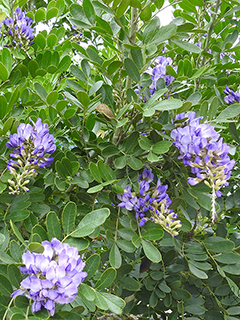
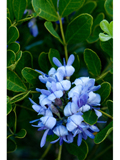
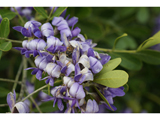
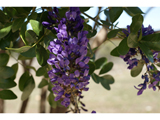
Mescal bean or Texas mountain laurel is an evergreen, usually multi-trunked shrub or small tree ranging from just a few feet tall to more than 30 ft. in height, though its usual height at maturity is 10-15 ft. The dense, dark green, and glossy compound leaves are composed of 7-9 shiny, leathery leaflets that are rounded on the ends. The leaflets are up to 2 inches or more long, tapering more gradually to the base than to the tip, and arranged along an axis terminated by a single leaflet . The bluish lavender flowers, in 3-7 in. drooping clusters, are very showy and fragrant. The fruit is a semi-woody pod with bright red poisonous seeds.
Sophora secundiflora is very popular as a native evergreen ornamental tree within its range, valued for its handsome, dark green foliage and lush early spring blooms. It is drought-tolerant, prefers rocky limestone soil, and is native from central Texas west to New Mexico and south to San Luis Potosi in Mexico. Like many woody plants native to rocky soils, it is slow growing. The fragrance of Texas mountain laurel flowers is reminiscent of artificial grape products. The brilliant, lacquer red seeds were valued by indigenous people for ornament and ceremonial use; they contain the highly poisonous alkaloid cytisine (or sophorine), a substance related to nicotine and widely cited as a narcotic and hallucinogen.

Plant Characteristics
Duration: PerennialHabit: Shrub , Tree
Leaf Retention: Evergreen
Leaf Arrangement: Alternate
Leaf Complexity: Pinnate
Leaf Pubescence: Glabrous
Leaf Margin: Entire
Leaf Texture: Leathery
Breeding System: Flowers Bisexual
Inflorescence: Raceme
Fruit Type: Legume
Size Notes: Up to about 30 feet tall, usually much shorter.
Leaf: Green
Flower: Racemes 5-15 cm long.
Fruit: Seedpods gray with a felt-like surface texture, aging to dark brown. Seeds glossy red, 2-12 cm.
Bloom Information
Bloom Color: Blue , PurpleBloom Time: Feb , Mar , Apr
Bloom Notes: Bloom fragrance often compared to artificial grape products like grape Kool-Aid, grape bubble gum, grape soft drinks, etc. A pleasant but almost overpoweringly strong fragrance that can waft a considerable distance from the plant.
Distribution
USA: NM , TXNative Distribution: S. & c. TX, w. to mts. of s. NM and s. to San Luis Potosi in Mexico
Native Habitat: Brushy slopes; open plains. Common in limestone soils. Well-drained sand, loam, clay, caliche, limestone.
Growing Conditions
Water Use: Low , MediumLight Requirement: Sun , Part Shade
Soil Moisture: Dry , Moist
Soil pH: Alkaline (pH>7.2)
CaCO3 Tolerance: High
Drought Tolerance: High
Cold Tolerant: yes
Heat Tolerant: yes
Soil Description: Dry, rocky, well-drained, preferably calcareous soils. Sandy, Sandy Loam, Medium Loam, Clay Loam, Clay
Conditions Comments: Needs good drainage.
Benefit
Use Ornamental: This species is often cultivated in warm regions for the shiny, evergreen foliage and large showy flowers. S. secundiflora is readily available as a small to medium sized propagated plant.Use Wildlife: Blooms attract insect pollinators.
Use Medicinal: Crushed beans boiled in water, strained & liquid poured in aching ears. (Weiner)
Use Other: Used by Native Americans for hallucinogenic drug. (Tull) Native Americans made necklaces as well as a narcotic powder from the seeds.
Warning: The brilliant red seeds contain the highly poisonous alkaloid cytisine (or sophorine) - this substance is related to nicotine and is widely cited as a narcotic and hallucinogen.
Conspicuous Flowers: yes
Fragrant Flowers: yes
Interesting Foliage: yes
Attracts: Butterflies
Deer Resistant: High
Propagation
Description: Sow scarified seed after the soil has warmed in spring or fresh seed still swollen in pod in fall. Lightly cover the seed in a pot large enough to allow good root development the first year. A light dusting with a general fungicide is a good precaution to prevent a fungal infection. Mountain laurel seedlings grow slowly the first two years. Cuttings from juvenile trees may root. Since S. secundiflora is a slow growing plant, most specimen sized shrubs are made commercially available by digging them from the wild, and then balling and burlapping. It is difficult for S. secundiflora to survive this kind of transplant because it has a sparse root system with a deep taproot. Because it is impossible to dig up the entire root, the plant often goes into shock and dies.Seed Collection: Fruit maturation occurs mid to late summer, but the fruit will remain on the plant through the winter, finally releasing the seed the next summer. Young fruit are large thick, leathery pods that appear brownish gray because of a layer of silky pubescence, which gives the pods a silvery luster. In their second year, the pods weather to become black and thin walled, and soon fall from the plant and deteriorate, eventually releasing the seed. The seed are usually deep red but can be orangish red to almost maroon. They are also very hard. Collect seeds when the pod begins to dry and the seeds turn red
Seed Treatment: Separate seeds from pod and store in bags or containers in a cool dry place. Soaking the hard pods in warm water will soften them and make seed removal easier. Seeds must be filed or mechanically scarified with a knife.
Commercially Avail: yes
Maintenance: Prune to avoid a dense shrubby appearance.
Mr. Smarty Plants says
Tree for sound block near Houston
April 24, 2010
I live in Pearland, just south of Houston and am looking for a tree that I can plant along my fenceline between my neighbor and me that will block noise. We have a pool and entertain a lot, but they a...
view the full question and answer
Hedge in central Texas
June 17, 2009
Help, my oleanders are dying. I am in need of hedge suggestions- ideal would be quick growing, maybe 8-12 feet at their tallest. I live in Central Texas.
view the full question and answer
Plants for green roof in Mexico
August 06, 2008
Hello! I am checking local plants to plant on a Green Roof, and am researching on which are mostly to survive better. Is it possible to plant the following on a green roof?? (Root depth needed, basica...
view the full question and answer
Native evergreen for privacy screen
May 15, 2008
I want to incorporate a tree in my landscaping near my house (10-15 feet) for privacy, what are the best trees that don't shed their leaves and have nice flowers and their roots wont destroy my found...
view the full question and answer
Native plants for butterfly garden in Waco, TX
February 03, 2008
Few weeks ago I sent you a letter but never got an answer back.
I would like to have your suggestions of native plants for a butterfly garden (30'x 30') here in Waco. The plants must be (1)drought ...
view the full question and answer
From the National Organizations Directory
According to the species list provided by Affiliate Organizations, this plant is on display at the following locations:Lady Bird Johnson Wildflower Center - Austin, TX
Texas Discovery Gardens - Dallas, TX
Sibley Nature Center - Midland, TX
Patsy Glenn Refuge, c/o Wimberley Birding Society - Wimberley, TX
NPSOT - Native Plant Society of Texas - Fredericksburg, TX
NPSOT - Fredericksburg Chapter - Fredericksburg, TX
NPSOT - Austin Chapter - Austin, TX
National Butterfly Center - Mission, TX
Jacob's Well Natural Area - Wimberley, TX
NPSOT - Williamson County Chapter - Georgetown, TX
Wildflower Center Seed Bank
LBJWC-656 Collected 2008-07-02 in Medina County by Lady Bird Johnson Wildflower CenterBibliography
Bibref 1207 - Earth Medicine, Earth Food (1990) Michael A. WeinerBibref 307 - Edible and Useful Plants of Texas and the Southwest: Including recipes, harmful plants, natural dyes, and textile fibers: A Practical Guide (1999) Tull, D.
Bibref 481 - How to Grow Native Plants of Texas and the Southwest: Revised and Updated Edition (2001) Nokes, J.
Bibref 355 - Landscaping with Native Plants of Texas and the Southwest (1991) Miller, G. O.
Bibref 293 - Manual of the Vascular Plants of Texas (1979) Correll, D. S. & M. C. Johnston
Bibref 841 - Native Alternatives to Invasive Plants (2006) Burrell, C. C.
Bibref 318 - Native Texas Plants: Landscaping Region by Region (2002) Wasowski, S. & A. Wasowski
Bibref 1230 - Remarkable Plants of Texas: Uncommon Accounts of Our Common Natives (2009) Matt Warnock Turner
Bibref 281 - Shinners & Mahler's Illustrated Flora of North Central Texas (1999) Diggs, G. M.; B. L. Lipscomb; B. O'Kennon; W. F...
Bibref 248 - Texas Wildflowers: A Field Guide (1984) Loughmiller, C. & L. Loughmiller
Bibref 291 - Texas Wildscapes: Gardening for Wildlife (1999) Damude, N. & K.C. Bender
Bibref 297 - Trees of Central Texas (1984) Vines, Robert A.
Bibref 286 - Wildflowers of the Texas Hill Country (1989) Enquist, M.
Search More Titles in Bibliography
From the Archive
Wildflower Newsletter 1984 VOL. 1, NO.1 - First issue. Lady Bird\'s Center is a dream come true. National Clearinghouse a ...Wildflower Newsletter 1991 VOL. 8, NO.3 - Native Plants Provide a Wealth of Foods and Fibers, Letter from the President, A...
Wildflower Newsletter 1992 VOL. 9, NO.2 - Native Landscaping City Restrictions and Homeowner Association, Director's Repor...
Wildflower Newsletter 1992 VOL. 9, NO.3 - Water and Landscaping with Native Plants, Research Update, Research Director's R...
Additional resources
USDA: Find Sophora secundiflora in USDA PlantsFNA: Find Sophora secundiflora in the Flora of North America (if available)
Google: Search Google for Sophora secundiflora
Metadata
Record Modified: 2022-03-29Research By: TWC Staff, LAS, GDG