Native Plants

Q. Who is Mr. Smarty Plants?
A: There are those who suspect Wildflower Center volunteers are the culpable and capable culprits. Yet, others think staff members play some, albeit small, role. You can torture us with your plant questions, but we will never reveal the Green Guru's secret identity.

Did you know you can access the Native Plant Information Network with your web-enabled smartphone?

Ask Mr. Smarty Plants
Ask Mr. Smarty Plants is a free service provided by the staff and volunteers at the Lady Bird Johnson Wildflower Center.

rate this answer

Wednesday - June 17, 2009
From: Kyle, TX
Region: Southwest
Topic: Trees
Title: Hedge in central Texas
Answered by: Janice Kvale
QUESTION:
Help, my oleanders are dying. I am in need of hedge suggestions- ideal would be quick growing, maybe 8-12 feet at their tallest. I live in Central Texas.ANSWER:
While we are sorry for the loss of the oleanders, beautiful as they can be, you may be better off with native Texas shrubs even if you must wait for them to grow. Oleanders are native to the Middle East and Asia and moderately toxic to humans and animals. Plants that are exotic to our region tend to not be as hardy as natives. Check out information on why native plants are preferred on our website.
At the same site, different location, you may read detailed descriptions of the shrubs we suggest. Click on Explore Plants, then Native Plant Database. Then click on Combination Search. Select your location, General Appearance (type of plant desired), and Life Span. Check the requirements of your site: light and soil moisture. Use the same database to find Suppliers for your choice.
Though you did not mention the specifics of your site, we tend to think of central Texas as fairly hot, sunny and dry. All of the shrubs suggested are native and may attract birds and butterflies.
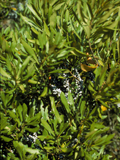
Morella cerifera (wax myrtle) is one of the faster growing shrubs. The height starts at 6 feet and could go to 20 feet, but dwarf varieties are available. It likes sandy, moist soil, but will tolerate drought once established.
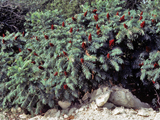
Rhus virens (evergreen sumac) is a slower growing evergreen shrub with glossy leaves. It ranges between 6-12 feet in height.
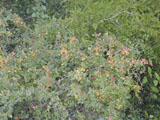
Rhus aromatica (fragrant sumac) is about the same height as the previous sumac but faster growing. It tends to form a thicket.
Rhus glabra (smooth sumac) is another fast growing sumac, 6-12 feet in height, and looks best in natural settings.
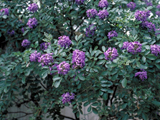
Sophora secundiflora (Texas mountain-laurel) is a slow grower that may be worth waiting for. It produces showy fragrant lavendar blossoms in the spring yielding a toxic red berry. Listed at 10-20 feet, it ends up comparable in height to the oleander.
Ungnadia speciosa (Mexican buckeye) is another showy bloomer. While it can reach 30 feet, it generally hovers between 8-12 feet tall. The seeds are mildly toxic.
Ilex vomitoria (yaupon) is a picturesque, holly-like shrub that may be trimmed into a lovely hedge. Dwarf varieties may be available. The female plant produces bright red berries.

More Trees Questions
Plants under an oak tree from Corpus Christi TX
June 30, 2012 - My project: To grow white turk's cap under an old oak tree
I first planted St. Augustine sod this spring because we had many oak suckers around the tree. We mixed new soil and compost, and laid the ...
view the full question and answer
Pruning live oak in Austin
April 28, 2012 - Hi, We recently purchased a house in South Austin and there is a huge Live Oak Tree about 6 feet from the back door (so so so love it!) The only real issues I have so far are:
1. Needing to trim a ...
view the full question and answer
Problems with mature cottonwood in Justin TX
September 17, 2012 - I have a very large, 90" circumference, approx 60' tall, cottonwood tree in my front yard that appears to be sick. The trunk splits at about the 4' level into 2 parts. at that split is a 10" wide...
view the full question and answer
Trees native to North Georgia
September 26, 2008 - What trees are native to North Georgia, (Blue Ridge Mountain, Elijay, Helen) area? Need info. for daughters school report.
view the full question and answer
pruning crape myrtle (ugh, non-native)
March 05, 2012 - We would like to plant a Dynamite Crape myrtle in front of our front window. They grow 20' to 30'. Can I trim it each year to about 15' to 20'? Should we plant it approximately 5 feet from the ...
view the full question and answer
| Support the Wildflower Center by Donating Online or Becoming a Member today. |