Native Plants

Plant Database
Search for native plants by scientific name, common name or family. If you are not sure what you are looking for, try the Combination Search or our Recommended Species lists.
Marcus, Joseph A.
Diospyros texana
Diospyros texana Scheele
Texas Persimmon, Mexican Persimmon, Black Persimmon, Chapote, Chapote Prieto
Ebenaceae (Ebony Family)
Synonym(s):
USDA Symbol: dite3
USDA Native Status: L48 (N)
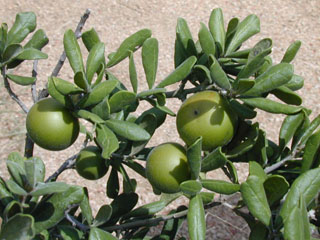
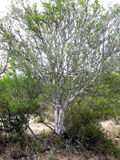
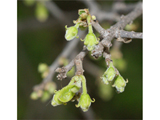
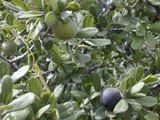
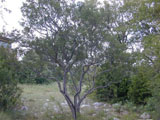
Shrub or small tree with very hard wood, usually multi-trunked. Normally 10-15 ft tall but can reach 35 ft, or more, in the southern parts of its range. Common in brushy areas on level uplands, stony hillsides, and lower slopes from Houston and Bryan, Texas, in the east, west to Big Bend in west Texas and south to Nuevo Leon in northeastern Mexico. Very common in central and south Texas. Bark light gray to white, smooth, thin, on some trunks peeling in rectangular flakes and exposing a pinkish layer beneath. Leaves up to 2 inches long, but most about half this length, firm textured, rounded or slightly notched at the tip and tapering to the base; margins smooth, rolled down. Flowers urn shaped, whitish, about 3/8 inch wide, arranged singly or in small clusters among the new leaves; male and female on separate plants, appearing in March and April. Fruit fleshy, round, up to 1 inch in diameter, black and sweet when ripe, ripening from late July into September.
This well-shaped, small tree is valued primarily for its striking trunk and branches, which are a smooth, pale greyish white or whitish grey, peeling off to reveal subtle greys, whites, and pinks beneath. The fruits, borne on female trees, are edible once soft, with a flavor some liken to prunes, and are favorites of many birds and mammals. It is extremely drought-tolerant and disease-resistant and is ideal for small spaces in full sun. The heartwood, found only in very large trunks, is black, like that of the related ebony (Diospyros ebenum), while the sapwood is clear yellow.

Plant Characteristics
Duration: PerennialHabit: Tree
Leaf Retention: Deciduous , Semi-evergreen
Leaf Arrangement: Alternate
Leaf Complexity: Simple
Leaf Shape: Obovate , Ovate
Leaf Venation: Pinnate
Leaf Pubescence: Glabrous , Tomentose
Leaf Margin: Entire
Leaf Apex: Emarginate
Leaf Texture: Leathery
Breeding System: Flowers Unisexual , Dioecious
Fruit Type: Berry
Size Notes: Up to about 45 feet tall, usually much shorter.
Leaf: Dark green.
Flower: Flowers 1/4 - 1/2 inch.
Fruit: Black or dark purple, 1 inch across.
Bloom Information
Bloom Color: White , GreenBloom Time: Feb , Mar , Apr
Bloom Notes: Fragrant.
Distribution
USA: TXNative Distribution: S.e., c. & w. TX, s. to n.e. Mex.
Native Habitat: Rocky, open woodlands, slopes & arroyos
Growing Conditions
Water Use: LowLight Requirement: Sun , Part Shade
Soil Moisture: Dry
Soil pH: Alkaline (pH>7.2)
Drought Tolerance: High
Heat Tolerant: yes
Soil Description: Well-drained, limestone loams, clays, and caliche.
Conditions Comments: North of the Rio Grande Valley where winters are cold, will usually be deciduous. From the Rio Grande Valley southward, will be semi-deciduous-to-evergreen, losing its leaves all at once in early spring like live oaks, with no period of bareness.
Benefit
Use Ornamental: A well-shaped, small tree valued chiefly for its striking trunk and branches.Use Wildlife: Fruits attract birds and mammals, especially deer and peccary. This is prized food for peccary. Flowers attract butterflies.
Use Food: Fruit edible when ripened to softness.
Use Other: Fruit juice used as a dye. Wood used in woodworking.
Fragrant Flowers: yes
Interesting Foliage: yes
Attracts: Birds , Butterflies
Larval Host: Gray hairstreak, Henry's Elfin butterfly
Nectar Source: yes
Deer Resistant: Moderate
Butterflies and Moths of North America (BAMONA)
|
Gray Hairstreak (Strymon melinus) 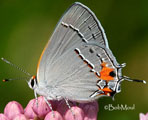 Larval Host |
Propagation
Propagation Material: SeedsDescription: Germinates readliy from fresh seed. Cold-moist storage will induce dormancy and delay germination. Sensitive to damping-off and root rot.
Seed Collection: Fruit ripens from August to October and turns purple-black when mature. Clean fruit immediately to prevent mold and fermentation. Air-dry seeds and store in sealed, refrigerated containers.
Commercially Avail: yes
Maintenance: Often pruned rather high to show off the attractive trunk and branches.
Mr. Smarty Plants says
Edible plants native to Austin, TX
August 05, 2009
Hello,
I am a chef from Buenos Aires Argentina visiting Austin, Texas and would like to learn about native, edible plants in the region.
Please let me know if there are any native, edible plants...
view the full question and answer
From the National Organizations Directory
According to the species list provided by Affiliate Organizations, this plant is on display at the following locations:Lady Bird Johnson Wildflower Center - Austin, TX
Texas Discovery Gardens - Dallas, TX
Tohono Chul Park, Inc. - Tucson, AZ
Brackenridge Field Laboratory - Austin, TX
Patsy Glenn Refuge, c/o Wimberley Birding Society - Wimberley, TX
NPSOT - Native Plant Society of Texas - Fredericksburg, TX
Nueces River Authority - Uvalde, TX
Texas Parks and Wildlife Department - Austin, TX
NPSOT - Fredericksburg Chapter - Fredericksburg, TX
Texas Master Naturalists - Lost Pines Chapter - Bastrop, TX
NPSOT - Austin Chapter - Austin, TX
National Butterfly Center - Mission, TX
Jacob's Well Natural Area - Wimberley, TX
NPSOT - Williamson County Chapter - Georgetown, TX
Herbarium Specimen(s)
NPSOT 0703 Collected Mar 30, 1994 in Bexar County by Mike FoxNPSOT 0866 Collected May 4, 1994 in Bexar County by Harry Cliffe
NPSOT 0841 Collected Mar 27, 1994 in Bexar County by Harry Cliffe
NPSOT 0720 Collected Mar 27,1994 in Comal County by Mary Beth White
Wildflower Center Seed Bank
LBJWC-55 Collected 2006-08-17 in Travis County by Lady Bird Johnson Wildflower CenterBibliography
Bibref 1186 - Field Guide to Moths of Eastern North America (2005) Covell, C.V., Jr.Bibref 298 - Field Guide to Texas Trees (1999) Simpson, B.J.
Bibref 1185 - Field Guide to Western Butterflies (Peterson Field Guides) (1999) Opler, P.A. and A.B. Wright
Bibref 355 - Landscaping with Native Plants of Texas and the Southwest (1991) Miller, G. O.
Bibref 354 - Native & Naturalized Woody Plants of Austin & the Hill Country (1981) Lynch, D.
Bibref 841 - Native Alternatives to Invasive Plants (2006) Burrell, C. C.
Bibref 318 - Native Texas Plants: Landscaping Region by Region (2002) Wasowski, S. & A. Wasowski
Bibref 291 - Texas Wildscapes: Gardening for Wildlife (1999) Damude, N. & K.C. Bender
Bibref 297 - Trees of Central Texas (1984) Vines, Robert A.
Search More Titles in Bibliography
Web Reference
Webref 3 - Flora of North America (2014) Missouri Botanical Garden, St. Louis, MO & Harvard University Herbaria, Cambridge, MA.From the Archive
Wildflower Newsletter 1993 VOL. 10, NO.6 - Saving Trees and Plants at New Center Site a Big Job, Director's Report, Wildflo...Additional resources
USDA: Find Diospyros texana in USDA PlantsFNA: Find Diospyros texana in the Flora of North America (if available)
Google: Search Google for Diospyros texana
Metadata
Record Modified: 2022-10-05Research By: TMH, GDG