Native Plants

Plant Database
Search for native plants by scientific name, common name or family. If you are not sure what you are looking for, try the Combination Search or our Recommended Species lists.
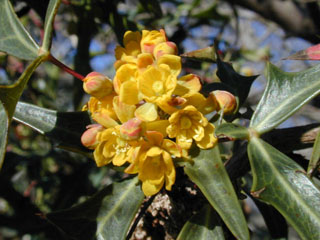
Marcus, Joseph A.
Mahonia trifoliolata
Mahonia trifoliolata (Moric.) Fedde
Agarita, Agarito, Algerita, Laredo Mahonia, Laredo Oregon-grape, Trifoliate Barberry, Wild Currant
Berberidaceae (Barberry Family)
Synonym(s): Berberis trifoliolata, Berberis trifoliolata var. glauca, Mahonia trifoliolata var. glauca
USDA Symbol: MATR3
USDA Native Status: L48 (N)
This 3-6 ft. evergreen shrub, can reach 10 ft. in favorable conditions. The rigid, spreading branches often form thickets. Gray-green to blue-gray, trifoliate, holly-like leaves are alternate, 2-4 inches long, divided into three leaflets which have 3-7 lobes ending in sharp spines. Wood bright yellow. Flowers numerous, yellow, up to 1/2 inch wide with 6 petals and 6 sepals, which are similar, forming a cup shape around the stamens and pistils. Flowers appearing in February and March, their fragrance often filling the air where they are plentiful. Fruit a red berry, edible appearing from May to July.


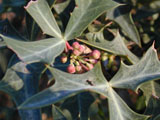
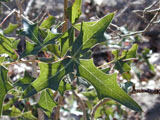
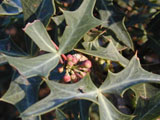
Plant Characteristics
Duration: PerennialHabit: Shrub
Leaf Retention: Evergreen
Leaf Complexity: Trifoliate
Breeding System: Flowers Bisexual
Fruit Type: Berry
Size Notes: Up to about 10 feet tall, often shorter.
Bloom Information
Bloom Color: YellowBloom Time: Feb , Mar , Apr
Distribution
USA: AZ , NM , TXNative Distribution: Coastal s. TX through Trans-Pecos to s. AZ & n. Mex.
Native Habitat: Hills; open woods; rocky slopes & cliffs, thickets and open woods from coastal South Texas northwest to the Trans-Pecos. Well-drained loam, clay, caliche, limestone.
Growing Conditions
Water Use: LowLight Requirement: Sun , Part Shade
Soil Moisture: Dry , Moist
Soil Description: Rocky, limestone soil.
Conditions Comments: This evergreen shrub has rigid, spreading branches often forming thickets. Gray-green to blue-gray, trifoliate, holly-like foliage has needle-sharp tips. Clusters of fragrant, yellow flowers are followed by red berries from May to July. Songbirds eat the fruits, and quail and small mammals use the plant for cover. It is considered a good honey source.
Benefit
Use Wildlife: Songbirds eat fruits. Quail and small mammals use the plant for cover. Considered a good honey source.Use Food: The lustrous red fruit, is a pea-sized berry that is used in making jelly and wine.
Use Other: Roots furnished a yellow dye used by early pioneers.
Fragrant Flowers: yes
Interesting Foliage: yes
Attracts: Birds
Deer Resistant: High
Mr. Smarty Plants says
Edible plants native to Austin, TX
August 05, 2009
Hello,
I am a chef from Buenos Aires Argentina visiting Austin, Texas and would like to learn about native, edible plants in the region.
Please let me know if there are any native, edible plants...
view the full question and answer
Shrub to hide chain link fence
August 12, 2008
Mr. Smarty Plants, Please recommend a tall, thick shrub to conceal the 6 foot chain link fence around the perimeter of our property. The fence is located down a hill from our home with western exposur...
view the full question and answer
Drought-tolerant shrub for privacy screen
November 23, 2007
Is there some kind of drought resistant bush or thorny plant we can rim our property with to stop all the foot traffic through our yard? We don't care if it's pretty, just something thick and/or th...
view the full question and answer
Plants for wildlife and trees for shade.
September 29, 2007
We live in Kempner Texas, our land has mostly cedar trees. We would like to make a wildlife habitat on the back side of our property. Can you recommend plants that will grow in shade to partial sun,...
view the full question and answer
Deer resistant, sun tolerant plants for landscaping
April 19, 2007
I live in Driftwood and am looking for flowering, deer-resistant plants for the northern side of my house; however the house turn just enough to the west that the flowerbed receives about 3 hours of a...
view the full question and answer
From the National Organizations Directory
According to the species list provided by Affiliate Organizations, this plant is on display at the following locations:Fredericksburg Nature Center - Fredericksburg, TX
Lady Bird Johnson Wildflower Center - Austin, TX
Sibley Nature Center - Midland, TX
Brackenridge Field Laboratory - Austin, TX
Patsy Glenn Refuge, c/o Wimberley Birding Society - Wimberley, TX
NPSOT - Native Plant Society of Texas - Fredericksburg, TX
Texas Parks and Wildlife Department - Austin, TX
NPSOT - Fredericksburg Chapter - Fredericksburg, TX
Texas Master Naturalists - Lost Pines Chapter - Bastrop, TX
NPSOT - Austin Chapter - Austin, TX
Jacob's Well Natural Area - Wimberley, TX
NPSOT - Williamson County Chapter - Georgetown, TX
Herbarium Specimen(s)
NPSOT 1054 Collected Mar 19, 1995 in Comal County by Mary Beth WhiteNPSOT 0833 Collected Mar 27, 1994 in Bexar County by Harry Cliffe
NPSOT 0186 Collected Feb. 25, 1992 in Bexar County by Lottie Millsaps
Wildflower Center Seed Bank
LBJWC-6 Collected 2006-05-05 in Travis County by Lady Bird Johnson Wildflower CenterBibliography
Bibref 354 - Native & Naturalized Woody Plants of Austin & the Hill Country (1981) Lynch, D.Bibref 841 - Native Alternatives to Invasive Plants (2006) Burrell, C. C.
Bibref 995 - Native Landscaping from El Paso to L.A. (2000) Wasowski, S. and A. Wasowski
Bibref 318 - Native Texas Plants: Landscaping Region by Region (2002) Wasowski, S. & A. Wasowski
Bibref 248 - Texas Wildflowers: A Field Guide (1984) Loughmiller, C. & L. Loughmiller
Search More Titles in Bibliography
Web Reference
Webref 38 - Flora of North America (2019) Missouri Botanical Garden, St. Louis, MO & Harvard University Herbaria, Cambridge, MA.Webref 23 - Southwest Environmental Information Network (2009) SEINet - Arizona Chapter
From the Archive
Wildflower Newsletter 1991 VOL. 8, NO.2 - Wildflower Outlook, Photography Seminars Offered, Ten Favorite Wildflower Areas,...Wildflower Newsletter 1993 VOL. 10, NO.2 - Berry Browsing in the Backyard, Director\'s Report, Essays on Trillium\'s, Natio...
Wildflower Newsletter 1993 VOL. 10, NO.6 - Saving Trees and Plants at New Center Site a Big Job, Director's Report, Wildflo...
Additional resources
USDA: Find Mahonia trifoliolata in USDA PlantsFNA: Find Mahonia trifoliolata in the Flora of North America (if available)
Google: Search Google for Mahonia trifoliolata
Metadata
Record Modified: 2023-02-17Research By: TWC Staff