Native Plants

Q. Who is Mr. Smarty Plants?
A: There are those who suspect Wildflower Center volunteers are the culpable and capable culprits. Yet, others think staff members play some, albeit small, role. You can torture us with your plant questions, but we will never reveal the Green Guru's secret identity.

Did you know you can access the Native Plant Information Network with your web-enabled smartphone?

Ask Mr. Smarty Plants
Ask Mr. Smarty Plants is a free service provided by the staff and volunteers at the Lady Bird Johnson Wildflower Center.

rate this answer

Wednesday - October 24, 2012
From: Benson, AZ
Region: Southwest
Topic: Non-Natives, Herbs/Forbs
Title: Euphorbia 'Cherokee' leaves drying from Benson AZ
Answered by: Barbara Medford
QUESTION:
I have a Euphorbia 'Cherokee' in a pot and has been growing nicely but some of the leaves are turning red and drying up and falling off. Is this normal for this plant?ANSWER:
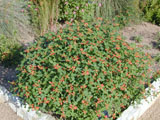
The closest we could find to the plant you asked about is Euphorbia x martinii 'Cherokee.' The little "x" in there indicates this is a cross with some other plant, which we couldn't identify, and the 'Cherokee' is a trade name. There are 17 Euphorbias or Spurge in our Native Plant Database but the cross or trade name would not be included. We tried to find an Euphorbia from our database that would be close but all the information on the Internet that we could find were ads, which of course extol the good qualities of a plant and don't mention problems. For instance, here is an ad from Plant Delights, Inc. from which about all the information we got is that it was sold out.
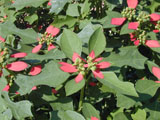
Since we could find out nothing substantial about the non-native hybrid you have, we thought we would have a try at information on some of the natives in our Native Plant Database. There are 7 members of the Euphorbiaceae (Spurge) native to Arizona. For our example, we chose Euphorbia cyathophora (Wild poinsettia), which happens to be a favorite of ours. Follow the plant link to our webpage on that page, and see if you can find any clues in the growing conditions that correspond with the problems you are having. Under Plant Characteristics on our webpage, we did note this sentence:
"Leaf: The upper or bracteal leaves usually red toward the base."
Perhaps that addresses your concern about the red leaves. We also noted that this native plant is an annual, which would mean the leaves should be dropping off anyway. Remember, we are only fishing for information from a plant we do know something about, as opposed to your plant, about which we don't know much, but is nevertheless related.
From this USDA Plant Profile Map, you will note that the native plant is not native to Cochise County, but is to Pima County, right next door, so we think we can assume that the soils, climate and rainfall are practical in both areas.
From the Image Gallery
More Herbs/Forbs Questions
Sad Germanders in Johnson City Texas
September 16, 2011 - I have some grey bush germanders that never seem to do well although they did at first when I planted them four years ago. They have sun and dappled shade on the south side of the house. A friend in ...
view the full question and answer
Plant ID at Wildflower Center from Waco TX
June 18, 2012 - I was at the Center last weekend and no one was able to answer these two questions: 1. Where can I buy Silver Ponyfoot groundcover? 2. What is the name of the plant with coral blossoms in front of...
view the full question and answer
Native perennial winter plants for Waco, TX
November 03, 2004 - I live in the Waco area, and would like to know winter plants that I could use that would come back each year, flowering or otherwise.
view the full question and answer
Plants for a lakeside bank in NC
November 07, 2011 - Our association is looking to plant a huge sloped area that runs down to Lake Wylie. We want to plant something that is good for erosion and that does not grow too tall so that we keep our view of th...
view the full question and answer
Need suggestions for plants to put between stones on a path in Austin, TX
April 12, 2013 - I am looking for plants to put between stones on a path, which are low-an inch or two, green, low water and tolerate full sun in Austin, Texas
view the full question and answer
| Support the Wildflower Center by Donating Online or Becoming a Member today. |