Native Plants

Q. Who is Mr. Smarty Plants?
A: There are those who suspect Wildflower Center volunteers are the culpable and capable culprits. Yet, others think staff members play some, albeit small, role. You can torture us with your plant questions, but we will never reveal the Green Guru's secret identity.

Did you know you can access the Native Plant Information Network with your web-enabled smartphone?

Ask Mr. Smarty Plants
Ask Mr. Smarty Plants is a free service provided by the staff and volunteers at the Lady Bird Johnson Wildflower Center.

rate this answer

Sunday - September 02, 2012
From: Austin, TX
Region: Southwest
Topic: Plant Lists, Vines
Title: Vine recommendations for Central Texas homes
Answered by: Brigid & Larry Larson
QUESTION:
I have hardy plank siding and am looking for a Central Texas native vine that will grow over it. I am trying to keep it from growing under the planks.ANSWER:
Wikipedia has a good article on vines and they discuss how vines attach themselves to whatever they climb. We can use this as a basis of choosing between different possible vines, Ones that climb by wrapping around protrusions or by twinned petioles [leaf stems] are likely OK while those that send roots into the wall or burrow under ‘bark” are not such a good choice.
We have eleven vines to choose from that are native to Central Texas. You can review the set by going to the Central Texas recommended species and narrowing the choices by choosing “vine” as the habit. You can then look for clues in the plant record. For instance, Campsis radicans (Trumpet creeper) climbs by means of aerial rootlets, which, like English Ivy, can damage wood, stone, and brick. Even though it can be quite attractive, I suspect this should not be on your list.
To me, these three look the gentlest to your wall:
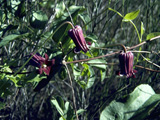
Clematis pitcheri (Purple clematis) – climbs to about 10 ft by twining petioles
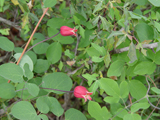
Clematis texensis (Scarlet clematis) - similar
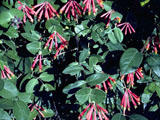
Lonicera sempervirens (Coral honeysuckle) – 3-20 feet by twining
If you can tolerate tendrils, then these also become possible choices
Ibervillea lindheimeri (Lindheimer's globeberry) – climbs to 6-10 feet by tendrils
Passiflora tenuiloba (Bird wing passionflower)
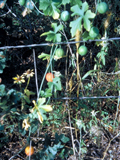
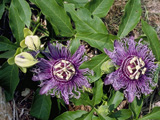
Passiflora incarnata (Purple passionflower) to 25 feet
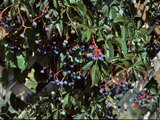
Parthenocissus quinquefolia (Virginia creeper) – to 40 feet
From the Image Gallery
More Plant Lists Questions
Evergreen shrub for northwest-facing wall
June 09, 2012 - Can you suggest a tall (8-10') evergreen shrub for a site against a northwest-facing wall which gets no sun in the winter but full sun in the summer? Texas sage got too leggy and viburnum will be to...
view the full question and answer
Less Maintenance Plant Suggestions for New Raised Bed in Henderson, NV.
April 03, 2014 - We have a newly constructed raised garden bed. I was wondering what kind of plants would be appropriate to plant this springtime in Henderson, NV with less maintenance because I work full time.
view the full question and answer
Plants for steep lakeside bank in Minnesota
January 17, 2012 - I am new to MN and would like to plant some pretty plants on my steep lakeside bank. What type plants and flowers should I plant to prevent erosion, but not block the lake view?
view the full question and answer
Planting under Pine Trees in Pocatello ID
April 08, 2014 - Hi I was wondering if you could give me some ideas of what I could plant under and near some pine trees for my area. The trees are huge and so it is also constant shade where I want to plant. Thanks f...
view the full question and answer
Need low-maintenance plants for courtyard in full sun in Rhode Island
June 01, 2007 - I live in West Warwick, Rhode Island. I am designing a courtyard which because of its shape and design receives full sun all day. I am looking for flowers and plants which thrive in the sun yet are ...
view the full question and answer
| Support the Wildflower Center by Donating Online or Becoming a Member today. |