Native Plants

Plant Database
Search for native plants by scientific name, common name or family. If you are not sure what you are looking for, try the Combination Search or our Recommended Species lists.
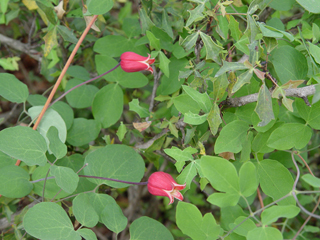
Lytle, Melody
Clematis texensis
Clematis texensis Buckley
Scarlet Clematis, Scarlet Leatherflower, Texas Clematis
Ranunculaceae (Buttercup Family)
Synonym(s): Clematis coccinea, Coriflora texensis
USDA Symbol: CLTE2
USDA Native Status: L48 (N)
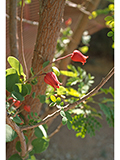
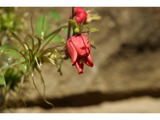
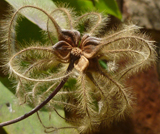
Scarlet Leather-flower or Scarlet Clematis is an herbaceous to slightly woody vine, climbing to 10 ft. Bell-shaped flowers, blooming only on new growth, are held in axillary clusters of one to seven. The flower petals are actually thick, leather-like, scarlet-colored sepals. A feathery ball of plumed seeds follows the floral display. Stems are bare for the first two feet.
This is a very hardy and drought tolerant clematis. Under ideal, sunny conditions, blooms may last until the first frost. Widely cultivated because of the red flowers but native only to the southeastern Edwards Plateau in Texas.


Plant Characteristics
Duration: PerennialHabit: Vine
Leaf Retention: Deciduous
Leaf Arrangement: Opposite
Leaf Complexity: Pinnate
Fruit Type: Achene
Size Notes: Climbing stems up to about 10 feet long.
Leaf: Terminal most leaflets often twisted and acting as tendrils.
Bloom Information
Bloom Color: RedBloom Time: Mar , Apr , May , Jun , Jul
Bloom Notes: Petals absent. Sepals petaloid.
Distribution
USA: TXNative Distribution: Endemic to Edwards Plateau, TX
Native Habitat: Texas endemic. Edwards Plateau. Well-drained limestone, loam, sand. Limestone cliffs; rocky slopes; streamsides
Growing Conditions
Water Use: LowLight Requirement: Part Shade
Soil Moisture: Moist
Cold Tolerant: yes
Heat Tolerant: yes
Soil Description: Rocky, limestone soils. Sandy, Sandy Loam, Medium Loam, Limestone-based
Conditions Comments: With a delicate vine form, rounded spade-shaped leaves and red, urn-shaped flowers, this plant provides a subtle, beautiful accent to a shady, moist area. It blooms best with half a day of sun, and blooms may continue until the first frost. This is a very hardy and drought tolerant clematis.
Benefit
Use Ornamental: Twines on fences & other plantsUse Medicinal: Tea from dried, chopped stems reported as treatment for headache, especially migraine. Tincture formerly used as counter-irritant.
Conspicuous Flowers: yes
Interesting Foliage: yes
Nectar Source: yes
Deer Resistant: Moderate
Propagation
Propagation Material: Softwood CuttingsDescription: Plant seed outdoors in the fall or store and stratify before planting. Single, internodal, softwood cuttings taken in summer can be rooted, although this species does not root readily. Clematis spp. are also propagated by late summer layerings.
Seed Collection: Gather seeds when they are no longer green but before the cluster of achenes completely dries and drops the seeds to the ground. Remain viable up to two years without refrigeration.
Seed Treatment: Moist stratify at 41 degrees for 60-90 days.
Commercially Avail: yes
Maintenance: After freezing weather cut stems back to ground as this clematis blooms on new wood.
From the National Organizations Directory
According to the species list provided by Affiliate Organizations, this plant is on display at the following locations:Lady Bird Johnson Wildflower Center - Austin, TX
NPSOT - Austin Chapter - Austin, TX
Jacob's Well Natural Area - Wimberley, TX
NPSOT - Williamson County Chapter - Georgetown, TX
Mt. Cuba Center - Hockessin, DE
Herbarium Specimen(s)
NPSOT 0655 Collected Jun 6, 1992 in Medina County by Harry CliffeNPSOT 0602 Collected May 13, 1992 in Medina County by Harry Cliffe
Wildflower Center Seed Bank
LBJWC-649 Collected 2004-07-20 in Travis County by Lady Bird Johnson Wildflower CenterBibliography
Bibref 355 - Landscaping with Native Plants of Texas and the Southwest (1991) Miller, G. O.Bibref 841 - Native Alternatives to Invasive Plants (2006) Burrell, C. C.
Bibref 318 - Native Texas Plants: Landscaping Region by Region (2002) Wasowski, S. & A. Wasowski
Bibref 281 - Shinners & Mahler's Illustrated Flora of North Central Texas (1999) Diggs, G. M.; B. L. Lipscomb; B. O'Kennon; W. F...
Bibref 328 - Wildflowers of Texas (2003) Ajilvsgi, Geyata.
Bibref 286 - Wildflowers of the Texas Hill Country (1989) Enquist, M.
Search More Titles in Bibliography
Web Reference
Webref 38 - Flora of North America (2019) Missouri Botanical Garden, St. Louis, MO & Harvard University Herbaria, Cambridge, MA.Webref 23 - Southwest Environmental Information Network (2009) SEINet - Arizona Chapter
Additional resources
USDA: Find Clematis texensis in USDA PlantsFNA: Find Clematis texensis in the Flora of North America (if available)
Google: Search Google for Clematis texensis
Metadata
Record Modified: 2023-05-04Research By: TWC Staff, GDB