Native Plants

Plant Database
Search for native plants by scientific name, common name or family. If you are not sure what you are looking for, try the Combination Search or our Recommended Species lists.
Marcus, Joseph A.
Ibervillea lindheimeri
Ibervillea lindheimeri (A. Gray) Greene
Balsam Gourd, Lindheimer's Globeberry, Globe Berry, Snake-apple, Balsam-apple
Cucurbitaceae (Cucumber Family)
Synonym(s): Ibervillea tenella, Ibervillea tripartita
USDA Symbol: ibli
USDA Native Status: L48 (N)
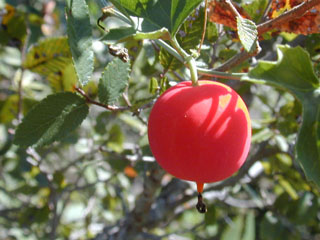
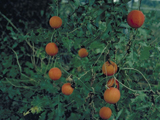
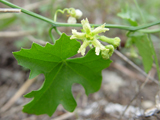
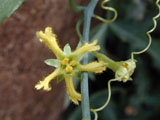
This gourd has tubular flowers with 5 spreading lobes, creamy-yellow, about 1/2 inch wide. Leaves are 1 1/2-3 1/4 inches long with 3-5 lobes, deeply cut and fine-toothed. The fruit is over 1 inch in diameter, with green stripes when young, but bright red when ripe. Before maturing it has a spiny-looking green covering which it sheds as it develops. The vine climbs 6-10 feet high by means of tendrils.
This species is named after Ferdinand Jacob Lindheimer (1801-1879) who is often called the Father of Texas Botany because of his work as the first permanent-resident plant collector in Texas. Lindheimer immigrated to the United States in 1834 as a political refugee. He spent from 1843-1852 collecting specimens in Texas. He settled in New Braunfels, Texas in 1844 and was granted land on the banks of the Comal River, where he continued his plant collecting and attempted to establish a botanical garden. He shared his findings with many others who shared his interest in botany, including Ferdinand von Roemer and Adolph Scheele. Lindheimer is credited with the discovery of several hundred plant species. In addition his name is used to designate forty-eight species and subspecies of plants. He is buried in New Braunfels. His house, on Comal Street in New Braunfels, is now a museum.


Plant Characteristics
Duration: PerennialHabit: Vine
Leaf Retention: Deciduous
Leaf Arrangement: Alternate
Fruit Type: Pepo
Size Notes: Climbs 6-10 feet.
Fruit: Green stripes when young, but bright red when ripe.
Bloom Information
Bloom Color: YellowBloom Time: Apr , May , Jun , Jul , Aug , Sep
Distribution
USA: NM , OK , TXNative Distribution: South central Texas in dry woods, thickets, and along fence lines. Sand, loam, clay, limestone.
Native Habitat: Open woodlands, Thickets, Fence rows
Growing Conditions
Water Use: LowLight Requirement: Sun
Soil Moisture: Moist
Cold Tolerant: yes
Heat Tolerant: yes
Soil Description: Sandy, Sandy Loam, Medium Loam, Clay Loam, Clay, Saline
Conditions Comments: The leaves and small yellow flowers of the balsam-gourd vine are attractive, but the ornamental value of this plant lies in its 1-2 inch, bright red, globular fruit. Light tolerance makes balsam-gourd a versatile plant for shade gardens. The plant will set more fruit in a sunnier setting. Climbs by tendrils so will need a shrub or trellis to clamber up.
Benefit
Use Ornamental: Fruits ornamental, AttractiveUse Wildlife: Nectar-insects, Fruit-birds
Conspicuous Flowers: yes
Interesting Foliage: yes
Attracts: Birds
Nectar Source: yes
Deer Resistant: Moderate
Propagation
Propagation Material: SeedsDescription: seed is best started in early spring
Seed Collection: Collect seed in summer when fruit is bright red and visible along roadsides.
Seed Treatment: No need to clean pulp off, it will dry and disintegrate.
Mr. Smarty Plants says
Identification of vine with gourd-like fruit
June 30, 2010
We live on a farm, and I have noticed a vine that has leaves like grapes, but produces this flower, and a fruit that is rather large, shaped like a gourd, right now green in color. It is growing over ...
view the full question and answer
Are gourds poisonous, edible?
August 27, 2008
Are all the Gourds edible? How can I know which one is which? If it is not edible, is it poisonous? If not, what is stopping us from eating them?
view the full question and answer
Is balsam gourd (Ibervillea lindheimeri) poisonous or edible?
August 18, 2008
Is the Balsam Gourd edible or poisonous?
view the full question and answer
From the National Organizations Directory
According to the species list provided by Affiliate Organizations, this plant is on display at the following locations:Lady Bird Johnson Wildflower Center - Austin, TX
Brackenridge Field Laboratory - Austin, TX
Stengl Biological Research Station - Smithville, TX
Texas Parks and Wildlife Department - Austin, TX
Texas Master Naturalists - Lost Pines Chapter - Bastrop, TX
Herbarium Specimen(s)
NPSOT 0601 Collected May 13, 1992 in Medina County by Harry CliffeNPSOT 0863 Collected May 4, 1994 in Bexar County by Harry Cliffe
NPSOT 0077 Collected Oct. 19, 1990 in Bexar County by Mollie Walton
NPSOT 0476 Collected Jul 30, 1993 in Atascosa County by Louise Morrell
NPSOT 0769 Collected Sep 9, 1993 in Bexar County by Harry Cliffe
Wildflower Center Seed Bank
LBJWC-MM-753 Collected 2006-07-11 in Hays County by Lady Bird Johnson Wildflower CenterBibliography
Bibref 355 - Landscaping with Native Plants of Texas and the Southwest (1991) Miller, G. O.Bibref 248 - Texas Wildflowers: A Field Guide (1984) Loughmiller, C. & L. Loughmiller
Bibref 291 - Texas Wildscapes: Gardening for Wildlife (1999) Damude, N. & K.C. Bender
Bibref 286 - Wildflowers of the Texas Hill Country (1989) Enquist, M.
Search More Titles in Bibliography
Additional resources
USDA: Find Ibervillea lindheimeri in USDA PlantsFNA: Find Ibervillea lindheimeri in the Flora of North America (if available)
Google: Search Google for Ibervillea lindheimeri
Metadata
Record Modified: 2019-08-20Research By: TWC Staff