Native Plants

Q. Who is Mr. Smarty Plants?
A: There are those who suspect Wildflower Center volunteers are the culpable and capable culprits. Yet, others think staff members play some, albeit small, role. You can torture us with your plant questions, but we will never reveal the Green Guru's secret identity.
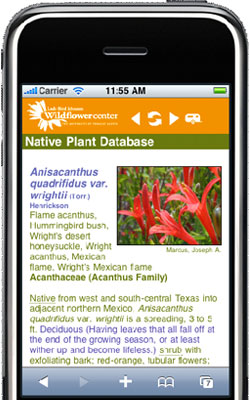
Did you know you can access the Native Plant Information Network with your web-enabled smartphone?

Ask Mr. Smarty Plants
Ask Mr. Smarty Plants is a free service provided by the staff and volunteers at the Lady Bird Johnson Wildflower Center.

rate this answer

Friday - February 10, 2012
From: Webster, KY
Region: Mid-Atlantic
Topic: Invasive Plants, Non-Natives, Meadow Gardens, Erosion Control, Grasses or Grass-like, Herbs/Forbs
Title: Landscaping large area in Webster KY
Answered by: Barbara Medford
QUESTION:
We just bought a house that we fell in love with. The land around it . . . well it has GREAT potential but is seriously lacking at the moment. Trying to get the farm up and running leaves very little time to even think about flower beds (which I dearly love). We have a lot of area where the previous owners just bulldozed and planted some cheap grass which in turn has left us with quite an erosion problem. My husbands answer for everything is tall fescue (I hear this in my nightmares at night!!!!) There is a small hill behind out house that is in horrible shape. While there are no huge washout craters the water runs down causing a huge puddle effect in our back yard - which I plan on fixing with a small pond and a false creek bed. By next year I am hoping to be able to do some slight terracing and plant some berry bushes and strawberries on the hill but in the meantime I don't want to be looking at TALL FESCUE out my kitchen and dining room windows (not to mention the thought of having to mow it). I am looking for a wild flower mix that is going to be a good ground cover, quick growing and help with the erosion. I want to something low maintenance but pretty. We live in KY so our weather is . . . well I guess ever changing is the word. Our area usually (ha ha - there's our jinx for this year) stays pretty moist until late june and then we are on the dry side until about late august. The area is close enough and if need be can be watered with a sprinkler but again I'm hoping to find a low maintenance but PRETTY solution. Any suggestions you have on what type of wildflower mix (or if there even is one that will work) would be greatly appreciated.ANSWER:
You gave us a very good verbal picture of your property and the problems you have identified. To sum them up, we see the problems as:
1. Fescue nightmares
2. Puddles
3. Wildflower mix
We have no expertise in getting a farm going, and wish you well with that. If we have missed another problem crying for attention, get back to us and we'll see what we can do. Please be aware there is no such thing as instant landscaping, large or small. We get a lot of questions from people who want to throw out a packet of wildflower or grass seeds and get quick magazine cover results. Isn't going to happen. You will have to do a lot of your own research, and avoid buying anything until you have established it will work for you. And, most important to us-please use plants native to your area.
1. Fescue nightmares: This may not carry any weight with your husband but Festuca arundinacea, tall fescue, is non-native to North America, having been imported from Europe in the 1800's. The Lady Bird Johnson Wildflower Center and Mr. Smarty Plants are committed to the growth, propagation and protection of plants native not only to North America but to the area in which the plant grows natively. This is because a plant native to an area has already adapted to and prefers the climate, rainfall and temperatures in that environment, which means they need less water and little or no fertilizer to do well. Tall fescue is a cool season perennial and a bunchgrass. According to this article from Invasives.org, it can become invasive, shading or crowding out more desirable plants. If you intend to use this for a lawn grass, yes, it will have to be aggressivly mowed; a bunchgrass is not easy to mow and can develop bald spots.
2. Puddles: This is not an uncommon problem at all, and while we seldom have the luxury of enough rain to make a puddle in Austin, we do know of some good, attractive solutions to the problem; i.e., rain gardens. There is tons of information on the Internet on this subject and you can begin with Rutgers Cooperative Research and Extension Rain Gardens. Properly constructed, these gardens not only cut down on erosion and runoff, but make attractive small gardens for birds and butterflies. Another good starting point is Rain Garden Design Templates.
3. Looking out your window and seeing wildflowers. Before we give you some research material on this, remember that most wildflowers are annuals, bloom 6 to 8 weeks at a particular time of year, and then dry up, set seeds and disappear. There is no seed mix that will keep you constantly in wildflowers. We have some How-To Articles that should help you: Getting Started on Large Scale Wildflower Planting, Meadow Gardening and Water Gardening.
One last word on the wildflower seed mixes. If you just buy a wildflower seed mix, it will most likely have a number of seeds not native to your environment that may not even germinate. Worse still, they may contain a number of seeds that are non-native and invasive. Read this article from the University of Kentucky Wild About Wildflowers. You can go to our Native Plant Database to find more information on the flowers listed, with pictures.
More Erosion Control Questions
Groundcover plants for erosion problem in Orlando
June 01, 2009 - Hi, I live in Orlando, and have a terrible erosion problem on one side of my back yard. Every time it rains, I lose my yard under the fence! The area is part sun. Can you please suggest a plant or ...
view the full question and answer
Erosion control in Ft. Wright KY
June 02, 2010 - My house sits on a hillside. On the back and behind a somewhat large concrete deck there is a retention wall that protects the deck, but after that there is this large area (at least 24X20 ft), that ...
view the full question and answer
Plants to stop erosion on sandy slope in north central Texas
November 27, 2009 - We have severe erosion problems that lead to a deep ravine.
There are deer in the area and the soil is sandy on a slope. What would be the best long term solution to stop or control this erosion. Th...
view the full question and answer
Plants for slopes in South Texas
October 05, 2009 - Can you provide a list of plants for use on slopes in S. Texas?
view the full question and answer
Getting rid of non-native, invasive English Ivy from Davidsonville MD
March 19, 2014 - Just moved and need to rid the well established Ivy planted on the steep slope area around the back and side of the house as it is taking over the bushes on the top and trees in forested area at botto...
view the full question and answer
| Support the Wildflower Center by Donating Online or Becoming a Member today. |