Native Plants

Q. Who is Mr. Smarty Plants?
A: There are those who suspect Wildflower Center volunteers are the culpable and capable culprits. Yet, others think staff members play some, albeit small, role. You can torture us with your plant questions, but we will never reveal the Green Guru's secret identity.

Did you know you can access the Native Plant Information Network with your web-enabled smartphone?

Ask Mr. Smarty Plants
Ask Mr. Smarty Plants is a free service provided by the staff and volunteers at the Lady Bird Johnson Wildflower Center.

rate this answer

Wednesday - July 07, 2010
From: Jacksonville, TX
Region: Southwest
Topic: Rain Gardens, Erosion Control, Groundcovers
Title: Plants for difficult site in Jacksonville, TX
Answered by: Nan Hampton
QUESTION:
East Texas (Cherokee County) red clay hillside, hard-packed, difficult to get to, 40' of it slopes 4' down in about 6'! Another 30' of it is flat. Between the hillside and the flat clay area is a 30' long by 8' wide sandy loam band, 6" to 8" deep, that stays wet for several days after a rain but NOT continuously. All of the property is in full sun all year. There is no foot or vehicular traffic. (1) For the clay hillside and "flat spot," I'm looking for a ground cover, preferably a shrub like creeping juniper, but I'd like native or well-adapted plants and I'm not sure juniper fits that category (does it?). I'd like to mix in some decorative clumps of, say, liriope or Monkey Grass but am unsure whether the hardpan would be conducive. (2) For the "rain garden" I want to create in the sandy loam mid-section, I'm looking for good transpirators, preferably bulbous without deep roots - but I repeat this area as well can get dry. All should be low maintenance due to difficulty accessing the area, and additional watering would be difficult as well although I have diverted the surrounding run-off areas into the "rain garden". Trees or anything with deep root systems are out of the question due to underground piping running close below the upper elevation of the hillside. Stabilization of the clay hillside is of lesser importance, but I'd like to keep the weeds and sedge at bay. Of course, they volunteer to grow there but do so in widely separated clumps that give the whole area a "mangy" look. Am I on a fool's quest here, or could you give me some leads on native plant selections for both of these areas?ANSWER:
You have given Mr. Smarty Plants a difficult challenge and it is going to be a challenge for you, too, to get the plants established here without some application of water initially. First of all, even though you think the grasses and sedges look a little mangy on your slope, don't get rid of them. They are what's keeping it from washing away. Let's first address the clay hillside and "flat spot". You are well out of the native range for Juniperus horizontalis (creeping juniper). The only juniper that is native to Cherokee County or adjacent counties is Juniperus virginiana (eastern redcedar) and it certainly wouldn't be considered a groundcover. It can grow to a maximum height of 90 feet. Also, we wouldn't recommend liriope (from East Asia) or monkey grass (native to Japan) since neither are native to North America and we, here at the Wildflower Center, are dedicated to promoting the conservation and use of native North American plants. We do, however, have some native plants to use as groundcovers that we will recommend:
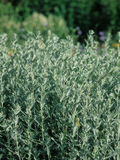
Artemisia ludoviciana (white sagebrush) is evergreen (or, maybe better described as 'ever-gray'). It grows from 1 to 3 feet high in clay and full sun and can be mowed.
Oenothera speciosa (pinkladies) is almost evergreen and grows from 1 to 2 feet high in clay and full sun.
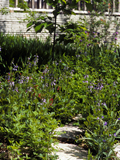
Salvia lyrata (lyreleaf sage) is evergreen if it gets water in the summer. It grows 4 inches to 2 feet in clay and full fun.
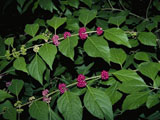
Callicarpa americana (American beautyberry) is a shrub that isn't evergreen but does have bright purple berries for interest in the fall and winter.
Grasses are excellent for controlling erosion because of their extensive fibrous root system. Here are some attractive native ones to add to the mix:
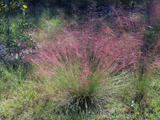
Muhlenbergia capillaris (hairawn muhly) grows 1 to 3 feet in clay and full sun with a pinkish-purple hazy bloom in October. It will be dormant in winter. This grass can stand seasonal poor drainage so it would also be suitable for the 'rain garden' area.
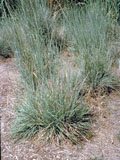
Schizachyrium scoparium (little bluestem) grows 1 to 3 or 4 feet in full sun in well-drained soil of almost any type and is bluish-green in the summer and turns reddish-brown in the fall and winter.
Sorghastrum nutans (Indiangrass) grows 3 to 8 feet in clay and full sun. It has golden blooms in October. It also should work in the 'rain garden'.
Here are some other plants for the 'rain garden' that are able to grow in very wet areas, but will also do well when the water goes away:
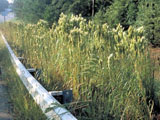
Andropogon glomeratus (bushy bluestem)
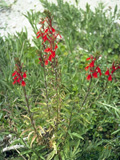
Lobelia cardinalis (cardinalflower)
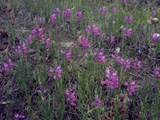
Physostegia intermedia (slender false dragonhead)
You can find more suggestions in a previous question we answered about plants for a rain garden in East Texas.
You can also check out our Piney Woods list for more possibilities for plants for your area.
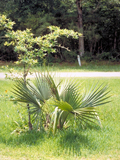
Here are photos from our Image Gallery:


More Rain Gardens Questions
Retention pond from Hendersonville NC
April 24, 2012 - We have a retention pond that has recently been cleaned and we would like to plant perennial native plant and grass seeds that will enhance the appearance and contribute to the natural process of filt...
view the full question and answer
Raingardens in Indiana
May 09, 2012 - I need to have annual native plants to add to a demonstration rain garden to fill in while we wait for the perennial plants to mature. The only plant I can think of is annual phlox. Do you have any ...
view the full question and answer
Rain garden plants for NC
April 19, 2010 - I have a small creek at the back of our property, it's normally dry except when it rains. Builders removed the natural plants and left it bare. What native plants could I plant in it to bring it bac...
view the full question and answer
Plants for floodplain in Fairfield, New Jersey
March 21, 2010 - I have an easy question for you... I hope... We just moved into the floodplains of NJ in Fairfield and are interested in some plants. We would like to know what plants are best suited to grow in flood...
view the full question and answer
Rain garden plants for Central Texas
February 06, 2014 - Do you have a list of rain garden plants for Central Texas?
view the full question and answer
| Support the Wildflower Center by Donating Online or Becoming a Member today. |