Native Plants

Plant Database
Search for native plants by scientific name, common name or family. If you are not sure what you are looking for, try the Combination Search or our Recommended Species lists.
Bransford, W.D. and Dolphia
Oenothera speciosa
Oenothera speciosa Nutt.
Pink Evening Primrose, Showy Evening Primrose, Mexican Evening Primrose, Showy Primrose, Pink Ladies, Buttercups, Pink Buttercups
Onagraceae (Evening Primrose Family)
Synonym(s): Hartmannia speciosa, Oenothera delessertiana, Oenothera speciosa var. childsii
USDA Symbol: oesp2
USDA Native Status: L48 (N)
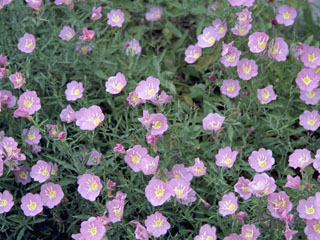
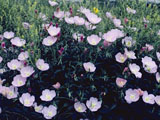
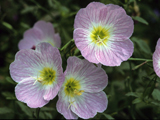
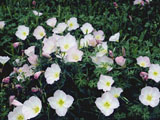
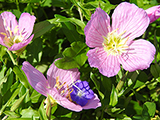
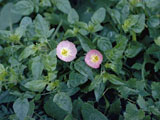
Originally native only to central grasslands from Missouri and Nebraska south through Kansas, Oklahoma, and Texas to northeastern Mexico, Pink Ladies or Pink Evening Primrose is an upright to sprawling, 1-2 ft. perennial, which spreads to form extensive colonies. Its large, four-petaled flowers, solitary from leaf axils, range in color from dark pink to white. Nodding buds, opening into pink or white flowers, are in the upper leaf axils on slender, downy stems. The delicate-textured, cup-shaped blossoms are lined with pink or red veins. Foliage is usually linear and pinnate, although leaves can be entire and lance-shaped depending on locality. A hardy and drought resistant species that can form colonies of considerable size. The flowers may be as small as 1" (2.5 cm) wide under drought conditions. The plant is frequently grown in gardens and escapes from cultivation.
As the common name implies, most evening primrose species open their flowers in the evening, closing them again early each morning. The flowers of some members of the genus open in the evening so rapidly that the movement can almost be observed. Pink evening primrose populations in the southern part of its natural range, however, open their flowers in the morning and close them each evening. To further complicate matters, populations in the northern parts of its range tend to open in the evening.
Plant Characteristics
Duration: PerennialHabit: Herb
Leaf Retention: Semi-evergreen
Fruit Type: Capsule
Size Notes: Up to about 2 feet tall.
Leaf: Medium green. Some leaves red in autumn.
Flower: Flowers 2 inches across
Bloom Information
Bloom Color: White , PinkBloom Time: Feb , Mar , Apr , May , Jun , Jul , Aug , Sep , Oct
Bloom Notes: In southern parts of its range, blooms tend to be darker pink or rose and to open in the morning. Northern populations are often paler or white and night-blooming. An average coloration would have shell-pink blooms that transition to white in the center and are veined in a deeper pink. Flowers release a scent starting at dusk. In the most southerly parts of its range, from Chihuahuan Desert grasslands to northeastern Mexico, blooms whenever temperatures are above freezing. Elsewhere, blooms heaviest during spring, with blooms diminishing in size as the weather gets hotter. Each flower lasts only a single day.
Distribution
USA: AL , AR , AZ , CA , CT , FL , GA , IA , IL , IN , KS , KY , LA , MO , MS , NC , NE , NM , OH , OK , PA , SC , TN , TX , UT , VA , WVNative Distribution: Originally native only to grasslands of Nebraska, Kansas, Missouri, Oklahoma, Texas, and northeastern Mexico. Naturalized elsewhere.
Native Habitat: Prairies, Plains, Meadows, Pastures, Savannas, Hillsides, Slopes, Woodland edges, Forest openings.
Growing Conditions
Water Use: Low , MediumLight Requirement: Sun
Soil Moisture: Dry , Moist
Soil Description: Readily colonizes in open areas in a variety of well-drained soils, rich or poor, dry or moist, disturbed or not: loams, clays, sand, caliche, rocky, or gravelly.
Conditions Comments: It cannot withstand complete soil dryness. Plants often go dormant in summer, resprouting with fall rains. Can work as a dense foliage groundcover in shade, but won't bloom without adequate sunlight.
Benefit
Use Ornamental: Full sun groundcover with showy flowersUse Wildlife: Seed capsules attract birds, especially finches, and various mammals.
Use Food: Cook as greens or in salads, best flavor when collected before flowering.
Conspicuous Flowers: yes
Attracts: Birds
Nectar Source: yes
Deer Resistant: High
Value to Beneficial Insects
Special Value to Native BeesThis information was provided by the Pollinator Program at The Xerces Society for Invertebrate Conservation.
Propagation
Propagation Material: Root Division , Seeds , Softwood CuttingsDescription: Propagate by seed in fall. After distributing seed evenly, rake into loosened topsoil to ensure good seed/soil contact.
Seed Treatment: Getting the seed to germinate may be difficult. The pre-germination requirements are not determined.
Commercially Avail: yes
Maintenance: Remove spent blossoms and fertilize in spring with rose food to encourage more blooms. Allow seeds to completely mature before mowing for reseeding or collecting seed to plant in a new area. To prevent summer dormancy, water sparingly. If gets too aggressive, divide and separate.
Find Seed or Plants
Order seed of this species from Native American Seed and help support the Wildflower Center.
Find seed sources for this species at the Native Seed Network.
Mr. Smarty Plants says
List of native perennial Texas flowers
March 13, 2006
Good day, I am searching for a list of native Texas flowers (preferably perennials) for a flower garden.
Thank you.
view the full question and answer
From the National Organizations Directory
According to the species list provided by Affiliate Organizations, this plant is on display at the following locations:Naval Air Station Kingsville - Kingsville, TX
Fredericksburg Nature Center - Fredericksburg, TX
Lady Bird Johnson Wildflower Center - Austin, TX
Pineywoods Native Plant Center - Nacogdoches, TX
Sibley Nature Center - Midland, TX
Brackenridge Field Laboratory - Austin, TX
Patsy Glenn Refuge, c/o Wimberley Birding Society - Wimberley, TX
Stengl Biological Research Station - Smithville, TX
Texas Parks and Wildlife Department - Austin, TX
NPSOT - Fredericksburg Chapter - Fredericksburg, TX
Native Seed Network - Corvallis, OR
Jacob's Well Natural Area - Wimberley, TX
NPSOT - Williamson County Chapter - Georgetown, TX
Herbarium Specimen(s)
NPSOT 0568 Collected Mar 10, 1990 in Bexar County by Harry CliffeNPSOT 0433 Collected May 26, 1993 in Bexar County by Cecil Mayo
NPSOT 0574 Collected Mar 22, 1990 in Bexar County by Harry Cliffe
NPSOT 0352 Collected May 19, 1993 in Bexar County by Louise Morrell
NPSOT 0212 Collected Apr. 19, 1992 in Comal County by Mary Beth White
Wildflower Center Seed Bank
LBJWC-19 Collected 2006-05-21 in Travis County by Lady Bird Johnson Wildflower CenterBibliography
Bibref 307 - Edible and Useful Plants of Texas and the Southwest: Including recipes, harmful plants, natural dyes, and textile fibers: A Practical Guide (1999) Tull, D.Bibref 946 - Gardening with Prairie Plants: How to Create Beautiful Native Landscapes (2002) Wasowski, Sally
Bibref 355 - Landscaping with Native Plants of Texas and the Southwest (1991) Miller, G. O.
Bibref 765 - McMillen's Texas Gardening: Wildflowers (1998) Howard, D.
Bibref 995 - Native Landscaping from El Paso to L.A. (2000) Wasowski, S. and A. Wasowski
Bibref 318 - Native Texas Plants: Landscaping Region by Region (2002) Wasowski, S. & A. Wasowski
Bibref 281 - Shinners & Mahler's Illustrated Flora of North Central Texas (1999) Diggs, G. M.; B. L. Lipscomb; B. O'Kennon; W. F...
Bibref 248 - Texas Wildflowers: A Field Guide (1984) Loughmiller, C. & L. Loughmiller
Bibref 1294 - The Midwestern Native Garden: Native Alternatives to Nonnative Flowers and Plants An Illustrated Guide (2011) Adelman, Charlotte and Schwartz, Bernard L.
Bibref 328 - Wildflowers of Texas (2003) Ajilvsgi, Geyata.
Bibref 286 - Wildflowers of the Texas Hill Country (1989) Enquist, M.
Search More Titles in Bibliography
Web Reference
Webref 38 - Flora of North America (2019) Missouri Botanical Garden, St. Louis, MO & Harvard University Herbaria, Cambridge, MA.Webref 23 - Southwest Environmental Information Network (2009) SEINet - Arizona Chapter
From the Archive
Wildflower Newsletter 1984 VOL. 1, NO.4 - Lady Bird Heartened by Progress, Horticultural Society Annual Meeting Held, Dire...Wildflower Newsletter 1987 VOL. 4, NO.2 - Wildflowers Provide Activity in Summer, Beautiful Colorado Beckons, What is Rese...
Wildflower Newsletter 1987 VOL. 4, NO.3 - Fall Planting Highlights the Season, Jubilee Celebration Commences December 1987...
Wildflower Newsletter 1989 VOL. 6, NO.2 - Wildflower Network Operates in Louisiana, Wildflower Handbook Published, Researc...
Wildflower Newsletter 1989 VOL. 6, NO.5 - Educator\\\'s Native Plants Poster Perfected, Pass a Law, Protect a Tree, Resear...
Additional resources
USDA: Find Oenothera speciosa in USDA PlantsFNA: Find Oenothera speciosa in the Flora of North America (if available)
Google: Search Google for Oenothera speciosa
Metadata
Record Modified: 2023-02-21Research By: NPC, WFS, GDG