Native Plants

Q. Who is Mr. Smarty Plants?
A: There are those who suspect Wildflower Center volunteers are the culpable and capable culprits. Yet, others think staff members play some, albeit small, role. You can torture us with your plant questions, but we will never reveal the Green Guru's secret identity.

Did you know you can access the Native Plant Information Network with your web-enabled smartphone?

Ask Mr. Smarty Plants
Ask Mr. Smarty Plants is a free service provided by the staff and volunteers at the Lady Bird Johnson Wildflower Center.

rate this answer

Saturday - January 02, 2010
From: Solgohachia, AR
Region: Southeast
Topic: Erosion Control, Septic Systems, Grasses or Grass-like, Herbs/Forbs
Title: Raised beds over lateral lines in Solgohachia AR
Answered by: Barbara Medford
QUESTION:
I would like to build raised flower beds over my lateral lines. They would be planted with strawberries and perennials. Will this cause any problems with the absorption into the ground or not letting it dry up?ANSWER:
There shouldn't be any problem with raised beds over lateral lines; in fact, the moisture from the lines will probably benefit the plants you choose. When you say you wish to plant "perennials," your concern needs to be more with the roots of the desired plants. We usually recommend grasses to go over lateral lines, because they have fibrous roots that will not interfere with the lines. However, we assume that what you want are herbaceous blooming perennials. What you need to avoid are perennials that become woody, with extensive woody roots, which will interfere with the lateral lines.
From our Native Plant Database:
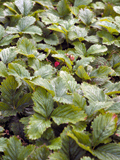
"Fragaria virginiana (Virginia strawberry), native to Arkansas, is a ground-hugging plant rising from a fibrous, perennial root system. Hairy leaf petioles, up to 6 in. long, each bear a single trifoliate leaf. The hairy flower stalk gives rise to a loose cluster of small, five-petaled flowers followed by tasty, wild strawberries. Found in patches in fields and dry openings, this plant produces the finest, sweetest, wild strawberry. The edible portion of the strawberry is actually the central portion of the flower (receptacle) which enlarges greatly with maturity and is covered with the embedded, dried, seed-like fruit."
Cultivated strawberries are hybrids developed from this native species and the South American one. The Lady Bird Johnson Wildflower Center is dedicated to the use, propagation and care of plants native not only to North America but to the area in which they are being grown. A hybrid, which is probably what you intend to use, falls outside our expertise. However, we are going to assume that the cultivar (cultivated variety) will also have fibrous roots and therefore be appropriate for planting over your lateral lines.
We will go to our Recommended Species, click on Arkansas on the map, and then select "herb" (herbaceous blooming plant) under GENERAL APPEARANCE and "perennial" under DURATION. From this, we will try to select plants that do not become woody as they mature and that would be useful in your garden. We do not intend this to be a list of plants you must use, but only indications of the kind of plant we recommend you use. You can make your own selections, using this same method, inserting specific site requirements for sun exposure, soil moisture and so forth. Follow each plant link to our page on that plant to learn the expected size, bloom time, etc.
From our Native Plant Database:
Fragaria virginiana (Virginia strawberry)
Aquilegia canadensis (red columbine)
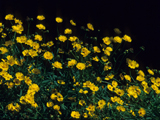
Coreopsis lanceolata (lanceleaf tickseed)
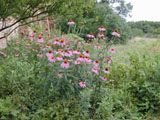
Echinacea purpurea (eastern purple coneflower)
Monarda fistulosa (wild bergamot)
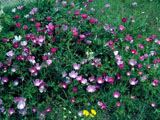
Oenothera speciosa (pinkladies)
Ratibida columnifera (upright prairie coneflower)
From our Native Plant Image Gallery:



More Grasses or Grass-like Questions
Hillside Erosion in Pace FL
July 17, 2015 - I have a hillside that slopes down about 10 feet to a spring fed pond. The pond drains into Escambia Bay. We have 2 dams with culverts to control the flow of water. Last year during a torrential ra...
view the full question and answer
Low maintenance grass for shade in Conroe, TX
September 15, 2012 - What is the best low maintenance grass to plant in front lawn shaded, no traffic area?
view the full question and answer
Will Bermuda grass survive a drought-induced dormancy?
August 12, 2015 - If I stop watering a Bermuda grass lawn and let it go dormant, will it green up again when it rains again?
view the full question and answer
Small, flowering, evergreen plants for hillside in Austin.
October 27, 2007 - I have a steep, dry hillside measuring approximately 4 feet high by six feet wide. I want to plant low growing, evergreen, flowering plants across the bed that will flower as long as possible, and thr...
view the full question and answer
Groundcover for Lighthouse Point FL
April 13, 2012 - Dear Mr. Smarty Plants:
I am looking for mowable ground cover for part of my back yard. Due to a Mahogany tree, a hammock, surrounding foliage and a fence, there is alot of shade in the area, alon...
view the full question and answer
| Support the Wildflower Center by Donating Online or Becoming a Member today. |