Native Plants

Q. Who is Mr. Smarty Plants?
A: There are those who suspect Wildflower Center volunteers are the culpable and capable culprits. Yet, others think staff members play some, albeit small, role. You can torture us with your plant questions, but we will never reveal the Green Guru's secret identity.

Did you know you can access the Native Plant Information Network with your web-enabled smartphone?

Ask Mr. Smarty Plants
Ask Mr. Smarty Plants is a free service provided by the staff and volunteers at the Lady Bird Johnson Wildflower Center.

rate this answer

Sunday - December 13, 2009
From: Austin, TX
Region: Southwest
Topic: Diseases and Disorders, Trees
Title: Freeze damage to Mexican olive in Austin
Answered by: Barbara Medford
QUESTION:
I have a Mexican Olive tree/bush. It is young - about 8 ft. tall. This last freeze in Austin made many of its leaves turn black. I got this from your database: "Its native range extends no farther north than the Rio Grande Valley because it can't survive harsh winters, but it has long been grown in San Antonio and even in Austin, where cold winters can cause it to die back to the ground. Those surviving longest in San Antonio and Austin are protected from north winds." My question is what should I do now - just wait and see or do some pruning. It is one big "trunk" with many branches full of leaves. Thanks!ANSWER:
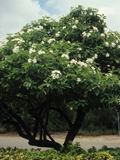
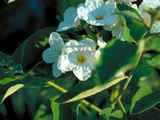
We have been receiving many questions regarding what to do after the sudden hard freeze that occurred recently in Central Texas; in fact, we are still dipping below freezing at night frequently. One thing that applies in every case is, don't fertilize. Plants should be fertilized in the Spring, when you want to encourage new shoots to appear. The last thing you want to do is encourage new shoots now that will put more stress on already-stressed roots and probably just get frozen back again. You may already know what happened; actively growing plants still have water in their upper structure, particularly the leaves. A sudden hard freeze causes that water to expand, bursting cell walls in the leaves, and they quickly turn dark and look pathetic. What made this freeze worse was that it was earlier than we ordinarily expect these conditions in this part of Texas, very sudden, temperatures went down very far, and remained below freezing for several hours. A gradual decrease in temperature over a period of time increases the ability of plants or plant parts to withstand cold temperatures. A sudden decrease in temperature in late fall or early winter usually results in more damage than the same low temperature in January or February. The information that you found in our database is exactly what we know about the hardiness of the Cordia boissieri (anacahuita). Was your plant protected from those hard, cold winds we had during our cold snap? If so, that might give you a better prognosis. The first thing to do is determine how much of the tree is still alive. Obviously, the leaves, probably black, are going to drop off. On the trunk and branches, use the thumbnail test. Scrape away a very fine, very small layer of the bark, beginning with upper branches and working down toward the base. If there is still some green beneath that scraping, that part of the plant is still alive. If it is black or even slimy beneath the outer bark, that portion of the plant should probably be marked for pruning. The good news is that the bark and woody portions of the tree have stronger cell walls, and are not so apt to burst in freezing. In your case, you are asking about pruning some damaged areas. From Texas A&M AgriLIFE Extension this article Follow Proper Pruning Techniques will give you some good information on what and when to prune. If you elect to prune now, in the interest of appearance, wait a few days first, as more damage may become evident as time passes. In any case, we would not disturb it except to remove dead areas, and wait to see if it starts to come back in the Spring. Hopefully, the roots were well enough protected by the soil to keep them from freezing, too. This is an illustration of why the Lady Bird Johnson Wildflower Center recommends the use of plants native not only to North America but to the area in which the plant is being grown. You knew you were gambling to plant the Mexican olive this far north; we hope that you will ultimately win the gamble and retain a live tree. From our Native Plant Image Gallery:

More Trees Questions
Need help with Tulip Tree in Jacksonville,Florida
July 03, 2012 - I planted a 20 foot tall Tulip Tree last spring. The hole I dug was double the size of what the tree came in. The tree was doing well until we got tropical storm Debby. In the middle of the night t...
view the full question and answer
Eastern red cedar for indoor Christmas tree
November 06, 2007 - I would love to have a live b&b or container tree for a Christmas tree, then plant it in the ground after Christmas. Would a Eastern Cedar survive if I brought it inside for a couple of weeks before p...
view the full question and answer
Is Viburnum rufidulum monoecious or dioecious?
July 28, 2014 - Is Viburnum rufidulum monoecious or dioecious? Your database does not address this for most plants.
view the full question and answer
How common is white blooming Mountain Laurel
April 01, 2003 - Is white blooming Mountain Laurel common?
view the full question and answer
Tropical looking plants for pool area in California
November 14, 2008 - I am looking for small tropical looking plants, groundcover, and 2-small trees for around my pool. They have to be non-toxic to dogs,cats, and people. They can't attract bees/wasps, or have a root ...
view the full question and answer
| Support the Wildflower Center by Donating Online or Becoming a Member today. |