Native Plants

Q. Who is Mr. Smarty Plants?
A: There are those who suspect Wildflower Center volunteers are the culpable and capable culprits. Yet, others think staff members play some, albeit small, role. You can torture us with your plant questions, but we will never reveal the Green Guru's secret identity.

Did you know you can access the Native Plant Information Network with your web-enabled smartphone?

Ask Mr. Smarty Plants
Ask Mr. Smarty Plants is a free service provided by the staff and volunteers at the Lady Bird Johnson Wildflower Center.

rate this answer

Tuesday - April 28, 2009
From: Flagstaff, AZ
Region: Southwest
Topic: Wildlife Gardens
Title: Plants for butterflies, birds and bees at 7000 feet in Arizona
Answered by: Nan Hampton
QUESTION:
What are the best plants for feeding and sheltering bees, butterflies, and birds in/near Flagstaff AZ. We are at 7,000 feet elevation and I am finding it very difficult to create a backyard habitat.ANSWER:
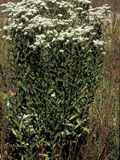
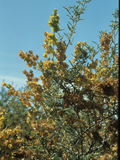
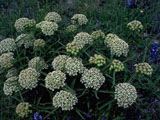
Finding plants for bees, butterflies and birds isn't too tricky, but finding such plants for 7000 feet are a bit trickier. I used this excellent book by Anne Orth Epple, A Field Guide to the Plants of Arizona, along with our Native Plant Database to find the following plants. The Epple book gives information about the plants size and describes leaves, flowers and fruits. It also gives habitat and, importantly, the elevation where the plant grows. Our Native Plant Database gives general information about the plant and also gives its benefits to various animals, including whether the plant serves as a larval or nectar source for butterflies. There are more plant possibilities but the ones listed below will give you a start. Perhaps you will be able to find a copy of the Epple book in your public library or to purchase to help you determine the elevation limits for any plants you would like to use in your garden.TREES
Populus tremuloides (quaking aspen) is larval host for the Eastern Tiger Swallowtail and Viceroy butterflies.
Quercus arizonica (Arizona white oak) provides acorns for turkeys, quail and songbirds. Larval host for Meridian Duskywing (Erynnis meridianus), Short-tailed Skipper (Zestusa dorus) and Dull Firetip (Apyrrothrix araxes).
Amelanchier utahensis (Utah serviceberry) flowers have nectar for insects and birds eat berries.
Prunus virginiana (chokecherry) is larval and/or nectar host for 4 different species of moths and butterflies and its fruits are eaten by birds.
Ceanothus fendleri (Fendler's ceanothus) is host for 3 species of butterflies and moths. Here are photos and more information.
SHRUBS
Comandra umbellata (bastard toadflax) attracts butterflies and is larval host for the Common Buckeye (Junonia coenia)
Atriplex canescens (fourwing saltbush) larval and/or nectar host for several butterflies, nectar for bees and other insects and fruits for birds.
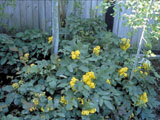
Mahonia repens (creeping barberry) blooms for pollinators and fruits for birds.
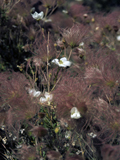
Fallugia paradoxa (Apache plume) flowers have nectar for insects and shrub provides shelter and nesting sites.
HERBACEOUS PLANTS
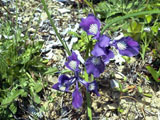
Iris missouriensis (Rocky Mountain iris) for hummingbirds
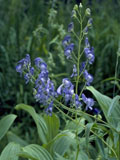
Aconitum columbianum (Columbian monkshood) for bumblebee, hawkmoths and hummingbirds.
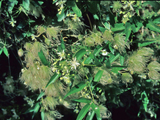
Clematis ligusticifolia (western white clematis) hummingbirds and other birds.
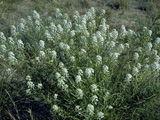
Lepidium montanum (mountain pepperweed) bees, butterflies and other insects. Larval host for Checkered White (Pontia protodice).
Heuchera sanguinea (coralbells) for hummingbirds and here are photos and more information.
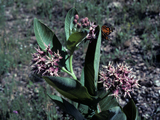
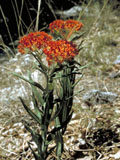
Asclepias asperula (spider milkweed), Asclepias speciosa (showy milkweed) and Asclepias tuberosa (butterfly milkweed) are all species of milkweed and all are hosts to several butterfly species, including the Monarch.
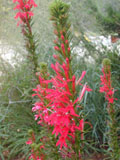
Lobelia cardinalis (cardinalflower) attracts butterflies, hummingbirds and other birds.
More Wildlife Gardens Questions
Butterflies and larval hosts in Dallas County
June 19, 2007 - My class is starting a butterfly habitat at school. We have researched plants that attract butterflies, however we forgot to look for plants that feed the caterpillars and we want to provide the expe...
view the full question and answer
Memorial garden in Georgia
December 08, 2008 - I would like to plant a memorial garden in memory of my mother. She loved butterflies and bulbs blooming. Our backyard is shaded by large oaks and pines. A pool is located to the right, a large fire...
view the full question and answer
Caterpillars on Carolina buckthorn (Frangula caroliniana)
September 29, 2007 - I have a Carolina buckthorn and last year there were interesting looking caterpillars munching on the leaves. They were camouflaged to look a bit like bird droppings. The plant database makes no ment...
view the full question and answer
Plants that ducks and geese will not eat
March 23, 2009 - Hello, I have a pet duck and goose. Who I love dearly and have built two ponds for.. one 4ft deep the other 6ft deep. The ponds are for their use, first and for most, but I would like to have a plan...
view the full question and answer
Wildflower meadow for Arkansas
September 16, 2007 - We want to create a 1/2-1 acre wildflower style "meadow" using native plants that we can naturalize. I found information for our area (Central Arkansas) on this website that is helpful, but I am als...
view the full question and answer
| Support the Wildflower Center by Donating Online or Becoming a Member today. |