Native Plants

Q. Who is Mr. Smarty Plants?
A: There are those who suspect Wildflower Center volunteers are the culpable and capable culprits. Yet, others think staff members play some, albeit small, role. You can torture us with your plant questions, but we will never reveal the Green Guru's secret identity.
Did you know you can access the Native Plant Information Network with your web-enabled smartphone?

Ask Mr. Smarty Plants
Ask Mr. Smarty Plants is a free service provided by the staff and volunteers at the Lady Bird Johnson Wildflower Center.

rate this answer

Sunday - September 16, 2007
From: Kettle Falls, WA
Region: Northwest
Topic: Propagation
Title: Encouraging Daisies to Reappear
Answered by: Barbara Medford
QUESTION:
Having moved into our home in the early spring of the year we hadn't seen any of the flowering plants around the place until we were living here and we were not given any info on care for them. So we were pleasantly surprised to find Irises, tulips, poppies, Johnny jump ups, and daisies coming up in various places. I didn't pay much mind to the daisies, knowing they were an 'easy care' plant. The clump of tall stems with large white flowers had been nearly two feet in diameter and bloomed profusely for two years in a row. I had noticed they were a bit crowded and had plans to separate the plants when I could see them again this spring. But I was disappointed-- they never showed up. There is not even any green in the area. Must I replant? Or is there some other way I can encourage them to 'resurrect' next spring? If I replant, when is the best time to separate the plants when crowding occurs?ANSWER:
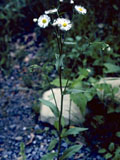
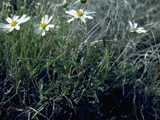
Sounds like you were very fortunate in that the previous owner of your property was a gardener. As there are literally dozens of flowers with "daisy" in their common names, we first tried to establish what your missing plant was. Since at the Lady Bird Johnson Wildflower Center we specialize in the preservation and propagation of plants native to North America, we started with our Native Plant Database. We found Erigeron annuus (eastern daisy fleabane) and Layia glandulosa (whitedaisy tidytips), pictures below, that seemed to come close to your description. Both are found in Washington State but, alas, both are annuals. Both do reseed, and the lack of return this year could be due to hungry birds getting to the seed before it could germinate, too much water, too little water, or a too-eager gardener pulling up in early Spring what was thought to be a weed.
We then went looking for a likely possibility in non-natives. Chrysanthemum maximum, commonly called the Shasta daisy, seems the best candidate. They are perennials and have widely naturalized in North America but are natives of Europe. Why did they disappear? Kind of a mystery, but again, it could have been water standing in the bed, which would have caused the roots to rot. Some perennials are referred to as short-lived perennials, which means they only survive a few years before they disappear, and since they were already there when you moved in, there is no way of knowing how long they had already lived. And can they be resurrected? Sorry, it would have prevented a lot of grief and mourning in our own gardens if such a thing were possible. If you decide to replant, the best time to plant as well as to divide depends on the climate in which you live. In Texas, we prefer to do both in the Fall, when the weather cools off (a little) and we can usually expect more rain. If you are in the more temperate climate of Washington, near the coast, you can probably do the same. However, if your average low temperature is 20 deg or below, you would probably be better off waiting for the soil and air to warm up in the Spring. Planting in the Fall means the roots can get established before the blazing heat of Summer. Planting in the Spring means the new plants don't have to withstand low temperatures before they get established.
More Propagation Questions
Removal of leaves before transplanting
April 05, 2008 - Before transplanting a plant, is it a good idea to remove leaves?
view the full question and answer
Propagation of Asclepias tuberosa
June 18, 2012 - Re: Asclepias tuberosa, "butterfly weed" bush -- I have a bed in a mix of Shoal Creek well-drained caliche, soil, and some enrichment of mulch that gets almost full sun and low water. After 4 yrs a...
view the full question and answer
Propagation of cedar cuttings in Manitoba
March 14, 2009 - How to propagate cedar cuttings to form a hedge?
view the full question and answer
How to Propagate Mountain Laurel by Seed
January 02, 2003 - How do I propagate mountain laurel by seed?
view the full question and answer
Transplanting young Nolina texana plants
August 05, 2011 - Mr. SP, I am looking for information relating to transplanting some young Nolina texana. Esp. the best time of the year and whether to replant directly in the ground or ..
Thanks,
view the full question and answer
| Support the Wildflower Center by Donating Online or Becoming a Member today. |