Native Plants

Plant Database
Search for native plants by scientific name, common name or family. If you are not sure what you are looking for, try the Combination Search or our Recommended Species lists.
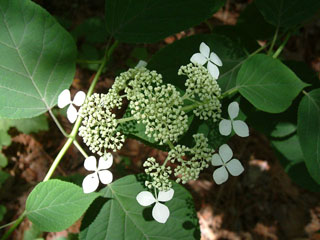
Bloodworth, Stefan
Hydrangea arborescens
Hydrangea arborescens L.
Smooth Hydrangea, Wild Hydrangea, Sevenbark
Hydrangeaceae (Hydrangea Family)
Synonym(s): Hydrangea arborescens var. oblonga, Hydrangea arborescens var. sterilis
USDA Symbol: HYAR
USDA Native Status: L48 (N), CAN (I)
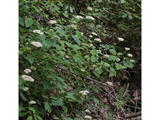
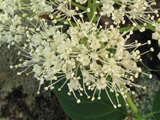
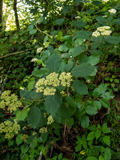
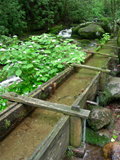
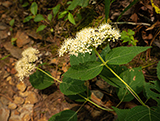
Small, mound-shaped, densely multi-stemmed shrub, usually 3-6 ft. tall, wild hydrangea is often broader than high at maturity. The flat-topped clusters of delicate, greenish-white flowers are the deciduous shrub’s main landscape feature. Some flowers are so heavy as to weigh the stem to the ground. Fall foliage is insignificant.
Plant Characteristics
Duration: PerennialHabit: Shrub
Leaf Retention: Deciduous
Fruit Type: Capsule
Size Notes: Up to about 10 feet tall, often shorter.
Autumn Foliage: yes
Fruit: Brown
Bloom Information
Bloom Color: White , GreenBloom Time: May , Jun , Jul , Aug
Distribution
USA: AL , AR , CT , DC , DE , FL , GA , IL , IN , KS , KY , LA , MA , MD , MO , MS , NC , NJ , NY , OH , OK , PA , SC , TN , VA , WVNative Distribution: S. NY to s.e. MO, s. to FL, LA & OK
Native Habitat: Rich woods; rocky slopes; stream banks
Growing Conditions
Light Requirement: Part ShadeSoil Moisture: Moist
Soil Description: Rich, well-drained, moist soils.
Conditions Comments: Wild hydrangea suckers freely, creeping over large areas. It is susceptible to sunscald, chlorosis in alkaline soils, and winter dieback. Many weak, brittle canes are easily broken in wind and ice. Fast-growing and short-lived, this hydrangea is often treated as an herbaceous perennial and cut to the ground every winter. If the canes are allowed to grow, the naturally peeling bark is attractive. The plant will need supplemental watering in hot, dry summers.
Butterflies and Moths of North America (BAMONA)
|
Hydrangea sphinx (Darapsa versicolor) 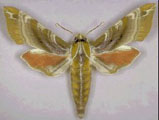 Larval Host |
Propagation
Description: Propagate by seed or cuttings. Softwood cuttings, which should be taken early, root extremely easily.Seed Treatment: Seeds require no sepcial treatment but need careful handling because they are so small.
Commercially Avail: yes
Find Seed or Plants
View propagation protocol from Native Plants Network.
National Wetland Indicator Status
| Region: | AGCP | AK | AW | CB | EMP | GP | HI | MW | NCNE | WMVE |
| Status: | UPL | FACU | FACU | FACU | FACU |
From the National Organizations Directory
According to the species list provided by Affiliate Organizations, this plant is on display at the following locations:Delaware Nature Society - Hockessin, DE
Longwood Gardens - Kennett Square, PA
First United Methodist Church of Jefferson City - Jefferson City, TN
Mt. Cuba Center - Hockessin, DE
Bibliography
Bibref 1186 - Field Guide to Moths of Eastern North America (2005) Covell, C.V., Jr.Bibref 1185 - Field Guide to Western Butterflies (Peterson Field Guides) (1999) Opler, P.A. and A.B. Wright
Bibref 1620 - Gardening with Native Plants of the South (Reprint Edition) (2009) Wasowski, S. with A. Wasowski
Search More Titles in Bibliography
Web Reference
Webref 38 - Flora of North America (2019) Missouri Botanical Garden, St. Louis, MO & Harvard University Herbaria, Cambridge, MA.Webref 23 - Southwest Environmental Information Network (2009) SEINet - Arizona Chapter
Additional resources
USDA: Find Hydrangea arborescens in USDA PlantsFNA: Find Hydrangea arborescens in the Flora of North America (if available)
Google: Search Google for Hydrangea arborescens
Metadata
Record Modified: 2022-10-18Research By: TWC Staff