Native Plants

Plant Database
Search for native plants by scientific name, common name or family. If you are not sure what you are looking for, try the Combination Search or our Recommended Species lists.
Alnus incana ssp. rugosa
Alnus incana (L.) Moench ssp. rugosa (Du Roi) R.T. Clausen
Speckled Alder
Betulaceae (Birch Family)
Synonym(s): Alnus incana var. americana, Alnus rugosa, Alnus rugosa var. americana
USDA Symbol: ALINR
USDA Native Status: L48 (N), CAN (N), SPM (N)
A low and clump-forming shrub; sometimes a small tree. The Latin subspecies name, meaning "rugose" or "wrinkled," refers to the network of sunken veins prominent on the lower leaf surfaces.
From the Image Gallery
No images of this plant
Plant Characteristics
Duration: PerennialHabit: Tree
Leaf Retention: Deciduous
Leaf Arrangement: Alternate
Leaf Complexity: Simple
Leaf Venation: Pinnate
Breeding System: Flowers Unisexual , Monoecious
Fruit Type: Samara
Size Notes: Up to about 25 feet tall.
Leaf: Dark Green.
Fruit: Green.
Bloom Information
Bloom Color: Yellow , Green , BrownBloom Time: Apr , May
Distribution
USA: CT , IA , IL , IN , MA , MD , ME , MI , MN , ND , NH , NJ , NY , OH , PA , RI , VA , VT , WI , WVCanada: NB , NL , NS , ON , PE , QC
Native Distribution: Widespread across Canada from Yukon and British Columbia to Newfoundland, south to West Virginia, west to NE. Iowa, and north to NE. North Dakota; almost to northern limit of trees; in south to 2600' (792 m).
Native Habitat: Wet soil along streams and lakes, and in swamps.
Growing Conditions
Water Use: MediumLight Requirement: Sun , Part Shade , Shade
Soil Moisture: Moist
CaCO3 Tolerance: Medium
Conditions Comments: Nitrogen fixing using root nodules
Benefit
Use Ornamental: Planted as an ornamental at water edges.Use Wildlife: Alder thickets provide cover for wildlife, browse for deer and moose.
Use Medicinal: Bark was boiled to make medicinal teas for treating rheumatism. It was also applied to wounds as a poultice to reducing bleeding and swelling.
Use Other: Inuit people and settlers extracted a dark dye from the bark for tanning and staining hides.
Interesting Foliage: yes
Attracts: Butterflies
Larval Host: Green Comma butterfly
Butterflies and Moths of North America (BAMONA)
|
Green Comma (Polygonia faunus) 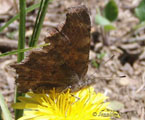 Larval Host |
Bibliography
Bibref 1186 - Field Guide to Moths of Eastern North America (2005) Covell, C.V., Jr.Bibref 1185 - Field Guide to Western Butterflies (Peterson Field Guides) (1999) Opler, P.A. and A.B. Wright
Bibref 841 - Native Alternatives to Invasive Plants (2006) Burrell, C. C.
Search More Titles in Bibliography
Web Reference
Webref 38 - Flora of North America (2019) Missouri Botanical Garden, St. Louis, MO & Harvard University Herbaria, Cambridge, MA.Additional resources
USDA: Find Alnus incana ssp. rugosa in USDA PlantsFNA: Find Alnus incana ssp. rugosa in the Flora of North America (if available)
Google: Search Google for Alnus incana ssp. rugosa
Metadata
Record Modified: 2022-09-30Research By: TWC Staff