Native Plants

Q. Who is Mr. Smarty Plants?
A: There are those who suspect Wildflower Center volunteers are the culpable and capable culprits. Yet, others think staff members play some, albeit small, role. You can torture us with your plant questions, but we will never reveal the Green Guru's secret identity.

Did you know you can access the Native Plant Information Network with your web-enabled smartphone?

Ask Mr. Smarty Plants
Ask Mr. Smarty Plants is a free service provided by the staff and volunteers at the Lady Bird Johnson Wildflower Center.

rate this answer

Wednesday - October 09, 2013
From: Rosharon, TX
Region: Southwest
Topic: Wildflowers
Title: Hymenocallis caroliniana and Hymenocallis liriosme Differences
Answered by: Anne Van Nest
QUESTION:
A couple of years ago a neighbor gave me three huge bulbs of a type unknown to her. They fit the description of a spider lily. In attempts to identify it I found Hymenocallis liriosme and Hymenocallis caroliniana. Their descriptions are very similar. Can you point out the difference(s) between Hymenocallis liriosme and Hymenocallis caroliniana?ANSWER:
Congratulations on being the recipient of some interesting pass-along bulbs.
Here is a summary of the spiderlily bulb characteristics.
Hymenocallis caroliniana (Carolina spiderlily)
1.5-2.5 ft tall, fragrant, spider-like blooms up to 7 inches across in clusters up to 6 on a leafless stalk. Blooming March – September. Dormant in the summer.
Leaves pale green, shiny and up to 2 feet long.
Hymenocallis liriosme (spring spiderlily)
1-3 ft tall, fragrant, spider-like blooms up to 7 inches across in clusters of 2-3 blooms on a leafless stalk. Petals form a tube 2-4 inches long. Blooming February to May.
Leaves shiny and up to 30 inches long, 1 inch wide.
Now the differences: Look at blooming time and the number of flowers in each cluster (on a mature plant) to tell the two species apart.
A posting by J. E. Shields on the Pacificbulbsociety.org forum describes how to tell the two species apart quite well. "Hymenocallis occidentalis (now the accepted name for H. caroliniana) normally blooms in late summer. This may be after the leaves have already died back. It's sister species, Hymenocallis liriosme, blooms in spring with the first flush of leaves."
The Pacific Bulb Society also have a webpage with many of the Hymenocallis species listed and pictures of the two species. And the Missouri Botanical Garden Plant Finder website has a good description of the two bulbs Hymenocallis lirioseme and H. caroliniana.
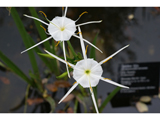
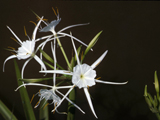
From the Image Gallery
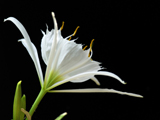
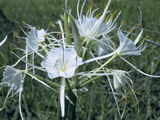
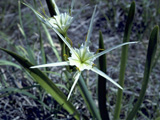
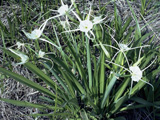
More Wildflowers Questions
When and where does sand verbena, Abronia ameliae, bloom in Texas
April 04, 2009 - Hello, I am a botany student in California. I need to collect a branch or two of Abronia ameliae, a Sand Verbena that grows only in Texas. I must collect this plant when it is both in flower and fruit...
view the full question and answer
The most common wildflower in North America
January 16, 2008 - Hi Mr. Smartyplants,
What the most common wildflower in North America? My friend thinks it's the oxeye daisy. Is this correct? I work for a puzzle publishing company, and am doing research for a them...
view the full question and answer
Native plants of Taos and Los Alamos NM from Houston
April 07, 2012 - Hi, Mr. Smarty Plants, can you recommend a guidebook for the native plants of the Taos/Los Alamos region? (I'm most interested in forbs.) I'll be headed there in May--is there anything I should es...
view the full question and answer
More on bluebonnets
August 26, 2004 - This year's strange summer weather has lead to a very unusual event. I have a second bloom on my Bluebonnet garden. I first noticed the blooms last week, and contacted my local nursery to confirm the...
view the full question and answer
Plants for slopes in South Texas
October 05, 2009 - Can you provide a list of plants for use on slopes in S. Texas?
view the full question and answer
| Support the Wildflower Center by Donating Online or Becoming a Member today. |