Native Plants

Q. Who is Mr. Smarty Plants?
A: There are those who suspect Wildflower Center volunteers are the culpable and capable culprits. Yet, others think staff members play some, albeit small, role. You can torture us with your plant questions, but we will never reveal the Green Guru's secret identity.

Did you know you can access the Native Plant Information Network with your web-enabled smartphone?

Ask Mr. Smarty Plants
Ask Mr. Smarty Plants is a free service provided by the staff and volunteers at the Lady Bird Johnson Wildflower Center.

rate this answer

Monday - September 23, 2013
From: Spicewood, TX
Region: Southwest
Topic: Plant Identification
Title: New thorn/bush tree in Central Texas
Answered by: Nan Hampton
QUESTION:
In Central Texas, over the last 5 years we have seen a new variety of thorn bush appear. It has very long thorns much like mesquite tree but thorns are every inch or so along the branches. The tree is like a bush but will grow 20 or more feet high. The color of the tree is almost a blue green.ANSWER:
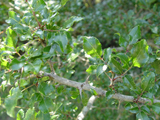
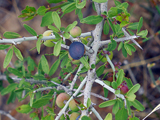
My best guess from your description is Zanthoxylum hirsutum (Texas hercules' club). Here are photos and more information from Archive of Central Texas Plants from the School of Biological Sciences, University of Texas. Crushed leaves give off an odor that smells like oranges or other citrus fruits. If you chew one of the leaves (the young leaves, in particular), you will notice that your tongue begins to feel numb. Native Americans used the leaves to treat toothache; thus, its common names of Tickle-tongue and Toothache tree.
Other possibilities are:
Ziziphus obtusifolia (Lotebush) Here are photos and more information from Texas A&M Horticulture and Virginia Tech University.
Castela erecta (Goatbush) Here is a description from the US Forest Service and here are photos and more information from Texas A&M Horticulture and photos from Flora of Dolan Falls Preserve in Val Verde County, Texas.
Sideroxylon lanuginosum (Gum bumelia) Here are photos and more information from the Archive of Central Texas Plants from the School of Biological Sciences, University of Texas.
From the Image Gallery
More Plant Identification Questions
Identity of 50 ft. tree
May 20, 2008 - I live in Austin and I have a tall (50-ft) tree outside my window. It's deciduous and has shiny, deep green, spear-tip, serrated leaves that vary in size from about hand- to dinner-plate size. I've ...
view the full question and answer
Identifcation of four o clock-like flower
August 25, 2007 - I've run across a flower I cannot find any information on. I saw it in West Virginia. I know that a pix might be needed to identify, but, since this is somewhat unusual, I thought possibly you might...
view the full question and answer
Smarty Plants on forbs
October 16, 2005 - What kind of plant is a forb? I see the term used frequently in reference to grasses (I think), but I can't figure out exactly what a forb is.
view the full question and answer
Observation of Kalmia angustifolia in George Washington National Forest in Virginia
March 19, 2015 - On Feb. 7th, 2015 I observed a variety Kalmia on the crest of a ridge, recently burned off, in the George Washington National Forest. I think it may be sheep laurel (Kalmia angustiflora), which coloni...
view the full question and answer
Mystery berries on vine in Montgomery County, TX
August 09, 2013 - While out in the woods today on Caney Creek near Grangerland, Texas, I found what I thought to be some grapes on a vine hanging down from a tree. I brought the vine down, but when I got it home to pr...
view the full question and answer
| Support the Wildflower Center by Donating Online or Becoming a Member today. |