Native Plants

Q. Who is Mr. Smarty Plants?
A: There are those who suspect Wildflower Center volunteers are the culpable and capable culprits. Yet, others think staff members play some, albeit small, role. You can torture us with your plant questions, but we will never reveal the Green Guru's secret identity.

Did you know you can access the Native Plant Information Network with your web-enabled smartphone?

Ask Mr. Smarty Plants
Ask Mr. Smarty Plants is a free service provided by the staff and volunteers at the Lady Bird Johnson Wildflower Center.

rate this answer

Wednesday - June 22, 2011
From: Laceys Spring, AL
Region: Southwest
Topic: Plant Identification, Trees, Wildflowers
Title: Wildflowers that grow in woodlands
Answered by: Nan Hampton
QUESTION:
Please tell me the names of wildflowers that grow under your oak trees in Texas. I am only familiar with those open meadow plants, not those that live under the deciduous trees. Thank you for your time!ANSWER:
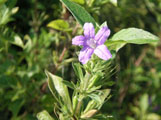
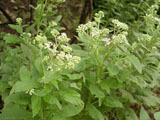
Well, Texas is a really big state with lots of different ecoregions so I am going to focus on the ones that grow in Central Texas where I live and where the Wildflower Center is located. East Texas, West Texas and South Texas plants can be very different from those that grow here in Central Texas. Also, since oaks are allelopathic to some plants growing beneath them (i.e., they produce chemicals that inhibit the growth of some plants), I will give you the names of wildflowers that you can find growing in shady woodlands instead of just plants that grow under the oaks. Below are a few herbaceous wildflowers. You can see more examples as well as flowering shrubs that grow in dry shade in two of our Recommended Species files—Dry Shade Plants for Central Texas and Woodland Plants for Central Texas. If you would like to see some of the wildflowers that grow in other ecoregions of Texas, check them out on our Recommended Species page under JUST FOR TEXANS. You can limit the number of species on those lists by using the NARROW YOUR SEARCH option and choosing "Part shade" and/or "Shade" under LIGHT REQUIREMENT.
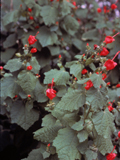
Malvaviscus arboreus var. drummondii (Turk's cap or turkscap)
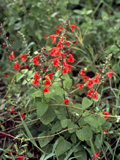
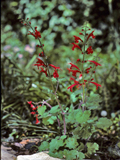
Salvia coccinea (Scarlet sage)
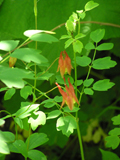
Aquilegia canadensis (Eastern red columbine)
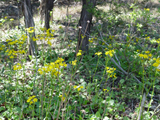
Packera obovata (Golden groundsel)
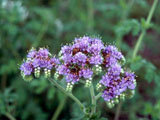
Phacelia congesta (Blue curls)
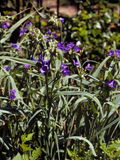
Tradescantia occidentalis (Prairie spiderwort)
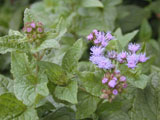
Conoclinium coelestinum (Blue mistflower)
Salvia roemeriana (Cedar sage)
From the Image Gallery
More Trees Questions
Transplanting crabapples in NJ
October 25, 2010 - I purchased a mature Red Baron crabapple in march of this year from a reputable nursery here in southern NJ. The tree was in the ground when I first viewed it, and since it was march and hadn't bloom...
view the full question and answer
Difficulty of watering at drip line of trees from The Woodlands TX
August 18, 2011 - I'm watering my couple dozen native mature trees to make sure they survive this drought and its aftermath..and I'm reading about how to water at the drip line. But..all of my trees' drip lines ext...
view the full question and answer
Yellow, pale green leaves on Cedar Elms in Texas
August 30, 2008 - I have had several cedar elms of various sizes planted in our yard over the last 10 years. Only the largest has dark green, healthy looking leaves. All the others have yellowish, pale green leaves. Th...
view the full question and answer
Identification of tree blooming in Austin with yellow balls
March 21, 2012 - What is the tree/large shrub that is blooming now (mid-March) in the Austin area? It has small mesquite-type leaves, round yellow balls with fuzz on them and is fragrant.
Thanks!
view the full question and answer
Butterfly Plants for Chicago
September 13, 2014 - I live near Chicago, IL and am interested in planting a butterfly garden. Not sure when to start, but I want all native plants that would attract butterflies. Can you please let me know which plants ...
view the full question and answer
| Support the Wildflower Center by Donating Online or Becoming a Member today. |