Native Plants

Q. Who is Mr. Smarty Plants?
A: There are those who suspect Wildflower Center volunteers are the culpable and capable culprits. Yet, others think staff members play some, albeit small, role. You can torture us with your plant questions, but we will never reveal the Green Guru's secret identity.

Did you know you can access the Native Plant Information Network with your web-enabled smartphone?

Ask Mr. Smarty Plants
Ask Mr. Smarty Plants is a free service provided by the staff and volunteers at the Lady Bird Johnson Wildflower Center.

rate this answer

Tuesday - September 21, 2010
From: Austin, TX
Region: Southwest
Topic: Propagation
Title: Planting star hibiscus seeds from Austin
Answered by: Barbara Medford
QUESTION:
TX star hibiscus seeds. How & when to plant in ground & in pots. Thank you, CarolANSWER:
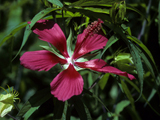
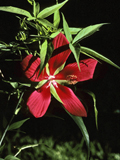
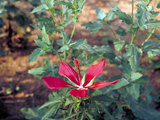
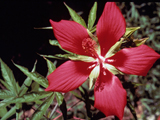
Hibiscus coccineus (Texas Star Hibiscus) is, strangely enough, not native to Texas, but instead its range is from Florida to Mississippi. However, the common name makes it very popular in Texas and it grows well here, so no worries.
From Floridata, this article on Hibiscus coccineus includes these instructions on using seed:
"Propagation: By seeds or root division. Seeds should be punctured with a needle or scraped with a file before planting."
Our own Native Plant Database doesn't say a whole lot more:
"Description: Easily grown from seed."
So, we went to Jill Nokes' book How to Grow Native Plants of Texas and the Southwest. See Bibliography below. She addressed Hibiscus in general, and here is an extract from her advice:
"Some species of Hibiscus will germinate from untreated seeds gathered in the previous season, while others require slight scarification. All hibiscus should be planted outdoors after all danger of frost is past and the soil has warmed, or earlier in a greenhouse. The soil in the seedbed must be warm before germination will proceed. Sow seeds thinly about 1/4" deep in well-drained soil. Press the seeds into the soil and gently water."
"Seedlings grow relatively fast if given filtered but strong sunlight and lightly fertilized. Spring-sown seedlings will be large enough for a one-gallon container by the fall and will bloom the following spring. Transplant seeds from the flat after they have grown their third set of leaves."
We suggest that on the subject of growing the Texas Star Hibiscus you read our How-To Article Container Gardening with Native Plants.
From our Native Plant Image Gallery:
More Propagation Questions
Mexican Sycamore trees grown from seed
November 15, 2011 - If someone is selling an alleged Mexican Sycamore grown from a seed harvested from a mature tree growing in Austin, is it likely to be a TRUE Mexican Sycamore -- or has it most likely been pollinated ...
view the full question and answer
Survival of bluebonnets in extreme heat from Tioga TX
September 03, 2011 - Is there anything I can do for my bluebonnet patch in this extreme drought for the rest of the summer and fall? Should I have watered this summer? I had a good show and think seeding was fairly normal...
view the full question and answer
Time to plant echinacea seeds in Austin
March 28, 2010 - When should I plant echinacea seeds in Austin?
view the full question and answer
Virginia wild strawberry plants for New Hampshire or Massachusetts
February 25, 2009 - Where can I find Virginia wild strawberry plants or seeds for my garden and will they grow up north in New Hampshire or Massachusetts?
view the full question and answer
Grow bluebonnets in Virginia
September 04, 2007 - I want to ATTEMPT to grow some Texas Bluebonnets in VA because I am homesick and both our kids are back in Austin. That said, the site says " it may be necessary to inoculate the soil with a rhizobiu...
view the full question and answer
| Support the Wildflower Center by Donating Online or Becoming a Member today. |