Native Plants

Q. Who is Mr. Smarty Plants?
A: There are those who suspect Wildflower Center volunteers are the culpable and capable culprits. Yet, others think staff members play some, albeit small, role. You can torture us with your plant questions, but we will never reveal the Green Guru's secret identity.

Did you know you can access the Native Plant Information Network with your web-enabled smartphone?

Ask Mr. Smarty Plants
Ask Mr. Smarty Plants is a free service provided by the staff and volunteers at the Lady Bird Johnson Wildflower Center.

rate this answer

Saturday - April 24, 2010
From: San Ramon, CA
Region: California
Topic: Trees
Title: Trees for pool area in San Ramon, California
Answered by: Nan Hampton
QUESTION:
We live in San Ramon. We are remodeling our pool and are looking for a tree that will be 15 feet from a pool. We just removed a pine tree. We have now lost our privacy and see the neighbor's back fence on their hillside. What can we plant that will be about 15 feet high, 10 feet wide at most, direct sunlight, that will not be messy near our pool, yet pretty both during every season.ANSWER:
Below are several evergreen trees in approximately the size range you are seeking that are native to Northern California:
Prunus ilicifolia ssp. lyonii (hollyleaf cherry)
Umbellularia californica (California laurel)
Lithocarpus densiflorus (tanoak) and here are photos and more information
Heteromeles arbutifolia (toyon)
Cercocarpus ledifolius (curl-leaf mountain mahogany) and here are photos and more information
Ceanothus thyrsiflorus (blueblossom)
Morella californica (California wax myrtle) and here are photos and more information
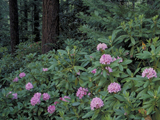
Rhododendron macrophyllum (Pacific rhododendron)
You can see more suggested species by going to our Recommended Species page and choosing Northern California from the map or the pull-down menu. You can use the NARROW YOUR SEARCH option in the side menu to select for characteristics that you want.
Here are photos from our Image Gallery of some of the above:
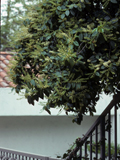
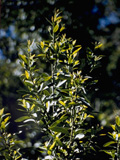
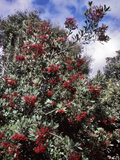
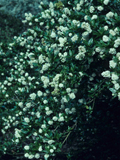
More Trees Questions
Galls on live oak trees in Austin, TX
April 14, 2005 - I am a resident of a condominium complex in Austin that has numerous Live Oak trees. Can you explain what the gall type things are hanging from the trees at this time of year and all over the grounds?...
view the full question and answer
A year and a half old live oak tree is doing poorly in Nevada, TX.
May 08, 2012 - We planted a live oak tree about a year and a half ago. the tree is still rather small. The leaves are of a vibrant green, however the leave have only grown through the center of the tree and not out...
view the full question and answer
Coconut in a husk from Round Rock TX
January 26, 2011 - Looking for a coconut in its complete husk ?
view the full question and answer
Are junipers tainting the soil in Loveland CO?
June 10, 2011 - Have several varieties of junipers around my yard. Each year I try to place a small garden in a corner of my yard, the plants don't do well at all. Growing up nearby, I gardened with my parents so ...
view the full question and answer
Treating scarred Gum Bumelia from Lampasas TX
June 05, 2013 - We have a very old Gum Bumelia with a scarred open tree trunk. In the past concrete was used to fill the scarred trunk. What is the acceptable method of helping the tree. More concrete or using blac...
view the full question and answer
| Support the Wildflower Center by Donating Online or Becoming a Member today. |