Native Plants

Q. Who is Mr. Smarty Plants?
A: There are those who suspect Wildflower Center volunteers are the culpable and capable culprits. Yet, others think staff members play some, albeit small, role. You can torture us with your plant questions, but we will never reveal the Green Guru's secret identity.

Did you know you can access the Native Plant Information Network with your web-enabled smartphone?

Ask Mr. Smarty Plants
Ask Mr. Smarty Plants is a free service provided by the staff and volunteers at the Lady Bird Johnson Wildflower Center.

rate this answer

Saturday - September 12, 2009
From: Lago Vista, TX
Region: Southwest
Topic: Trees
Title: Stressed Texas persimmon, Diospyros texana
Answered by: Nan Hampton
QUESTION:
I planted a 5' Texas Persimmon last May..it is watered by drip irrigation and has done well, putting on lots of new leaves and looking healthy as can be. That is, until several days ago when it began to look stressed. Now the underside of the each leaf is covered with small black dots, smaller than the head of a pin. These black dots are also on the limbs. On close inspection, there are many nearly transparent insects on the underside of leaves also. The insects are anywhere from a millimeter to nearly 2 millimeters long and they're difficult to identify since they are nearly clear. Poor persimmon tree! What are these clear bugs, what are the black dots, and what can I do to help get the tree back to good health?ANSWER:
The transparent insects sound like aphids. Even though Diospyros texana (Texas persimmon) is touted as been relatively disease and pest free, aphids can infest almost any plant. The black spots may be the beginning of sooty mold fungus that grows on the sticky, sweet "honeydew" produced and deposited on the leaves by the aphids. The Texas Agricultural Extension Service article, "Aphids in Texas Landscapes", has a number of suggestions for controlling these pests including biological control methods (lady beetles and greenlacewings), mechanical means (high pressure water spraying) and pesticides (insecticidal soaps and oils). You can see photos and information about various aphids in A Field Guide to Common Insects on the Travis County Extension Service page.Eriophyid mites are another possibility. The are extremely tiny and cause galls to form on leaves. There is one of the mites, Aceria theospyri, that is specific to Diospyros sp., but others could potentially cause problems. Treatments with insecticidal soaps and oils are recommended for these. (Notice the galls on the leaves in the photographs below.)
An article by Quintin Lee Holdeman (Persimmons for Louisiana's Children—Young and Old) has a section describing other pests and diseases of persimmons (Diospyros sp.). One of the pests, Persimmon Psylla nymphs (Trioza diospyri), feeds exclusively on persimmon species but its description doesn't really match yours.
Good luck! I hope your persimmon survives and thrives!
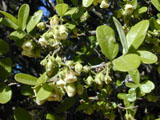
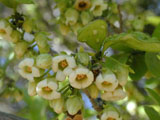
More Trees Questions
Mountain Laurel not growing in Hallettesville, TX.
September 16, 2012 - Mountain laurel has been planted over 2 years. Well drained,sandy soil, full sun. They have not grown or set blooms despite occasional all purpose fertilizers. What is wrong?
view the full question and answer
Pecan tree for Johnson City TN
September 10, 2009 - I live in E. Tennessee and was wondering if there are any pecan trees that can be grown here? If so, which type? I am a native Texan and love pecans. I would appreciate any information you can give ...
view the full question and answer
Will magnolia roots damage foundation?
May 16, 2010 - We have a Magnolia tree planted in a 5 foot square with foundation on three sides and a side walk on the front. These are all over our block placed by the builder. Will this tree work in this area or ...
view the full question and answer
Problems with transplanted Texas Madrones from Junction TX
May 13, 2014 - We planted 3 little Texas madrones last year 9 - 12 inches high. 2 of them seem to have some kind of black blight along the edges of the leaves that I don't think was the result of our late freezes. ...
view the full question and answer
Clicking heard under an Oak in near Bandera, TX
May 06, 2014 - Hi, I live on a ranch in TX outside of Bandera. We're covered with live oaks, spanish oak and cedar. Last week,as I stood under an oak, I heard a constant fairly loud clicking sound under and around ...
view the full question and answer
| Support the Wildflower Center by Donating Online or Becoming a Member today. |