Native Plants

Q. Who is Mr. Smarty Plants?
A: There are those who suspect Wildflower Center volunteers are the culpable and capable culprits. Yet, others think staff members play some, albeit small, role. You can torture us with your plant questions, but we will never reveal the Green Guru's secret identity.

Did you know you can access the Native Plant Information Network with your web-enabled smartphone?

Ask Mr. Smarty Plants
Ask Mr. Smarty Plants is a free service provided by the staff and volunteers at the Lady Bird Johnson Wildflower Center.

rate this answer

Wednesday - April 29, 2009
From: Cincinnati, OH
Region: Midwest
Topic: Erosion Control
Title: Plants for controlling erosion on a cleared slope in Ohio
Answered by: Nan Hampton
QUESTION:
I live in Cincinnati, OH. BP owns a pipeline which runs thru part of my property. They clear out all the large trees every few years, so that it is visible from the air. Our area is surrounded by Mt. Airy forest and is heavily wooded, other than the cleared area. Our property is sloped, rather steeply beginning about 10' behind our above ground pool. Over the last 9 years, the top of our yard has begun to erode, exposing large roots from the surrounding trees. BP will do nothing to correct this, and they said we cannot plant any large trees to help keep the yard from eroding (I believe this is caused from the ground clearing). They said we can plant anything that is not more than 5' high and will not obscure an aerial view of the pipeline. My question is this: are there any plants, shrubs, evergreens, ground cover, etc. that would be helpful in anchoring the ground? We do not have the financial ability to hire an engineer to install a retaining wall. We did have 9 cubic yards of dirt put down last summer, and we had nice new grass coming up in the fall. but now this spring, it is only about half grass and half mud. we put down more seed and are trying some expanding pellets to help keep the seeds from sitting on top of the mud. But our concern mainly is the erosion control at the top of the hill. Any recommendations, links, or advice you have would be greatly appreciated. Thank you for your time.ANSWER:
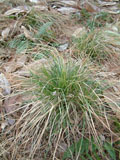
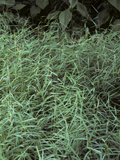
This sounds like a good place for an erosion-control blanket to stabilize the erosion area so that the grass seeds can get a better chance to germinate and become established. The erosion-control fabric works by slowing the runoff water and allowing sediment to fall out rather than be washed away. Seeds are sown under the erosion-control material and grow up through the matting when they germinate. Underneath the matting the roots of the plants growing through the erosion-control material anchor the soil to stop the erosion. If you use erosion-control blankets made of biodegrable material, they will eventually disappear leaving the plants to control the problem. Native grasses are an excellent choice for controlling erosion because they develop extensive fibrous root systems that hold the soil in place. Seeds can be sown under an erosion control blanket or grass plugs can be planted through the blanket. After the grasses have begun to establish themselves and stabilize the area you can add other plants.I don't know which grasses you have tried, but here are some, along with a couple of sedges, that occur in or adjacent to Hamilton County, Ohio that I would recommend:
Elymus canadensis (Canada wildrye)
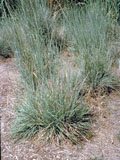
Schizachyrium scoparium (little bluestem)
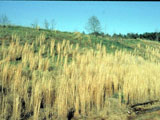
Andropogon virginicus (broomsedge bluestem)
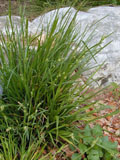
Carex blanda (eastern woodland sedge)
Carex pensylvanica (Pennsylvania sedge)
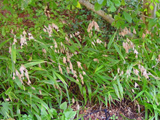
Chasmanthium latifolium (Inland sea oats)
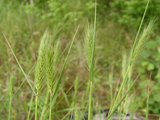
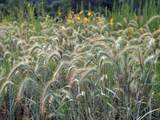
Elymus villosus (hairy wildrye) and here is more information from Illinois Wildflowers.
Muhlenbergia schreberi (nimblewill)
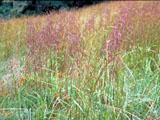
Tridens flavus (purpletop tridens)
Here are some low-growing shrubs and perennial herbaceous plants that could be added with the grasses:
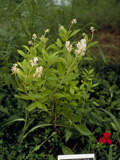
Ceanothus americanus (New Jersey tea)
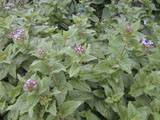
Conoclinium coelestinum (blue mistflower)
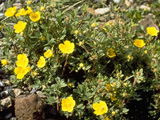
Dasiphora fruticosa ssp. floribunda (shrubby cinquefoil)
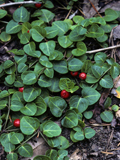
Mitchella repens (partridgeberry)
Parthenocissus quinquefolia (Virginia creeper)
You can check for other possibilities by choosing Ohio from the map or the pulldown menu on our Recommended Species page.
More Erosion Control Questions
Need recommendations for native plants on a dry sunny hillside in Baltimore Maryland.
July 28, 2009 - Need native recommendations for sunny, dry hillside for ground cover or shrub in Maryland. Mowing the grass is a pain and an energy waster (and I don't want to be tempted to extend some adjacent exi...
view the full question and answer
Plants for erosion control in West Mifflin PA
November 23, 2009 - I have recently had a retaining wall rebuilt in my back yard and an above the ground pool installed. My lawn is uneven with no grass and the hillside is very dry dirt with rocks. What type of plant ...
view the full question and answer
Erosion control for slope to detention pond
August 09, 2008 - We have been required by code to build a detention pond for new church buildings in the Webster, TX (Clear Lake) area. There is a serious erosion of soil from water runoff from the building roof need...
view the full question and answer
Plants for erosion control in arid region
September 29, 2008 - In semi arid south west (Phoenix), the drainage is managed by creating incised channels. Typically, the dirt channel can erode with even very low velocities of moving water. To reduce erosion therefor...
view the full question and answer
Plants for erosion control in East Texas
January 03, 2009 - We have recently moved to Conroe and are having a problem with erosion behind a retaining wall (installed by previous owner. The retaining wall is made of concrete and is about 8 foot tall by 110 foo...
view the full question and answer
| Support the Wildflower Center by Donating Online or Becoming a Member today. |