Native Plants

Q. Who is Mr. Smarty Plants?
A: There are those who suspect Wildflower Center volunteers are the culpable and capable culprits. Yet, others think staff members play some, albeit small, role. You can torture us with your plant questions, but we will never reveal the Green Guru's secret identity.

Did you know you can access the Native Plant Information Network with your web-enabled smartphone?

Ask Mr. Smarty Plants
Ask Mr. Smarty Plants is a free service provided by the staff and volunteers at the Lady Bird Johnson Wildflower Center.

rate this answer

Monday - September 29, 2008
From: Phoenix, AZ
Region: Southwest
Topic: Erosion Control
Title: Plants for erosion control in arid region
Answered by: Nan Hampton
QUESTION:
In semi arid south west (Phoenix), the drainage is managed by creating incised channels. Typically, the dirt channel can erode with even very low velocities of moving water. To reduce erosion therefore vegetation needs to be established. This is difficult due to lack of adequate and consistent rain runoff. Any suggestion on what kind of vegetation ( ground cover, grass etc) could be used so that gradually it establishes (with minimum infrequent rain) a strong root structure causing a stable environment for handling rain runoff.ANSWER:
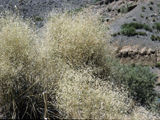
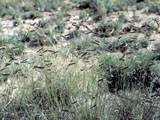
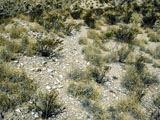
Grasses would be your best bet for erosion control since their extensive fibrous root systems do a good job of holding the soil. Here is a list of grasses that are native to Arizona and will withstand dry conditions. To get them established you may have to do some minimal watering at first, but then they should be able to handle dry conditions and hold the soil when it rains.Achnatherum hymenoides (Indian ricegrass)
Aristida purpurea (purple threeawn)
Bouteloua eriopoda (black grama)
Bouteloua gracilis (blue grama)
Bouteloua hirsuta (hairy grama)
Eragrostis intermedia (plains lovegrass)
Dasyochloa pulchella (low woollygrass)
Hilaria belangeri var. belangeri (curly-mesquite)
Muhlenbergia emersleyi (bullgrass)
Sporobolus airoides (alkali sacaton)
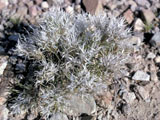
Here are some suggestions for low growing shrubs that would also do well in the area. You will note that some are specifically suggested for erosion control.
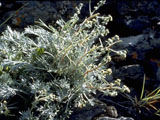
Artemisia frigida (prairie sagewort)
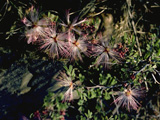
Calliandra eriophylla (fairyduster)
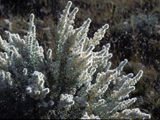
Krascheninnikovia lanata (winterfat)
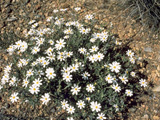
Melampodium leucanthum (plains blackfoot)
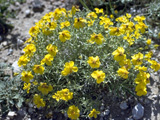
Zinnia grandiflora (Rocky Mountain zinnia)
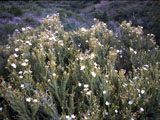
Fallugia paradoxa (Apache plume)
If you would like to see more native plants that are commercially available for Arizona, visit our Recommended Species page and select Arizona from the map there.
More Erosion Control Questions
Wildflowers for high canal bank in Florida
May 27, 2009 - My home is on a canal to a natural lake in Central Florida (Orlando area). I am wondering if there is a wildflower that I can grow on a 3' high canal bank that is mostly shady.
view the full question and answer
Erosion for check dam in San Antonio
February 13, 2009 - What are the best trees for a shallow soil wind break in San Antonio?
I am building a check dam (maybe 2' deep by 20' wide tall) over a shallow limestone gully to slow the erosion. the gully drai...
view the full question and answer
Preventing erosion on a sloping lot
April 16, 2011 - I am trying to find a native plant to use on a sloped area in my back yard to help prevent the slope from eroding away (zone 7- N. Atlanta, GA). I want something evergreen, between 6 to 30 inches tal...
view the full question and answer
Erosion control plantings in Washington state
September 06, 2007 - Hi,
I am trying to do an eagle project that involves putting vegetation onto a hill to prevent erosion. I live in Washington state where there is plenty of rain so erosion is a big problem. We are t...
view the full question and answer
Plants for erosion control in West Mifflin PA
November 23, 2009 - I have recently had a retaining wall rebuilt in my back yard and an above the ground pool installed. My lawn is uneven with no grass and the hillside is very dry dirt with rocks. What type of plant ...
view the full question and answer
| Support the Wildflower Center by Donating Online or Becoming a Member today. |