Native Plants

Plant Database
Search for native plants by scientific name, common name or family. If you are not sure what you are looking for, try the Combination Search or our Recommended Species lists.
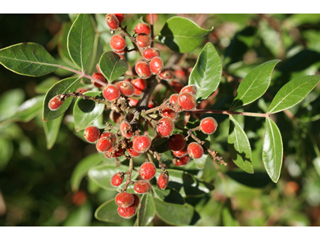
Mathews, Ray
Rhus virens
Rhus virens Lindh. ex A. Gray
Evergreen Sumac, Tobacco Sumac, Lambrisco, Lentrisco
Anacardiaceae (Sumac Family)
Synonym(s):
USDA Symbol: rhvi3
USDA Native Status: L48 (N)
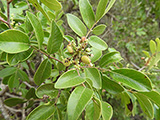
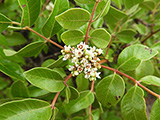
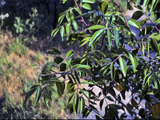
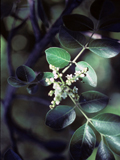
Evergreen sumac is a shrub or small tree, from 6-10 ft. in height with spreading branches. Its shiny, evergreen, pinnate foliage is tinged with pink in early spring and maroon after frost. Leaves are alternate, 2-5 1/2 inches long, with 5-9 fleshy leaflets on stiff stems. The 5-petaled, inconspicuous, greenish or white flowers grow in clusters 1-2 inches long at the end of stout branches. When the fruit matures in mid-September it is red, broader than long, and covered with fine hair.
Evergreen sumac can be used to make a nice, thick hedge or screen, but can grow tree-like with a long, straight trunk. Only female plants produce flowers and berries. It is fast growing, generally insect and disease-free, and drought-tolerant. Not a true evergreen – leaves are green through the winter, then are dropped, to be replaced within a week with a new crop.

Plant Characteristics
Duration: PerennialHabit: Shrub
Leaf Retention: Evergreen
Leaf Arrangement: Alternate
Leaf Complexity: Pinnate
Leaf Shape: Elliptic
Leaf Margin: Entire
Leaf Texture: Leathery
Breeding System: Flowers Unisexual , Dioecious
Fruit Type: Drupe
Size Notes: Up to about 10 feet tall.
Fruit: Orange-red. 1/4 inch.
Bloom Information
Bloom Color: WhiteBloom Time: Jun , Jul , Aug , Sep , Oct , Nov
Distribution
USA: AZ , NM , TXNative Distribution: central Texas west to southern Arizona, south to Oaxaca in southern Mexico
Native Habitat: Rocky hillsides, gullies, & bluffs. In Texas, found on rocky bluffs, slopes, banks, and dry hillsides in the Edwards Plateau and Trans-Pecos.
Growing Conditions
Water Use: LowLight Requirement: Sun , Part Shade
Soil Moisture: Dry
Drought Tolerance: High
Cold Tolerant: yes
Soil Description: Rocky soils. Sandy, Sandy Loam, Medium Loam Clay Loam Clay, Caliche type, Limestone-based Igneous
Benefit
Use Ornamental: Aromatic, Blooms ornamental, Fruits ornamental, Fall conspicuousUse Wildlife: Birds and other animals feed on the fuzzy red fruit. The flower is a nectar source for adult butterflies.
Use Food: When soaked in water, the berries make a tart, tasty tea that is high in vitamin C.
Conspicuous Flowers: yes
Attracts: Birds , Butterflies
Deer Resistant: Moderate
Value to Beneficial Insects
Special Value to Native BeesProvides Nesting Materials/Structure for Native Bees
This information was provided by the Pollinator Program at The Xerces Society for Invertebrate Conservation.
Propagation
Propagation Material: SeedsDescription: Treated seed and root cuttings are used for increase.
Seed Treatment: Scarify fresh, uncleaned seed for 30-45 minutes.
Commercially Avail: yes
Mr. Smarty Plants says
Hedge in central Texas
June 17, 2009
Help, my oleanders are dying. I am in need of hedge suggestions- ideal would be quick growing, maybe 8-12 feet at their tallest. I live in Central Texas.
view the full question and answer
Shrub to hide chain link fence
August 12, 2008
Mr. Smarty Plants, Please recommend a tall, thick shrub to conceal the 6 foot chain link fence around the perimeter of our property. The fence is located down a hill from our home with western exposur...
view the full question and answer
Drought-tolerant shrub for privacy screen
November 23, 2007
Is there some kind of drought resistant bush or thorny plant we can rim our property with to stop all the foot traffic through our yard? We don't care if it's pretty, just something thick and/or th...
view the full question and answer
Variety of native tall plants for a screen in shady area near Ft. Worth
June 12, 2007
Hello, we live west of Ft Worth. We are looking for tall plants to form a visual screen along a chain link fence we share with a neighbor. We have post oaks there and it is very shady and the ground ...
view the full question and answer
Fast growing native hedges for Sachse, TX
March 30, 2007
I just bought a house in Sachse, Tx and want to plant a privacy hedge. It will be about 220' long and I want it to grow to at least 10'-12' high. I also want it to be fast growing and be evergree...
view the full question and answer
From the National Organizations Directory
According to the species list provided by Affiliate Organizations, this plant is on display at the following locations:Lady Bird Johnson Wildflower Center - Austin, TX
Brackenridge Field Laboratory - Austin, TX
Patsy Glenn Refuge, c/o Wimberley Birding Society - Wimberley, TX
NPSOT - Native Plant Society of Texas - Fredericksburg, TX
Nueces River Authority - Uvalde, TX
NPSOT - Fredericksburg Chapter - Fredericksburg, TX
NPSOT - Austin Chapter - Austin, TX
Jacob's Well Natural Area - Wimberley, TX
NPSOT - Williamson County Chapter - Georgetown, TX
Wildflower Center Seed Bank
LBJWC-635 Collected 2008-01-02 in Mason County by Lady Bird Johnson Wildflower CenterBibliography
Bibref 355 - Landscaping with Native Plants of Texas and the Southwest (1991) Miller, G. O.Bibref 841 - Native Alternatives to Invasive Plants (2006) Burrell, C. C.
Bibref 318 - Native Texas Plants: Landscaping Region by Region (2002) Wasowski, S. & A. Wasowski
Bibref 248 - Texas Wildflowers: A Field Guide (1984) Loughmiller, C. & L. Loughmiller
Bibref 297 - Trees of Central Texas (1984) Vines, Robert A.
Search More Titles in Bibliography
Web Reference
Webref 23 - Southwest Environmental Information Network (2009) SEINet - Arizona ChapterWebref 1 - Texas Native Shrubs (2002) Texas A&M University Agriculture Program and Leslie Finical, Dallas Arboretum
From the Archive
Wildflower Newsletter 1985 VOL. 2, NO.3 - Greenhouse Assists Research, Wild color on the Hills, Director's Report, Clearin...Additional resources
USDA: Find Rhus virens in USDA PlantsFNA: Find Rhus virens in the Flora of North America (if available)
Google: Search Google for Rhus virens
Metadata
Record Modified: 2022-10-20Research By: TWC Staff