Native Plants

Plant Database
Search for native plants by scientific name, common name or family. If you are not sure what you are looking for, try the Combination Search or our Recommended Species lists.
Page, Lee
Morella cerifera
Morella cerifera (L.) Small
Wax Myrtle , Southern Wax Myrtle, Southern Bayberry, Eastern Bayberry, Bayberry, Candleberry, Tallow Shrub
Myricaceae (Bayberry Family)
Synonym(s): Cerothamnus ceriferus, Cerothamnus pumilus, Morella cerifera var. pumila, Myrica cerifera, Myrica cerifera var. pumila, Myrica pusilla
USDA Symbol: moce2
USDA Native Status: L48 (N), HI (I), PR (N)
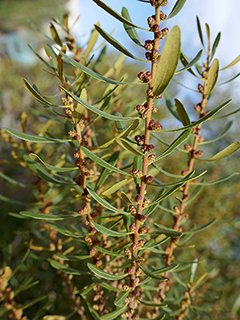
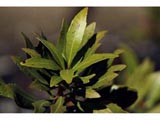
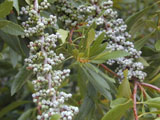
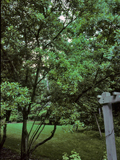
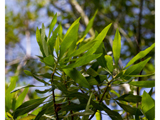
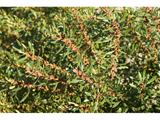
A wispy, 6-12 ft., multi-trunked, evergreen shrub, southern bayberry or wax myrtle can reach 20 ft. in height. The light olive-green foliage has a spicy fragrance. Pale blue fruits occur on female plants in the winter. Handsome gray bark is almost white on some plants.
Native from New Jersey west to eastern Oklahoma and east Texas, south through Mexico to Central America as well as through much of the Caribbean, this popular evergreen ornamental is used for screens, hedges, landscaping, wetland gardens, habitat restoration, and as a source of honey. Essentially a shrub, it serves as an excellent screen plant, with both standard and dwarf varieties available. Because there are separate male and female plants, if you want berries you must have male plants close enough to the berry-producing female plants for pollination to occur. The leaves are aromatic, with an appealing, piquant fragrance when crushed. Colonists separated the fruits' waxy covering in boiling water to make fragrant-burning candles, a custom still followed in some countries.
Plant Characteristics
Duration: PerennialHabit: Shrub
Leaf Retention: Evergreen
Leaf Arrangement: Alternate
Leaf Complexity: Simple
Leaf Shape: Oblanceolate
Leaf Venation: Pinnate
Leaf Pubescence: Glabrous
Leaf Margin: Entire
Leaf Apex: Acute
Leaf Texture: Waxy
Breeding System: Flowers Unisexual , Dioecious
Inflorescence: Spike
Fruit Type: Drupe
Size Notes: 6-40 feet tall, but normally no higher than 12 feet.
Leaf: Green
Fruit: Bluish white 2-3 mm.
Bloom Information
Bloom Color: GreenBloom Time: Feb , Mar , Apr , May
Distribution
USA: AL , AR , DE , FL , GA , HI , LA , MD , MS , NC , NJ , OK , SC , TX , VA , WVNative Distribution: New Jersey west to southeast Oklahoma and east Texas, south through Florida and the West Indies and through Mexico to Central America
Native Habitat: Moist forest; marshes; fresh to slightly brackish stream banks; swamps
Growing Conditions
Water Use: HighLight Requirement: Sun , Part Shade
Soil Moisture: Moist , Wet
Soil pH: Acidic (pH<6.8) , Circumneutral (pH 6.8-7.2)
CaCO3 Tolerance: Medium
Drought Tolerance: Medium
Heat Tolerant: yes
Soil Description: Slightly acidic, moist, deep sands, loams, clays.
Conditions Comments: Requires constant moisture to get established, but both drought- and flood-tolerant once established. If temperature goes below zero degrees F, will defoliate, not releafing until spring. Tolerant of saline conditions and urban confinement within pavement.
Benefit
Use Ornamental: A popular, evergreen screening shrub for residential landscapes.Use Wildlife: Berries eaten by many species of birds (Wasowski and Wasowski 1994).
Use Other: Berries can be boiled down to use as candle wax.
Fragrant Flowers: yes
Interesting Foliage: yes
Fragrant Foliage: yes
Attracts: Birds , Butterflies
Larval Host: Red-Banded Hairstreak
Deer Resistant: Moderate
Butterflies and Moths of North America (BAMONA)
|
Banded Hairstreak (Satyrium calanus) 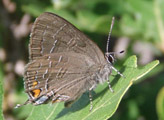 Larval Host |
Red-banded Hairstreak (Calycopis cecrops) 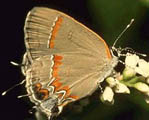 Larval Host |
Propagation
Propagation Material: Seeds , Semi-hardwood Cuttings , Softwood CuttingsDescription: Sow seed outdoors in the fall or stratify. Wax myrtle will root from softwood or semi-hardwood cuttings taken in summer. Root cuttings, 2-3 in. long., can be made in early winter.
Seed Collection: Collect fruit in September or October. Leave waxy coating on during storage, but remove it prior to sowing or stratification. Remove in a solution of 1 t. lye to 1 gal. water. Store seeds in sealed, refrigerated containers.
Seed Treatment: Stratify in moist peat 60-90 days at 34-41 degrees. Many seeds have a waxy coat that prevents water uptake and stratification. Soaking seeds in hot water or rubbing them vigorously against a rough surface will help remove the wax.
Commercially Avail: yes
Maintenance: Height and legginess can be maintained with a line trimmer or the shrub can be allowed to develop into an airy hedge. Prune annually to maintain a tree shape.
Find Seed or Plants
View propagation protocol from Native Plants Network.
Mr. Smarty Plants says
Evergreen plants safe for horses in Louisville, Kentucky
May 16, 2010
I have a horse farm in Louisville, Ky. I want to plant evergreen plants along the walls in front of the horse barns. What types of plants are not toxic to horses can I use? Thank you so much for all y...
view the full question and answer
Tree for sound block near Houston
April 24, 2010
I live in Pearland, just south of Houston and am looking for a tree that I can plant along my fenceline between my neighbor and me that will block noise. We have a pool and entertain a lot, but they a...
view the full question and answer
Shrub for part shade for hedge in Holly Ridge NC
April 07, 2010
We live in Coastal NC. We would like a type of shrub for the front of our home which is partial shade, similar style to a boxwood or trainable hedge. What NC native would compare?
view the full question and answer
Native plant to replace invasive non-native nandina in Houston
February 28, 2010
I'm just now finding out that Nandinas are an invasive species from our local chapter of the Native Plant Society of Texas. I have three of them in my front yard and want to replace them. Can you sug...
view the full question and answer
Hedge in central Texas
June 17, 2009
Help, my oleanders are dying. I am in need of hedge suggestions- ideal would be quick growing, maybe 8-12 feet at their tallest. I live in Central Texas.
view the full question and answer
National Wetland Indicator Status
| Region: | AGCP | AK | AW | CB | EMP | GP | HI | MW | NCNE | WMVE |
| Status: | FAC | FAC | FAC | FAC | FAC | FAC |
From the National Organizations Directory
According to the species list provided by Affiliate Organizations, this plant is on display at the following locations:Lady Bird Johnson Wildflower Center - Austin, TX
NPSOT - Native Plant Society of Texas - Fredericksburg, TX
Crosby Arboretum - Picayune, MS
Texas Parks and Wildlife Department - Austin, TX
Georgia Native Plant Society - Atlanta, GA
NPSOT - Austin Chapter - Austin, TX
Wellspring Organic Farm and Education Center - West Bend, WI
Wildflower Center Seed Bank
LBJWC-MLE-40 Collected 2010-10-02 in Tyler County by Lady Bird Johnson Wildflower CenterBibliography
Bibref 1186 - Field Guide to Moths of Eastern North America (2005) Covell, C.V., Jr.Bibref 298 - Field Guide to Texas Trees (1999) Simpson, B.J.
Bibref 1185 - Field Guide to Western Butterflies (Peterson Field Guides) (1999) Opler, P.A. and A.B. Wright
Bibref 1620 - Gardening with Native Plants of the South (Reprint Edition) (2009) Wasowski, S. with A. Wasowski
Bibref 481 - How to Grow Native Plants of Texas and the Southwest: Revised and Updated Edition (2001) Nokes, J.
Bibref 293 - Manual of the Vascular Plants of Texas (1979) Correll, D. S. & M. C. Johnston
Bibref 841 - Native Alternatives to Invasive Plants (2006) Burrell, C. C.
Bibref 318 - Native Texas Plants: Landscaping Region by Region (2002) Wasowski, S. & A. Wasowski
Search More Titles in Bibliography
Web Reference
Webref 38 - Flora of North America (2019) Missouri Botanical Garden, St. Louis, MO & Harvard University Herbaria, Cambridge, MA.From the Archive
Wildflower Newsletter 1993 VOL. 10, NO.6 - Saving Trees and Plants at New Center Site a Big Job, Director's Report, Wildflo...Wildflower Newsletter 1998 VOL. 15, NO.5 - Native Shrubs Providing Landscape Heritage and Habitat, Executive Director\'s Re...
Additional resources
USDA: Find Morella cerifera in USDA PlantsFNA: Find Morella cerifera in the Flora of North America (if available)
Google: Search Google for Morella cerifera
Metadata
Record Modified: 2023-04-18Research By: TWC Staff, MAC, GDG