Native Plants

Q. Who is Mr. Smarty Plants?
A: There are those who suspect Wildflower Center volunteers are the culpable and capable culprits. Yet, others think staff members play some, albeit small, role. You can torture us with your plant questions, but we will never reveal the Green Guru's secret identity.

Did you know you can access the Native Plant Information Network with your web-enabled smartphone?

Ask Mr. Smarty Plants
Ask Mr. Smarty Plants is a free service provided by the staff and volunteers at the Lady Bird Johnson Wildflower Center.

rate this answer

Sunday - February 28, 2010
From: Houston, TX
Region: Southwest
Topic: Non-Natives
Title: Native plant to replace invasive non-native nandina in Houston
Answered by: Barbara Medford
QUESTION:
I'm just now finding out that Nandinas are an invasive species from our local chapter of the Native Plant Society of Texas. I have three of them in my front yard and want to replace them. Can you suggest anything native that has the similar coloring such as the reddish leaves, even berries if possible, but mostly something in similar leaf coloration to Nandinas? I live in Houston. Thank you!ANSWER:
Sorry, that's why so many non-native (and invasive) plants are sold, because they have qualities or appearances that we do not find in plants native to an area. Then if, like nandina, they are invasive exact replacements are not to be found. You do know that even after you dig out your existing nandinas, you will still be fighting them for a long time. Learn about how it spreads and survives from this University of Florida Center for Aquatic and Invasive Plants website on Nandina domestica.
So, may we reset your thinking? We will look in our Recommended Species for East Texas for shrubs that could provide some Fall color, are of medium height and will not be invasive.
Native shrubs for Houston:
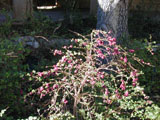
Callicarpa americana (American beautyberry) - 3 to 5 ft. tall, deciduous, attractive bark, pinky purple berries in fall and Winter, or until the birds get them. Blooms white, pink May to July, low water use, part shade.
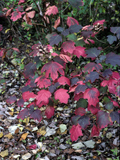
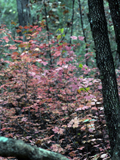
Hydrangea quercifolia (oakleaf hydrangea) - 3 to 12 ft., greenish flowers turn white, then purple and persist on bush until Winter. Foliage shaped shaped something like a red oak, becomes colorful in Fall. Medium water use, shade
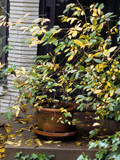
Itea virginica (Virginia sweetspire) - 3 to 6 ft., semi-evergreen, blooms white April to June, leaves turn red to purple in Fall and persist well into Winter. High water use, part shade
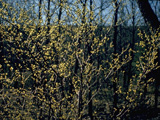
Lindera benzoin (northern spicebush) - 6 to 12 ft., deciduous, glossy red fruit, leaves turn golden yellow in Fall, medium water use, sun, part shade or shade
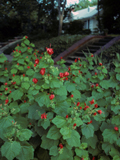
Malvaviscus arboreus var. drummondii (wax mallow) - 2 to 3 ft., deciduous, blooms white, red May to November, medium water use, part shade or shade
Morella cerifera (wax myrtle) - 6 to 12 ft., evergreen, fragrant foliage, high water use, sun or part shade. Berries eaten by many species of birds, but plant is dioecious.
Symphoricarpos orbiculatus (coralberry) - 4 to 6 ft., deciduous, blooms white, green April to July, coral pink to purple berries remain on plant through winter, low to medium water use, part shade or shade
Viburnum acerifolium (mapleleaf viburnum) -4 to 6 ft., bright to dark green deciduous foliage, very colorful in Fall. White flowers May to August followed by red to blue-black berries.
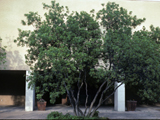
From our Native Plant Image Gallery:

More Non-Natives Questions
Various landscape problems in Omaha, NE.
June 18, 2015 - Thank you for your time, sorry i cant sort this out because my issue seems to fit many but also none of the issues I've read about. Some patches of grass in my lawn have yellow spots and dying and/or...
view the full question and answer
Growing non-native daylilies from Albuquerque
May 05, 2013 - Need some tips on planting daylilies in the Northeast heights of Albuquerque. I've amended clay soil with cottonbur mulch/compost mix and added gypsum. Can I do anything else to ensure growing succes...
view the full question and answer
Root ball disintegrating on Arroyo sweetwood from Dripping Springs TX
May 11, 2013 - I just purchased a arroyo sweetwood in a 5 gallon container and when I went to put it in the ground the root ball completely fell apart. I put it in the ground and watered it really good. What are its...
view the full question and answer
Non-native, invasive Datura sprouting from compost
September 26, 2005 - Hi,
I have a plant growing out of some compost we purchased this spring and no one can tell me what it is.
It's about 4 ft. tall, the stem is maroon like rhubarb and it produces 4-5 in. tubular lig...
view the full question and answer
Foxglove safety from England
April 21, 2013 - Hi, regarding safety of foxgloves grown near edible plants - foxgloves are good companion plants for vegetables, in case of root vegetables they improve their storage life and quality. Foxgloves prote...
view the full question and answer
| Support the Wildflower Center by Donating Online or Becoming a Member today. |