Native Plants

Plant Database
Search for native plants by scientific name, common name or family. If you are not sure what you are looking for, try the Combination Search or our Recommended Species lists.
Marcus, Joseph A.
Bouteloua curtipendula
Bouteloua curtipendula (Michx.) Torr.
Sideoats Grama, Banderilla, Banderita, Navajita
Poaceae (Grass Family)
Synonym(s):
USDA Symbol: bocu
USDA Native Status: L48 (N), HI (I), CAN (N)
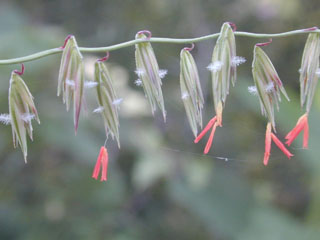
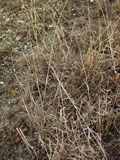
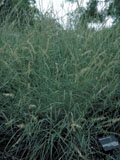
Side-oats grama is a bunchy or sod-forming grass with 2-3 ft. stems in erect, wiry clumps. Purplish, oat-like spikelets uniformly line one side of the stem, bleaching to a tan color in the fall. The basal foliage often turns shades of purple and red in fall. This is a perennial warm season grass; clump forming. Two varieties are recognized: variety curtipendula is shorter and more rhizomatous and ranges from southern Canada to Argentina. Variety caespitosa spreads more by seed than by rhizomes, is more of a bunchgrass, and is restricted mostly to southwestern North America.
Not only is Sideoats Grama the state grass of Texas, but this medium-tall grass mixes well in plantings with spring wildflowers, because it stays short in the spring. Birds love the ripe seeds. This plant increases rapidly in nature when its site is damaged by drought or grazing.


Plant Characteristics
Duration: PerennialHabit: Grass/Grass-like
Root Type: Fibrous
Leaf Arrangement: Alternate
Leaf Complexity: Simple
Leaf Venation: Parallel
Inflorescence: Spike
Fruit Type: Caryopsis
Size Notes: 1 to 3 feet, rarely higher
Leaf: Green, Blue-green, sometimes turning purple or red in fall
Autumn Foliage: yes
Fruit: Tan, Ivory
Bloom Information
Bloom Color: Red , Orange , YellowBloom Time: Jun , Jul , Aug , Sep , Oct , Nov
Distribution
USA: AL , AR , AZ , CA , CO , CT , DC , FL , GA , HI , IA , ID , IL , IN , KS , KY , LA , MD , ME , MI , MN , MO , MS , MT , ND , NE , NJ , NM , NV , NY , OH , OK , OR , PA , SC , SD , TN , TX , UT , VA , WA , WI , WV , WYCanada: MB , ON , SK
Native Distribution: South-central Canada and much of the US, south through Mexico and Central America to western South America as far as Argentina
Native Habitat: Prairies; open brush; forest openings; rocky slopes
Growing Conditions
Water Use: MediumLight Requirement: Sun , Part Shade
Soil Moisture: Dry , Moist
CaCO3 Tolerance: Medium
Drought Tolerance: High
Cold Tolerant: yes
Heat Tolerant: yes
Soil Description: Medium-textured, well-drained soils. Disturbed, igneous, limestone-based sands, loams, and clays.
Conditions Comments: Often found growing with Little Bluestem (Schizachyrium scoparium), but doesn't compete well with very tall grasses.
Benefit
Use Ornamental: An attractive grass good for wildflower meadows, prairie restorations, and garden accents.Use Wildlife: Provides bird food, nesting material, and cover, as well as graze for mammals.
Conspicuous Flowers: yes
Attracts: Birds , Butterflies
Larval Host: Green Skipper butterfly, Dotted Skipper butterfly
Deer Resistant: High
Value to Beneficial Insects
Provides Nesting Materials/Structure for Native BeesThis information was provided by the Pollinator Program at The Xerces Society for Invertebrate Conservation.
Butterflies and Moths of North America (BAMONA)
|
Orange Skipperling (Copaeodes aurantiaca) 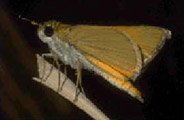 Adult Food Source |
Bronze Roadside-Skipper (Amblyscirtes aenus) 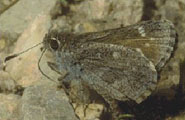 Adult Food Source |
Sheep Skipper (Atrytonopsis edwardsi)  Larval Host |
Elissa Roadside-Skipper (Amblyscirtes elissa) Larval Host |
|
Green Skipper (Hesperia viridis) 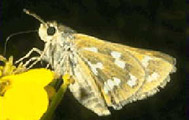 Larval Host |
Dotted Skipper (Hesperia attalus) 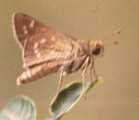 Larval Host |
Propagation
Propagation Material: Root Division , SeedsDescription: Easily propagated from seed sown unstratified in fall or statified in spring. Sow 1/4" deep. Plants may be divided while dormant in spring or fall.
Seed Collection: Collect seed in summer.
Commercially Avail: yes
Maintenance: It may be cut back in winter but this is not necessary. The clump-forming, bunchgrass variety can be mowed or cut back only very sparingly; mowing more than twice a year (once before June and once after frost) may damage it. If you have to mow it during the summer growing season, mow no shorter than 8 inches and no more than once. The spreading, rhizomatous variety can be mowed more often and shorter with little or no damage.
Find Seed or Plants
Order seed of this species from Native American Seed and help support the Wildflower Center.
Find seed sources for this species at the Native Seed Network.
View propagation protocol from Native Plants Network.
Mr. Smarty Plants says
Native grasses for medians in Colorado Springs
June 11, 2010
Our city has stopped watering our historic landscaped medians due to severe budget shortfalls. The medians were historically tree boulevards but have had curb and gutter and blue grass added over th...
view the full question and answer
Plants to stop erosion in Arizona
January 17, 2009
I'm looking for a plant to stop erosion; I have big wash outs that are starting to erode my yard so I guess I'm looking for deep rooting plants. I live south of Tucson, Arizona. If you can advise me...
view the full question and answer
Native grasses for shade in Dallas
November 30, 2008
What native grasses can be grown under large Live Oaks in the Dallas Area? The combination of shade and black gumbo soil seem to keep all plant life, except for poison ivy and ferns, out. I would lo...
view the full question and answer
Deer-resistant plants for steep hillside erosion control
June 03, 2008
Hello, I am looking for advice on native plants to control erosion on a steep hillside in the western cross timbers. This is a shady area under post oaks and cedar elms, in shallow sandy soil mixed w...
view the full question and answer
Plants to control hillside erosion in Vermont
May 23, 2008
Hi, I am trying to do an eagle project that involves putting vegetation onto a hill to prevent erosion. I live in Vermont. What kinds of plants would hold together a hillside and could be planted in ...
view the full question and answer
From the National Organizations Directory
According to the species list provided by Affiliate Organizations, this plant is on display at the following locations:Lady Bird Johnson Wildflower Center - Austin, TX
Santa Barbara Botanic Garden - Santa Barbara, CA
Texas Discovery Gardens - Dallas, TX
Sibley Nature Center - Midland, TX
Brackenridge Field Laboratory - Austin, TX
Patsy Glenn Refuge, c/o Wimberley Birding Society - Wimberley, TX
Texas Parks and Wildlife Department - Austin, TX
NPSOT - Fredericksburg Chapter - Fredericksburg, TX
North American Native Plant Society - Etobicoke, ON
NPSOT - Austin Chapter - Austin, TX
Native Seed Network - Corvallis, OR
Jacob's Well Natural Area - Wimberley, TX
NPSOT - Williamson County Chapter - Georgetown, TX
Mt. Cuba Center - Hockessin, DE
Wildflower Center Seed Bank
LBJWC-57 Collected 2006-10-30 in Travis County by Lady Bird Johnson Wildflower CenterBibliography
Bibref 1186 - Field Guide to Moths of Eastern North America (2005) Covell, C.V., Jr.Bibref 1185 - Field Guide to Western Butterflies (Peterson Field Guides) (1999) Opler, P.A. and A.B. Wright
Bibref 946 - Gardening with Prairie Plants: How to Create Beautiful Native Landscapes (2002) Wasowski, Sally
Bibref 995 - Native Landscaping from El Paso to L.A. (2000) Wasowski, S. and A. Wasowski
Bibref 318 - Native Texas Plants: Landscaping Region by Region (2002) Wasowski, S. & A. Wasowski
Bibref 291 - Texas Wildscapes: Gardening for Wildlife (1999) Damude, N. & K.C. Bender
Bibref 1294 - The Midwestern Native Garden: Native Alternatives to Nonnative Flowers and Plants An Illustrated Guide (2011) Adelman, Charlotte and Schwartz, Bernard L.
Search More Titles in Bibliography
From the Archive
Wildflower Newsletter 1989 VOL. 6, NO.4 - Spring Climbs Rockies Slowly, Colorado Cooler, Conference of Wildflower and Nati...Additional resources
USDA: Find Bouteloua curtipendula in USDA PlantsFNA: Find Bouteloua curtipendula in the Flora of North America (if available)
Google: Search Google for Bouteloua curtipendula
Metadata
Record Modified: 2019-08-06Research By: TWC Staff, RLU, GDG