Native Plants

Q. Who is Mr. Smarty Plants?
A: There are those who suspect Wildflower Center volunteers are the culpable and capable culprits. Yet, others think staff members play some, albeit small, role. You can torture us with your plant questions, but we will never reveal the Green Guru's secret identity.

Did you know you can access the Native Plant Information Network with your web-enabled smartphone?

Ask Mr. Smarty Plants
Ask Mr. Smarty Plants is a free service provided by the staff and volunteers at the Lady Bird Johnson Wildflower Center.

rate this answer

Tuesday - June 03, 2008
From: Palo Pinto, TX
Region: Southwest
Topic: Deer Resistant
Title: Deer-resistant plants for steep hillside erosion control
Answered by: Nan Hampton
QUESTION:
Hello, I am looking for advice on native plants to control erosion on a steep hillside in the western cross timbers. This is a shady area under post oaks and cedar elms, in shallow sandy soil mixed with large boulders. Most of the land is 45 degrees or worse. Oh, and the plants must be deer-resistant as it is heavily infested with deer. The primary understory now is smilax and prickly pear.ANSWER:
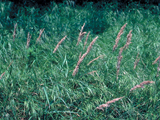
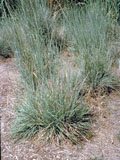
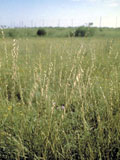
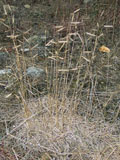
Your best bet for controling erosion is grass. The grasses have fibrous root systems that hold the soil very effectively. Additionally, grasses are not a primary food for deer. They will eat grass when it is young and tender, but tend to avoid it after the grass is older unless it is their only choice for food. Here is a list of grasses that are native to Palo Pinto, Texas that will grow in part shade (2-6 hours sun per day) or shade (<2 hours of sun per day).Poa arachnifera (Texas bluegrass) sun, part shade
Schizachyrium scoparium (little bluestem) sun, part shade
Bouteloua curtipendula (sideoats grama) part shade, shade
Bouteloua hirsuta (hairy grama) part shade
Elymus canadensis (Canada wildrye) sun, part shade, shade
Elymus virginicus (Virginia wildrye) part shade
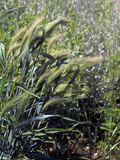
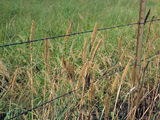
Tridens albescens (white tridens) sun, part shade. Photo from Texas A&M Uvalde.
You can also look through the other plants that are on our Deer Resistant Species list for possibilites for erosion control plants; however, grasses are going to be the best solution. Use the "Narrow Your Search" option to limit the list to Texas species.
You don't mention whether you are thinking of removing the cactus and greenbriar, but I recommend not removing them until you get some grasses established there—those prickly plants are helping with erosion control.
More Deer Resistant Questions
Evergreen deer resistant shrub for Texas
September 25, 2009 - I live in Bastrop TX and the deer have decimated the landscaping at the end of our sidewalk. I need to find compact, evergreen shrubs, (flowering would be a bonus), that will do well in shade and gro...
view the full question and answer
What is eating Eve's Necklace in San Marcos TX
June 16, 2011 - A small Styphnolobium affine in my yard is repeatedly being defoliated by something. It courageously leafs out again each time, even in the drought. There is a larger tree nearby that remains untouc...
view the full question and answer
Deer resistant evergreen shrubs for Saratoga Springs, NY
April 20, 2009 - Deer resistant, evergreen shrubs for Saratoga Springs, NY.
view the full question and answer
Deer Resistance Input from Northern VA
June 22, 2016 - Hello. I live in the deer infested woods of Northern VA. I am always looking for plants that deer have little interest in to cover other plants. The deer generally have little interest in mints (Py...
view the full question and answer
Native, deer-resistant evergreen trees for Rhode Island
March 17, 2008 - What deer proof evergreens can I plant in RI that may make nice xmas trees in a few years?
view the full question and answer
| Support the Wildflower Center by Donating Online or Becoming a Member today. |