Native Plants

Plant Database
Search for native plants by scientific name, common name or family. If you are not sure what you are looking for, try the Combination Search or our Recommended Species lists.
Mathews, Ray
Symphoricarpos orbiculatus
Symphoricarpos orbiculatus Moench
Coralberry, Indian Currant, Buckbrush
Caprifoliaceae (Honeysuckle Family)
Synonym(s): Symphoricarpos symphoricarpos
USDA Symbol: SYOR
USDA Native Status: L48 (N), CAN (I)
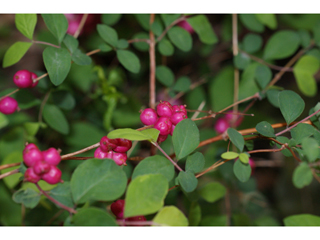
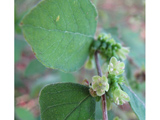
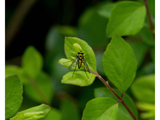
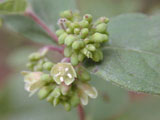
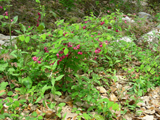
This small, mound-shaped, deciduous shrub with shredding bark on older wood and brown to purplish branchlets covered with short hairs visible under a 10x hand lens, usually grows to 4 ft. but can reach 6 ft. Its smooth, dull green leaves are opposite and roughly oval, tapering about equally to tip and base, up to 2 inches long but often less than 1 inch, with smooth, turned down margins and a rounded or broadly pointed tip. The greenish-white flower clusters are not as showy as the clusters of coral-pink to purple fruit up to 1/4 inch in diameter which remain on the plant through winter.
Particularly common in Post Oak (Quercus stellata) woods, Coralberry forms extensive colonies and spreads by rooting at the nodes where it touches the ground. A good choice for a woodland garden.

Plant Characteristics
Duration: PerennialHabit: Shrub
Leaf Retention: Deciduous
Leaf Arrangement: Opposite
Leaf Complexity: Simple
Fruit Type: Drupe
Size Notes: Up to about 6 feet tall.
Fruit: Purple, pinkish purple, coral pink, 1/8 inch.
Bloom Information
Bloom Color: White , GreenBloom Time: Apr , May , Jun , Jul , Aug , Sep
Distribution
USA: AL , AR , CT , DC , DE , FL , GA , IA , IL , IN , KS , KY , LA , MA , MD , MI , MN , MO , MS , NC , NE , NJ , NY , OH , OK , PA , RI , SC , SD , TN , TX , UT , VA , VT , WI , WVNative Distribution: Eastern US from New York south to eastern Texas, west to South Dakota and Colorado.
Native Habitat: Shaded woods, thickets, open woodlands, streambanks, river banks. Common in Post Oak woodlands (Quercus stellata).
Growing Conditions
Water Use: Low , MediumLight Requirement: Part Shade , Shade
Soil Moisture: Dry , Moist
Soil pH: Circumneutral (pH 6.8-7.2)
CaCO3 Tolerance: Low
Soil Description: Well-drained sand, loam, or clay.
Benefit
Use Ornamental: A low-growing forest shrub with attractive winter berries and persistent, bright green foliage for use in eastern North America.Use Wildlife: Songbirds, ground birds, small mammals, and browsers use this plant for food, cover, and nesting sites.
Interesting Foliage: yes
Attracts: Birds
Deer Resistant: Moderate
Value to Beneficial Insects
Special Value to Native BeesSupports Conservation Biological Control
This information was provided by the Pollinator Program at The Xerces Society for Invertebrate Conservation.
Propagation
Propagation Material: Semi-hardwood CuttingsDescription: Semi-hardwood cuttings from current growth.
Seed Collection: Fruits can be collected anytime during the fall and winter by stripping or flailing onto drop cloths. Seeds can be extracted by macerating the fruits in water.
Seed Treatment: Nutlets are difficult to germinate because of hard seed coats and immature embryos. Warm stratification for 3-4 months followed by cold for 4-6 months is necessary.
Commercially Avail: yes
Maintenance: To keep it at a low height, cut it back to knee high every 5 to 10 years. If it gets too leggy, it can be cut back to the ground and it will come back bushier and with more berries the next year.
Find Seed or Plants
Find seed sources for this species at the Native Seed Network.
View propagation protocol from Native Plants Network.
Mr. Smarty Plants says
Flowering and evergreen shrubs for landscape in Indiana
May 29, 2010
I live in Southern Indiana and we are getting ready to redesign our front landscape. Currently, we have some yews and other shrubs that are unruly and require a lot of pruning and care. My husband hat...
view the full question and answer
Native plant to replace invasive non-native nandina in Houston
February 28, 2010
I'm just now finding out that Nandinas are an invasive species from our local chapter of the Native Plant Society of Texas. I have three of them in my front yard and want to replace them. Can you sug...
view the full question and answer
Planting shade plants in 100+ weather
June 25, 2009
I was planning on planting some columbines in a barrel and Turk's Cap and Coralberry in my yard, but hadn't counted on the extreme heat this early in the summer. Is it okay to plant these things as...
view the full question and answer
National Wetland Indicator Status
| Region: | AGCP | AK | AW | CB | EMP | GP | HI | MW | NCNE | WMVE |
| Status: | FACU | UPL | FACU | FACU | FACU | FACU | UPL |
From the National Organizations Directory
According to the species list provided by Affiliate Organizations, this plant is on display at the following locations:Lady Bird Johnson Wildflower Center - Austin, TX
Texas Discovery Gardens - Dallas, TX
Sibley Nature Center - Midland, TX
Patsy Glenn Refuge, c/o Wimberley Birding Society - Wimberley, TX
NPSOT - Native Plant Society of Texas - Fredericksburg, TX
Texas Parks and Wildlife Department - Austin, TX
NPSOT - Fredericksburg Chapter - Fredericksburg, TX
NPSOT - Austin Chapter - Austin, TX
Native Seed Network - Corvallis, OR
NPSOT - Williamson County Chapter - Georgetown, TX
Bibliography
Bibref 946 - Gardening with Prairie Plants: How to Create Beautiful Native Landscapes (2002) Wasowski, SallyBibref 354 - Native & Naturalized Woody Plants of Austin & the Hill Country (1981) Lynch, D.
Bibref 841 - Native Alternatives to Invasive Plants (2006) Burrell, C. C.
Bibref 318 - Native Texas Plants: Landscaping Region by Region (2002) Wasowski, S. & A. Wasowski
Bibref 281 - Shinners & Mahler's Illustrated Flora of North Central Texas (1999) Diggs, G. M.; B. L. Lipscomb; B. O'Kennon; W. F...
Bibref 291 - Texas Wildscapes: Gardening for Wildlife (1999) Damude, N. & K.C. Bender
Search More Titles in Bibliography
Web Reference
Webref 23 - Southwest Environmental Information Network (2009) SEINet - Arizona ChapterAdditional resources
USDA: Find Symphoricarpos orbiculatus in USDA PlantsFNA: Find Symphoricarpos orbiculatus in the Flora of North America (if available)
Google: Search Google for Symphoricarpos orbiculatus
Metadata
Record Modified: 2023-02-28Research By: TWC Staff, LAS