Native Plants

Plant Database
Search for native plants by scientific name, common name or family. If you are not sure what you are looking for, try the Combination Search or our Recommended Species lists.
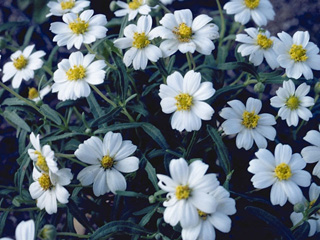
Bransford, W.D. and Dolphia
Melampodium leucanthum
Melampodium leucanthum Torr. & A. Gray
Blackfoot Daisy, Rock Daisy, Plains Blackfoot, Arnica
Asteraceae (Aster Family)
Synonym(s):
USDA Symbol: MELE2
USDA Native Status: L48 (N)
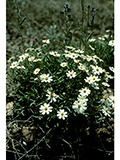
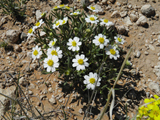
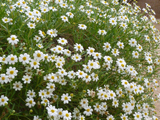
A low, round, bushy plant with flower heads of 8-13 broad white rays surrounding a small yellow central disc. Plains Blackfoot or Blackfoot Daisy is a low, bushy, mounded perennial, usually 6-12 in. tall and twice as wide. It is covered with narrow leaves and 1 in. wide, white, daisy-like flowers. The white rays are toothed at the tips and surround yellow disc flowers. These honey-scented flower heads are solitary and terminal on slender stalks.
At first glance, Blackfoot Daisy appears to be the twin of White Zinnia (Zinnia acerosa), but flower heads of the latter species have 4-7 broad white rays and a narrow base of several overlapping scales. Both may be found in the same habitat, but the range of White Zinnia does not extend as far south as Blackfoot Daisy.
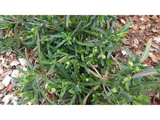
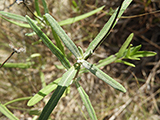
Plant Characteristics
Duration: PerennialHabit: Herb
Size Notes: Plants are seldom over 6 inches high, and the clump is 1-2 feet across. Occasionally found from 1-2 feet tall.
Fruit: Fruit is a cypsela (pl. cypselae). Though technically incorrect, the fruit is often referred to as an achene.
Bloom Information
Bloom Color: White , YellowBloom Time: Mar , Apr , May , Jun , Jul , Aug , Sep , Oct , Nov
Bloom Notes: The yellow-orange disc flowers contrast sharply with the white ray flowers.
Distribution
USA: AZ , CO , KS , NM , OK , TXNative Distribution: CO to OK, s. to AZ, c. TX & Mex.
Native Habitat: Throughout, Prairie, Plains, Meadows, Pastures, Savannas, Dry calcalreous substrates
Growing Conditions
Water Use: LowLight Requirement: Sun , Part Shade
Soil Moisture: Dry
Soil pH: Alkaline (pH>7.2)
Soil Description: Dry, rocky, calcareous soils. Rocky, Gravelly Sandy, Limestone-based, Caliche type
Conditions Comments: Blackfoot daisy is a sturdy, mounding plant, that will flourish in rock gardens. It is heat and drought tolerant. Good drainage is essential to its success. In late winter, older plants can be cut back halfway to keep them compact. Rich soil and abundant water will likely produce many more flowers in the short-term, but may consequently shorten the lifespan.
Benefit
Use Ornamental: Showy, Rock gardens, Blooms ornamental, Long-bloomingUse Wildlife: Nectar-Bees, Nectar-Butterflies, Nectar-insects, Seeds-Granivorous birds
Conspicuous Flowers: yes
Fragrant Flowers: yes
Deer Resistant: High
Mr. Smarty Plants says
Native grasses for medians in Colorado Springs
June 11, 2010
Our city has stopped watering our historic landscaped medians due to severe budget shortfalls. The medians were historically tree boulevards but have had curb and gutter and blue grass added over th...
view the full question and answer
Native plants for container gardens in Central Texas
March 11, 2008
Dear Mr. Smarty Plants: I moved to TX last year, for now living in an apartment with a good-size but shady deck; my garden in VA was full of VA native plants. What TX natives, if any, can I grow in ...
view the full question and answer
Deer resistant, sun tolerant plants for landscaping
April 19, 2007
I live in Driftwood and am looking for flowering, deer-resistant plants for the northern side of my house; however the house turn just enough to the west that the flowerbed receives about 3 hours of a...
view the full question and answer
Erosion control plants for steep slope in Austin, TX
April 09, 2007
I'm interested in finding native plants, either perennials or grasses, that would help control erosion on a fairly steep slope. These plants would be in a park, and volunteers will be watering the pl...
view the full question and answer
List of native perennial Texas flowers
March 13, 2006
Good day, I am searching for a list of native Texas flowers (preferably perennials) for a flower garden.
Thank you.
view the full question and answer
From the National Organizations Directory
According to the species list provided by Affiliate Organizations, this plant is on display at the following locations:Lady Bird Johnson Wildflower Center - Austin, TX
Sibley Nature Center - Midland, TX
Brackenridge Field Laboratory - Austin, TX
Patsy Glenn Refuge, c/o Wimberley Birding Society - Wimberley, TX
United States Botanic Garden - Washington, DC
NPSOT - Native Plant Society of Texas - Fredericksburg, TX
Texas Parks and Wildlife Department - Austin, TX
NPSOT - Fredericksburg Chapter - Fredericksburg, TX
NPSOT - Austin Chapter - Austin, TX
Jacob's Well Natural Area - Wimberley, TX
NPSOT - Williamson County Chapter - Georgetown, TX
Herbarium Specimen(s)
NPSOT 0289 Collected Aug. 21, 1992 in Kendall County by Kristina CoatesNPSOT 0204 Collected Apr 7, 1992 in Comal County by Mary Beth White
Bibliography
Bibref 765 - McMillen's Texas Gardening: Wildflowers (1998) Howard, D.Bibref 841 - Native Alternatives to Invasive Plants (2006) Burrell, C. C.
Bibref 995 - Native Landscaping from El Paso to L.A. (2000) Wasowski, S. and A. Wasowski
Bibref 318 - Native Texas Plants: Landscaping Region by Region (2002) Wasowski, S. & A. Wasowski
Bibref 281 - Shinners & Mahler's Illustrated Flora of North Central Texas (1999) Diggs, G. M.; B. L. Lipscomb; B. O'Kennon; W. F...
Bibref 248 - Texas Wildflowers: A Field Guide (1984) Loughmiller, C. & L. Loughmiller
Bibref 291 - Texas Wildscapes: Gardening for Wildlife (1999) Damude, N. & K.C. Bender
Bibref 328 - Wildflowers of Texas (2003) Ajilvsgi, Geyata.
Bibref 286 - Wildflowers of the Texas Hill Country (1989) Enquist, M.
Search More Titles in Bibliography
Web Reference
Webref 3 - Flora of North America (2014) Missouri Botanical Garden, St. Louis, MO & Harvard University Herbaria, Cambridge, MA.Additional resources
USDA: Find Melampodium leucanthum in USDA PlantsFNA: Find Melampodium leucanthum in the Flora of North America (if available)
Google: Search Google for Melampodium leucanthum
Metadata
Record Modified: 2022-12-30Research By: TWC Staff, MAC