Native Plants

Plant Database
Search for native plants by scientific name, common name or family. If you are not sure what you are looking for, try the Combination Search or our Recommended Species lists.
Marcus, Joseph A.
Juniperus ashei
Juniperus ashei J. Buchholz
Ashe Juniper, Ashe's Juniper, Mountain Cedar, Rock Cedar, Post Cedar, Texas Cedar, Brake Cedar, Mexican Juniper, Blueberry Juniper, Ozark White Cedar, Sabino, Enebro
Cupressaceae (Cypress Family)
Synonym(s): Juniperus ashei var. ovata, Juniperus occidentalis var. conjungens, Juniperus occidentalis var. texana, Juniperus sabinoides
USDA Symbol: JUAS
USDA Native Status: L48 (N)
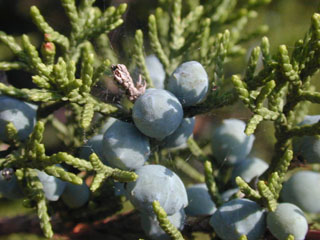
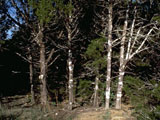
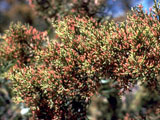
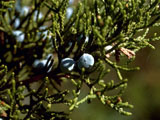
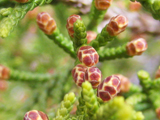
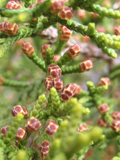
Evergreen tree with trunk often grooved and twisted or branched from base, and with rounded or irregular, open crown; sometimes forming thickets. Ashe Juniper's large, radiating branches, which start almost at ground level, give the illusion of a multi-trunked tree. Female trees with blue berry-like cones; male with a burnt gold appearance in winter due to pollen. Fragrant, dark-green foliage, blue fruits on females, and shaggy bark are characteristic of this 30 ft. evergreen.
Though a fragrant, evergreen, and picturesque tree, Ashe Juniper pollen, like that of many junipers, is very irritating to people with cedar allergies, so where the tree occurs in large concentrations, as in Central Texas, it often becomes hated and targeted for removal, with various, sometimes invented, rationalizations given for doing so. Ashe Juniper is native from southern Missouri south through Oklahoma and then down through central and west Texas to northern Chihuahua. It was abundant in Central Texas when the earliest European explorers arrived, having existed in the region at least since the Pleistocene. It is thus an integral part of the native flora. The uniquely rich and well-draining soil that builds up as juniper leaves fall and decompose is ideal for several native plants, some of which tend to occur almost exclusively in association with it, including Cedar Sage (Salvia roemeriana) and Cedar Rosette Grass (Dichanthelium pedicillatum). The beautiful but notoriously difficult to propagate Texas Madrone (Arbutus xalapensis) also seems to germinate best in the soil beneath these trees, as seen in this photo. Other central Texas plants often seen under or near it are American Smoke Tree (Cotinus obovatus), White Limestone Honeysuckle (Lonicera albiflora), Lindheimer's Garrya (Garrya ovata var. lindheimeri), and Orange Zexmenia (Wedelia acapulcensis var. hispida). Better known is that a rare warbler, the Golden-cheeked Warbler, uses Ashe Juniper bark almost exclusively to build its nests. Many kinds of wildlife eat the sweetish "berries," and the durable wood is a local source of fenceposts. The tree is named in honor of William Willard Ashe 1872-1932, pioneer forester of the United States Forest Service, who collected a specimen in Arkansas.
Plant Characteristics
Duration: PerennialHabit: Tree
Root Type: Tap
Leaf Retention: Evergreen
Leaf Complexity: Simple
Breeding System: Flowers Unisexual , Dioecious
Fruit Type: Cone
Size Notes: Rarely grows over 30 feet tall.
Fruit: Though technically incorrect, the seed cones are often referred to as berries.
Bloom Information
Bloom Color: White , BrownBloom Time: Feb
Bloom Notes: Flowers inconspicuous. Pollen cones cream to reddish brown.
Distribution
USA: AR , MO , OK , TXNative Distribution: S. MO, s.w. through AR and OK to central and w. TX, s.e. NM, & Chihuahua
Native Habitat: Canyons; arroyos; limestone outcrops
Growing Conditions
Water Use: LowLight Requirement: Part Shade
Soil Moisture: Dry
Soil Description: Rocky, well-drained soils. Limestone-based, Sandy, Sandy Loam, Medium Loam, Clay Loam, Clay
Conditions Comments: Texas madrone, Texas smoke tree, silk-tassel tree, cedar sage, and zexmenia germinate and grow well beneath ashe juniper, refuting the rumor that nothing grows under these trees. Ashe juniper is immune to cedar-apple rust. It invades disturbed sites.
Benefit
Use Ornamental: Aromatic, Attractive, ornamental.Use Wildlife: Ashe juniper "berries" are highly palatable to many species of birds and small mammals. The bark of Ashe juniper is very is used for nesting material by the rare golden-cheeked warbler.
Use Other: Ashe juniper is used for fenceposts, crossties, poles and fuel.
Fragrant Foliage: yes
Attracts: Butterflies
Larval Host: Juniper hairstreak, Olive butterfly.
Deer Resistant: Minimal
Butterflies and Moths of North America (BAMONA)
|
Juniper Hairstreak (Callophrys gryneus) 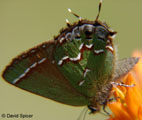 Larval Host |
Propagation
Propagation Material: SeedsDescription: Seed can be sown outdoors in fall or stratified and sown in spring. Seed germination is often poor, so a large quantity of seeds should be sown.
Seed Collection: Collect seeds from late summer through fall when it has turned its ripe color. Seed can be extracted by running the fruits through a macerator. Thoroughly dry and clean seeds to avoid mold and overheating. If not planting immediately, air dry before storing. Store in sealed containers at 20-40 degrees.
Seed Treatment: Stratify at 41 degrees for 30-120 days.
Commercially Avail: yes
Mr. Smarty Plants says
Plants for wildlife and trees for shade.
September 29, 2007
We live in Kempner Texas, our land has mostly cedar trees. We would like to make a wildlife habitat on the back side of our property. Can you recommend plants that will grow in shade to partial sun,...
view the full question and answer
From the National Organizations Directory
According to the species list provided by Affiliate Organizations, this plant is on display at the following locations:Lady Bird Johnson Wildflower Center - Austin, TX
Brackenridge Field Laboratory - Austin, TX
Patsy Glenn Refuge, c/o Wimberley Birding Society - Wimberley, TX
NPSOT - Native Plant Society of Texas - Fredericksburg, TX
Nueces River Authority - Uvalde, TX
Texas Parks and Wildlife Department - Austin, TX
Jacob's Well Natural Area - Wimberley, TX
NPSOT - Williamson County Chapter - Georgetown, TX
Wildflower Center Seed Bank
LBJWC-191 Collected 2007-11-12 in Travis County by Lady Bird Johnson Wildflower CenterBibliography
Bibref 1282 - Explorers' Texas: The Lands and Waters (1984) Weniger, DelBibref 298 - Field Guide to Texas Trees (1999) Simpson, B.J.
Bibref 354 - Native & Naturalized Woody Plants of Austin & the Hill Country (1981) Lynch, D.
Bibref 318 - Native Texas Plants: Landscaping Region by Region (2002) Wasowski, S. & A. Wasowski
Bibref 281 - Shinners & Mahler's Illustrated Flora of North Central Texas (1999) Diggs, G. M.; B. L. Lipscomb; B. O'Kennon; W. F...
Bibref 291 - Texas Wildscapes: Gardening for Wildlife (1999) Damude, N. & K.C. Bender
Bibref 297 - Trees of Central Texas (1984) Vines, Robert A.
Search More Titles in Bibliography
Web Reference
Webref 23 - Southwest Environmental Information Network (2009) SEINet - Arizona ChapterFrom the Archive
Wildflower Newsletter 1993 VOL. 10, NO.6 - Saving Trees and Plants at New Center Site a Big Job, Director's Report, Wildflo...Additional resources
USDA: Find Juniperus ashei in USDA PlantsFNA: Find Juniperus ashei in the Flora of North America (if available)
Google: Search Google for Juniperus ashei
Metadata
Record Modified: 2023-03-23Research By: TWC Staff, GDG