Native Plants

Plant Database
Search for native plants by scientific name, common name or family. If you are not sure what you are looking for, try the Combination Search or our Recommended Species lists.
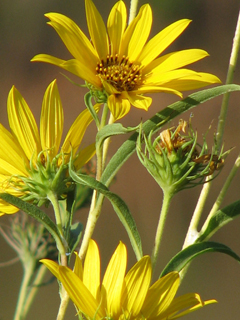
Smith, Sandy
Helianthus maximiliani
Helianthus maximiliani Schrad.
Maximilian Sunflower, Max Sunflower
Asteraceae (Aster Family)
Synonym(s): Helianthus dalyi
USDA Symbol: HEMA2
USDA Native Status: L48 (N), CAN (N)
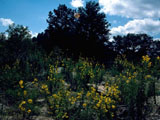
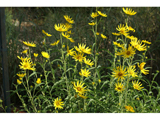
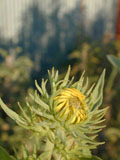
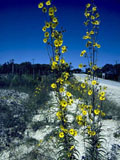
The several tall, leafy, unbranched stems of michaelmas-daisy or maximilian sunflower grow to a height of 3-10 ft. Leaves are long and narrow, up to 10 inches near the bottom and as short as 2 inches near the top. They are alternate, coarse and hairy, slightly wavy on the edges, often folded lengthwise, slightly toothed and very pointed. Numerous yellow flower heads grow on their own stalks terminally and from leaf axils. The flower head is up to 5 inches across, with 15-19 ray flowers, deeply veined and slightly toothed on the tip. The center is 1 inch or more across, green to dark brown. These perennial plants can form large colonies.
A native prairie perennial, this sunflower is a desirable range plant, eaten by many livestock. A heavy crop of seeds is produced, thus it is also a valuable plant for wildlife. It was named for the naturalist Prince Maximilian of Wied-Neuwied, Germany, who led an expedition into the American West in the 1830s. Another bluegrass prairie species, Willow-leaved Sunflower (H. salicifolius), has numerous long, narrow, drooping leaves covered with soft hairs and a purple-brown central disc; it is typical of rocky outcrops with heavy soil.

Plant Characteristics
Duration: PerennialHabit: Herb
Size Notes: Up to about 10 feet tall.
Flower: Flowers 3 inches
Fruit: Fruit is a cypsela (pl. cypselae). Though technically incorrect, the fruit is often referred to as an achene.
Bloom Information
Bloom Color: Yellow , BrownBloom Time: Aug , Sep , Oct , Nov
Distribution
USA: AL , AR , CA , CO , CT , IA , ID , IL , IN , KS , KY , MA , MD , ME , MI , MN , MO , MS , MT , NC , ND , NE , NJ , NM , NY , OH , OK , PA , SC , SD , TN , TX , VA , WA , WI , WV , WYCanada: BC , MB , SK
Native Distribution: MN to Sask., s. to MO, OK & TX; naturalized eastward & occasionally westward
Native Habitat: Rich prairies; ditches
Growing Conditions
Water Use: LowLight Requirement: Sun
Soil Moisture: Dry , Moist
Soil Description: Prefers moist clay-like soil, but tolerant of a wide range of soils including Limestone-based, Sandy, Sandy Loam, Medium Loam, Clay Loam, Clay.
Conditions Comments: A native prairie perennial, this sunflower is a desirable range plant, eaten by many livestock. A heavy crop of seeds is produced, thus it is also a valuable plant for wildlife. Numerous yellow flower heads grow on their it's stalk.
Benefit
Use Ornamental: Showy, Attractive, Color, Pocket prairie, Perennial garden, Wildflower meadowUse Wildlife: This species is palatable to deer and numerous species of birds who eat the seeds. It is also a useful wildlife cover plant. Nectar-Bees, Nectar-Butterflies
Conspicuous Flowers: yes
Attracts: Birds
Nectar Source: yes
Deer Resistant: Moderate
Value to Beneficial Insects
Special Value to Native BeesSpecial Value to Honey Bees
This information was provided by the Pollinator Program at The Xerces Society for Invertebrate Conservation.
Propagation
Propagation Material: Seeds , Softwood CuttingsDescription: Excellent germination occurs with seeds that have been refrigerated over winter. Stem cuttings can be taken before flowering, but the easiest method of increase in to divide the clump in early spring, replant and water immediately.
Seed Collection: Nutlets usually mature 2-3 weeks after flowering. To beat finched to the seeds, secure a small bag around seeds heads after the flowers fade. Air-dry collected seed heads, separate nutlets from chaff, and store in sealed, refrigerated containers.
Seed Treatment: A long cold period is a pre-germination requirement. Seeding should be sparse to allow adequate space for growth.
Commercially Avail: yes
Maintenance: Fertile soil often produces lush growth and weak stems, which are likely to fall over. Stake plants if stems begin to arch before flowering. Plants will improve in appearance if watered during periods of drought.
Find Seed or Plants
Order seed of this species from Native American Seed and help support the Wildflower Center.
Find seed sources for this species at the Native Seed Network.
View propagation protocol from Native Plants Network.
National Wetland Indicator Status
| Region: | AGCP | AK | AW | CB | EMP | GP | HI | MW | NCNE | WMVE |
| Status: | UPL | UPL | UPL | FACU | UPL | UPL | UPL |
From the National Organizations Directory
According to the species list provided by Affiliate Organizations, this plant is on display at the following locations:Fredericksburg Nature Center - Fredericksburg, TX
Lady Bird Johnson Wildflower Center - Austin, TX
Nueces River Authority - Uvalde, TX
Texas Parks and Wildlife Department - Austin, TX
NPSOT - Fredericksburg Chapter - Fredericksburg, TX
NPSOT - Austin Chapter - Austin, TX
Native Seed Network - Corvallis, OR
NPSOT - Williamson County Chapter - Georgetown, TX
Herbarium Specimen(s)
NPSOT 0589 Collected Jul 6, 1990 in Comal County by Harry CliffeNPSOT 0282 Collected Oct 9 1992 in Comal County by Mary Beth White
Wildflower Center Seed Bank
LBJWC-629 Collected 2007-11-05 in Travis County by Lady Bird Johnson Wildflower CenterBibliography
Bibref 946 - Gardening with Prairie Plants: How to Create Beautiful Native Landscapes (2002) Wasowski, SallyBibref 355 - Landscaping with Native Plants of Texas and the Southwest (1991) Miller, G. O.
Bibref 318 - Native Texas Plants: Landscaping Region by Region (2002) Wasowski, S. & A. Wasowski
Bibref 281 - Shinners & Mahler's Illustrated Flora of North Central Texas (1999) Diggs, G. M.; B. L. Lipscomb; B. O'Kennon; W. F...
Bibref 248 - Texas Wildflowers: A Field Guide (1984) Loughmiller, C. & L. Loughmiller
Bibref 291 - Texas Wildscapes: Gardening for Wildlife (1999) Damude, N. & K.C. Bender
Bibref 1294 - The Midwestern Native Garden: Native Alternatives to Nonnative Flowers and Plants An Illustrated Guide (2011) Adelman, Charlotte and Schwartz, Bernard L.
Bibref 328 - Wildflowers of Texas (2003) Ajilvsgi, Geyata.
Bibref 286 - Wildflowers of the Texas Hill Country (1989) Enquist, M.
Search More Titles in Bibliography
From the Archive
Wildflower Newsletter 1986 VOL. 3, NO.1 - Library and Clearinghouse Serve the Nation, What is a Weed, More than Just a Pre...Wildflower Newsletter 1987 VOL. 4, NO.3 - Fall Planting Highlights the Season, Jubilee Celebration Commences December 1987...
Additional resources
USDA: Find Helianthus maximiliani in USDA PlantsFNA: Find Helianthus maximiliani in the Flora of North America (if available)
Google: Search Google for Helianthus maximiliani
Metadata
Record Modified: 2014-10-06Research By: TWC Staff