Native Plants

Plant Database
Search for native plants by scientific name, common name or family. If you are not sure what you are looking for, try the Combination Search or our Recommended Species lists.
Marcus, Joseph A.
Cercis canadensis var. texensis
Cercis canadensis L. var. texensis (S. Watson) M. Hopkins
Texas Redbud
Fabaceae (Pea Family)
Synonym(s): Cercis canadensis ssp. texensis, Cercis occidentalis
USDA Symbol: CECAT
USDA Native Status: L48 (N)
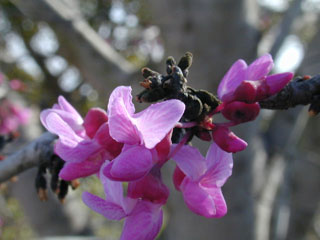
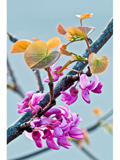
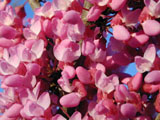
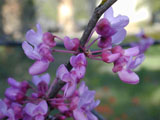
This Cercis canadensis variety is a large shrub or small tree, 10-20 ft. in height, differing from the more easterly Eastern redbud (Cercis canadensis var. canadensis) in having smaller, more glossy, and usually hairier leaves with wavy edges, more of a tendency to have red seedpods, and a smaller stature. With a natural range extending from the mountains of southern Oklahoma through the limestone spine of central Texas south to northeastern Mexico, it is also more drought-tolerant than Eastern redbud, though less so than the smaller, more western Mexican redbud (Cercis canadensis var. mexicana). Like all Cercis canadensis varieties, its clusters of flowers appear in early spring before the leaves emerge and continue to bloom as the leaves develop. Leaves are heart shaped to kidney shaped, rounded at the tip, slightly wavy on the edges, and glossy, often with some hairiness on the underside. Flowers rose purple, in small clusters along the branches, appearing before the leaves, in March or early April. Fruit a flat, reddish brown pod up to 4 inches long and pointed at the tip. Deciduous leaves turn gold or red in fall. Seedpods are reddish purple and persist into the winter.
The redbuds of eastern North America have long been popular for their pink-purple early spring flowers that appear on bare wood before the leaves emerge. Texas redbud is the appropriate variety to use if you live on limestone soils from southern Oklahoma through central Texas to northeastern Mexico. It is drought-tolerant within its range, prefers dappled shade but is also found in full sun, and can do well even on relatively thin soils. Its glossy, rounded leaves bring welcome shade and its flowers attract pollinators.
Plant Characteristics
Duration: PerennialHabit: Tree
Leaf Retention: Deciduous
Leaf Arrangement: Alternate
Leaf Complexity: Simple
Leaf Shape: Cordate , Ovate , Reniform
Leaf Venation: Palmate
Leaf Margin: Entire
Leaf Apex: Acute , Obtuse
Leaf Texture: Leathery
Breeding System: Flowers Unisexual , Monoecious
Fruit Type: Legume
Size Notes: Up to about 20 feet tall.
Leaf: Dark Green
Flower: Flowers 1/3-2/5 in. long
Fruit: Green to red or purplish red to reddish brown pods 2-4 in. long pod, about 1/2 in. wide or less, tapering at both ends, flat with several seeds 1/6-1/5 in. long.
Bloom Information
Bloom Color: White , Pink , PurpleBloom Time: Mar , Apr
Bloom Notes: Color normally pink or purple, rarely white. White-flowered cultivars have been developed.
Distribution
USA: OK , TXNative Distribution: Southern Oklahoma south through central Texas to Nuevo Leon in Mexico
Native Habitat: Dry slopes of canyons & foothills below 4500 ft. Edwards Plateau and limestone soils of north central Texas and eastern part of Plains Country.
Growing Conditions
Water Use: Low , MediumLight Requirement: Sun , Part Shade
Soil Moisture: Dry
Soil pH: Alkaline (pH>7.2)
CaCO3 Tolerance: Low
Drought Tolerance: Medium , High
Cold Tolerant: yes
Heat Tolerant: yes
Soil Description: Well-drained, calcareous, rocky, sandy, loamy, or clay soils, usually limestone-based.
Conditions Comments: Drought- and cold-tolerant within its range. Give dappled shade when young. A selection called 'Sanderson' is said to be the most drought-adapted Texas redbud cultivar.
Benefit
Use Ornamental: Showy, attractive, understory tree or accent tree.Use Wildlife: The nectar is sought after by butterflies, bees, moths, and insects. The leaves are sometimes browsed by deer. The seeds are eaten by granivorous birds.
Use Food: The flowers are fried in Mexico. The flowers are acid and are sometimes pickled for salads. The nectar is of some value as a source of honey.
Use Medicinal: A fluid extract can be taken from the bark which is an active astringent used in the treatment of dysentery.
Conspicuous Flowers: yes
Interesting Foliage: yes
Attracts: Butterflies
Larval Host: Henry's Elfin butterfly
Nectar Source: yes
Deer Resistant: Moderate
Value to Beneficial Insects
Special Value to Native BeesSpecial Value to Bumble Bees
Provides Nesting Materials/Structure for Native Bees
This information was provided by the Pollinator Program at The Xerces Society for Invertebrate Conservation.
Propagation
Propagation Material: SeedsDescription: Propagate with scarified and stratified seed.
Seed Collection: Harvest pods as soon as they begin to dry to reduce insect damage.
Seed Treatment: Scarification and stratification necessary.
Commercially Avail: yes
Mr. Smarty Plants says
Plants for wildlife and trees for shade.
September 29, 2007
We live in Kempner Texas, our land has mostly cedar trees. We would like to make a wildlife habitat on the back side of our property. Can you recommend plants that will grow in shade to partial sun,...
view the full question and answer
Invasive, non-native Paulownia
May 03, 2006
Hi. We would like to plant a fast growing tree that will provide shade for our house. What do you think of the Paulownia tree (Empress Tree) as a possibility for the Austin area? If this is not a g...
view the full question and answer
From the National Organizations Directory
According to the species list provided by Affiliate Organizations, this plant is on display at the following locations:Fredericksburg Nature Center - Fredericksburg, TX
Lady Bird Johnson Wildflower Center - Austin, TX
Sibley Nature Center - Midland, TX
Patsy Glenn Refuge, c/o Wimberley Birding Society - Wimberley, TX
NPSOT - Native Plant Society of Texas - Fredericksburg, TX
Texas Parks and Wildlife Department - Austin, TX
NPSOT - Fredericksburg Chapter - Fredericksburg, TX
NPSOT - Austin Chapter - Austin, TX
Jacob's Well Natural Area - Wimberley, TX
NPSOT - Williamson County Chapter - Georgetown, TX
Bibliography
Bibref 1186 - Field Guide to Moths of Eastern North America (2005) Covell, C.V., Jr.Bibref 298 - Field Guide to Texas Trees (1999) Simpson, B.J.
Bibref 1185 - Field Guide to Western Butterflies (Peterson Field Guides) (1999) Opler, P.A. and A.B. Wright
Bibref 481 - How to Grow Native Plants of Texas and the Southwest: Revised and Updated Edition (2001) Nokes, J.
Bibref 354 - Native & Naturalized Woody Plants of Austin & the Hill Country (1981) Lynch, D.
Bibref 841 - Native Alternatives to Invasive Plants (2006) Burrell, C. C.
Bibref 318 - Native Texas Plants: Landscaping Region by Region (2002) Wasowski, S. & A. Wasowski
Bibref 297 - Trees of Central Texas (1984) Vines, Robert A.
Search More Titles in Bibliography
From the Archive
Wildflower Newsletter 1985 VOL. 2, NO.4 - Message From Helen Hayes, Head for the Hill Country, Spring Tours at the Center,...Wildflower Newsletter 1989 VOL. 6, NO.5 - Educator\\\'s Native Plants Poster Perfected, Pass a Law, Protect a Tree, Resear...
Additional resources
USDA: Find Cercis canadensis var. texensis in USDA PlantsFNA: Find Cercis canadensis var. texensis in the Flora of North America (if available)
Google: Search Google for Cercis canadensis var. texensis
Metadata
Record Modified: 2015-11-12Research By: TWC Staff, GDG