Native Plants

Plant Database
Search for native plants by scientific name, common name or family. If you are not sure what you are looking for, try the Combination Search or our Recommended Species lists.
Strickland, Sam C.
Bouteloua dactyloides
Bouteloua dactyloides (Nutt.) J.T. Columbus
Buffalograss, Buffalo Grass
Poaceae (Grass Family)
Synonym(s): Buchloe dactyloides, Bulbilis dactyloides, Sesleria dactyloides
USDA Symbol: BODA2
USDA Native Status: L48 (N), CAN (N)
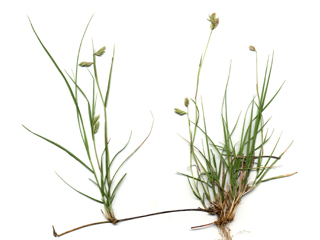
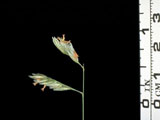
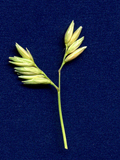
Buffalograss is a soft, gray-green or blue-green, perennial turf grass which grows 3-12 inches if left unmowed and spreads by rhizomes. This long-lived, warm-season, sod-forming grass has curly leaf blades, slender stems, and compact seed heads.
One of very few drought-tolerant North American grasses suitable for lawn use, and the only one widely available, Buffalograss has become very popular since the late 1980s. (Two other drought-tolerant native lawn grasses are Blue Grama/B. gracilis and Curly Mesquite Grass/Hilaria belangeri.) Buffalograss does best in clay loam, where it can survive on as little as one and a half inches of rainfall per month. In areas with even less rainfall, Buffalograss is sometimes mixed with the more drought-tolerant Blue Grama (B. gracilis) to insure solid color through the dry season. Cultivars "Texoka" and "Comanche" were bred for forage and can reach 12 inches. "Prairie", "609", and "Stampede" are lawn selections. "Stampede" does not get taller than 4 inches. Buffalograss lawns can be mowed or left to billow softly in the wind.

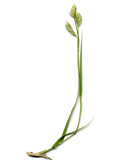
Plant Characteristics
Duration: PerennialHabit: Grass/Grass-like
Root Type: Fibrous
Leaf Retention: Semi-evergreen
Leaf Arrangement: Alternate
Leaf Complexity: Simple
Leaf Venation: Parallel
Breeding System: Flowers Unisexual , Dioecious
Inflorescence: Spike
Fruit Type: Caryopsis
Size Notes: 3 to 12 inches tall.
Leaf: Gray-Green, Blue-Green
Bloom Information
Bloom Color: YellowBloom Time: Apr , May , Jun , Jul , Aug , Sep , Oct , Nov , Dec
Bloom Notes: Blooms opportunistically throughout growing season.
Distribution
USA: AR , AZ , CO , GA , IA , IL , KS , LA , MN , MO , MT , ND , NE , NM , NV , OK , SD , TX , UT , VA , WI , WYCanada: MB , SK
Native Distribution: Manitoba and Saskatchewan south through the central plains states of the US as far south as Puebla in Mexico. Mostly west of the 97th meridian and east of the Rocky Mountains and desert regions.
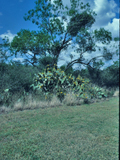
Native Habitat: Prairies, plains, meadows, pastures, savannas. A dominant grass in shortgrass prairie, understory in taller prairie.
Growing Conditions
Water Use: Low , MediumLight Requirement: Sun
Soil Moisture: Dry
CaCO3 Tolerance: High
Drought Tolerance: High
Soil Description: Well-drained loam, clay, caliche, or limestone. Does not like sand.
Conditions Comments: Requires only one and a half inches of rain per month to stay green. Will go dormant during droughts and in winter.
Benefit
Use Ornamental: A soft, fine-leaved, low-maintenance, drought-tolerant turf grass that can be mowed.Use Wildlife: Foliage cured on the ground furnishes winter browse for mammals. Seeds and leaves are food and nesting material for birds.
Interesting Foliage: yes
Attracts: Birds , Butterflies
Larval Host: Green Skipper butterfly.
Butterflies and Moths of North America (BAMONA)
|
Green Skipper (Hesperia viridis) 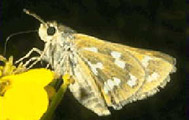 Larval Host |
Propagation
Propagation Material: SeedsDescription: Sow treated seed from April to September, preferably in clay loam. If on caliche, sow thickly. Keep moist until established. Seed requires light for germination. Old seed germinates better than young seed.
Seed Treatment: Seeds should be cold-moist stratified at 40 degrees for six weeks.
Commercially Avail: yes
Maintenance: Buffalograss can be mowed once or twice per season to maintain height.
Find Seed or Plants
Order seed of this species from Native American Seed and help support the Wildflower Center.
Mr. Smarty Plants says
Native grasses for East Texas that require no mowing or watering
June 16, 2010
What native grass can I grow in deep East Texas that would require no supplemental watering and no mowing?
view the full question and answer
Native grasses for medians in Colorado Springs
June 11, 2010
Our city has stopped watering our historic landscaped medians due to severe budget shortfalls. The medians were historically tree boulevards but have had curb and gutter and blue grass added over th...
view the full question and answer
Will drought-stricken non-native St. Augustine come back in Cedar Park TX
January 30, 2010
I recently bought a new house but the grass in the yard looked completely dead (bought house in Nov) even though the neighbor's grass was still green. The previous owner stopped watering the grass (e...
view the full question and answer
Eliminating crabgrass in Middletown MO
September 28, 2009
Dear Mr. Smarty Plants,
I am having trouble with my lawn, specifically with the crabgrass in it. It now covers over 1/3 of it. I started using corn gluten meal this year, with limited tangible succ...
view the full question and answer
Curvularia blight in buffalograss in Kansas
March 05, 2009
Our buffalo grass is infected with a fungus called curvularia. How can we treat it?
view the full question and answer
National Wetland Indicator Status
| Region: | AGCP | AK | AW | CB | EMP | GP | HI | MW | NCNE | WMVE |
| Status: | FACU | FACU | FACU | FACU | FACU | FACU | UPL |
From the National Organizations Directory
According to the species list provided by Affiliate Organizations, this plant is on display at the following locations:Lady Bird Johnson Wildflower Center - Austin, TX
Sibley Nature Center - Midland, TX
Brackenridge Field Laboratory - Austin, TX
Patsy Glenn Refuge, c/o Wimberley Birding Society - Wimberley, TX
Texas Parks and Wildlife Department - Austin, TX
NPSOT - Austin Chapter - Austin, TX
National Butterfly Center - Mission, TX
Bibliography
Bibref 946 - Gardening with Prairie Plants: How to Create Beautiful Native Landscapes (2002) Wasowski, SallyBibref 318 - Native Texas Plants: Landscaping Region by Region (2002) Wasowski, S. & A. Wasowski
Bibref 291 - Texas Wildscapes: Gardening for Wildlife (1999) Damude, N. & K.C. Bender
Bibref 1294 - The Midwestern Native Garden: Native Alternatives to Nonnative Flowers and Plants An Illustrated Guide (2011) Adelman, Charlotte and Schwartz, Bernard L.
Search More Titles in Bibliography
From the Archive
Wildflower Newsletter 1984 VOL. 1, NO.3 - Lady Bird Looks Forward to Fall\'s Activity, Gardeners Celebrate a Decade of Ope...Wildflower Newsletter 1989 VOL. 6, NO.4 - Spring Climbs Rockies Slowly, Colorado Cooler, Conference of Wildflower and Nati...
Wildflower Newsletter 1992 VOL. 9, NO.1 - Research Update, Creating Native Lawn with Sod, Director's Report, What Makes Pl...
Wildflower Newsletter 1998 VOL. 15, NO.1 - Potentials and Challenges Designing with Native Plants, Announcement of Wildflow...
Wildflower Newsletter 1998 VOL. 15, NO.4 - Grasses from the Ground Up, Celebrating Wildflowers Hotline, Executive Director\...
Additional resources
USDA: Find Bouteloua dactyloides in USDA PlantsFNA: Find Bouteloua dactyloides in the Flora of North America (if available)
Google: Search Google for Bouteloua dactyloides
Metadata
Record Modified: 2018-10-25Research By: NPC