Native Plants

Q. Who is Mr. Smarty Plants?
A: There are those who suspect Wildflower Center volunteers are the culpable and capable culprits. Yet, others think staff members play some, albeit small, role. You can torture us with your plant questions, but we will never reveal the Green Guru's secret identity.

Did you know you can access the Native Plant Information Network with your web-enabled smartphone?

Ask Mr. Smarty Plants
Ask Mr. Smarty Plants is a free service provided by the staff and volunteers at the Lady Bird Johnson Wildflower Center.

rate this answer

Thursday - June 28, 2012
From: Fort Worth, TX
Region: Southwest
Topic: Invasive Plants, Non-Natives, Herbs/Forbs, Trees
Title: Plants for under non-native fruitless mullberry trees from Ft. Worth TX
Answered by: Barbara Medford
QUESTION:
I live in Tarrant county, where summer droughts are the norm. I have a 150x50 foot swathe of mature "fruitless mulberry" trees, which create a very shady atmosphere. The soil is clay dominated, rocky and alkaline. My question is what wild flowers and flowering ground cover will thrive under such conditions?ANSWER:
Wow! That is quite an extensive property for maintenance. Is this residential or are there groundskeepers, because this is going to be a huge job. This particular member of the Mr. Smarty Plants Team gardened in Tarrant County for 38 years, so we are quite familiar with the climate and soils there.
Morus alba, fruitless mulberry or white mulberry, is native to southern and eastern China and therefore falls out of the range of the expertise of Mr. Smarty Plants. Here is more information on it: Morus alba from Ohio State University. Because it is non-native and therefore not in our Native Plant Database, we are unsure what kind of root systems it has, whether it exhibits allelopathy (exuding substances to discourage competing plants beneath it) or how long it lives.
From a USDA Forest Service report on mulberry tree:
"Belowground description: White mulberry has a wide, spreading root system, with both a tap root and lateral roots. Roots are large in diameter close to the root crown but decrease rapidly in size, branching within a few feet of the root crown into numerous fibrous roots The longest lateral root extension was 42 feet. Most lateral roots occurred in the upper 1 to 3 feet of soil, and no lateral roots occurred below 5 feet; average lateral root spread was calculated at 190 to 330 ft."
We quote this to remind you where you will have interaction between the tree roots and the roots of the plants you will be placing beneath them. You might consider putting a bed of organic mulch out a few feet from the tree trunks but not against the trunks, which can cause insect and fungus damage. If you are going to be planting that far out from the trunks, we will indicate shade (2 hours or less of sun a day) and part shade (2 to 6 hours).
We can't promise "thrive" necessarily in North Central Texas, especially in the current climate conditions. We will think more in terms of "survive". First, you must know that this is not a good time to be planting anything, woody plants (shrubs and trees) especially. Very few wildflowers do well in shady conditions, and should be planted (in the case of most Texas wildflowers) in the Fall. By using the Recommended Species list for North Central Texas, we will be looking at "herbs" (herbaceous blooming plants) and then doing a second search on the same habit, but restricting it to 0 to 1' tall, for groundcovers. If we choose plants native to North Central Texas, as we would do under any circumstances, they should already be acclimated to the climate, rainfall and soils by centuries of experience. Follow each plant link to our webpage on that plant to learn its light requirements, water needs and growing conditions. You can then go back and do the search with your own specifications to see if you can find plants you like better than our choices.
Flowering Plants for Shade:
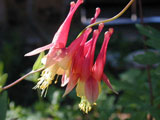
Aquilegia canadensis (Eastern red columbine)
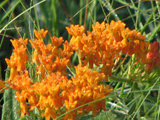
Asclepias tuberosa (Butterflyweed)
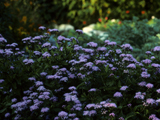
Conoclinium coelestinum (Blue mistflower)
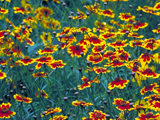
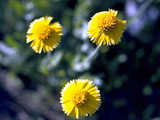
Coreopsis tinctoria (Plains coreopsis)
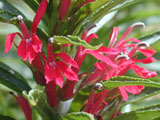
Lobelia cardinalis (Cardinal flower)
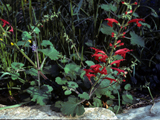
Salvia roemeriana (Cedar sage)
Amblyolepis setigera (Huisache daisy)
Glandularia bipinnatifida var. bipinnatifida (Prairie verbena)
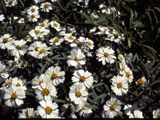
Melampodium leucanthum (Blackfoot daisy)
Callirhoe involucrata (Winecup)
From the Image Gallery

More Trees Questions
Chinkapin oak (Quercus muehlenbergeii) weeping sap
October 14, 2010 - Help, help! Our Chinkapin Oak is weeping sap along the trunk. There is no sign of damage. What can we do?
view the full question and answer
Difficulty of watering at drip line of trees from The Woodlands TX
August 18, 2011 - I'm watering my couple dozen native mature trees to make sure they survive this drought and its aftermath..and I'm reading about how to water at the drip line. But..all of my trees' drip lines ext...
view the full question and answer
Growing Chilopsis in Florida
July 25, 2013 - I live in St. Johns County, FL between Jacksonville and St Augustine. I live inland, not near the beach. I bought a small desert willow plant in Victoria, TX and brought it back to FL to grow. I plan ...
view the full question and answer
Lantana trees in Wyoming MI
August 16, 2010 - We love lantana with its multicolored flowers. This weekend we visited Michigan State University and saw "lantana trees".They were amazing!! Have these trees been grown from the annual plant we have...
view the full question and answer
Trees Planted Over Underground Parking Garage
July 13, 2014 - I live in an apartment complex. We have trees planted over an underground parking lot. I know the names of all the trees and I want to know how much soil they should be planted in to NOT cause damage ...
view the full question and answer
| Support the Wildflower Center by Donating Online or Becoming a Member today. |