Native Plants

Q. Who is Mr. Smarty Plants?
A: There are those who suspect Wildflower Center volunteers are the culpable and capable culprits. Yet, others think staff members play some, albeit small, role. You can torture us with your plant questions, but we will never reveal the Green Guru's secret identity.

Did you know you can access the Native Plant Information Network with your web-enabled smartphone?

Ask Mr. Smarty Plants
Ask Mr. Smarty Plants is a free service provided by the staff and volunteers at the Lady Bird Johnson Wildflower Center.

rate this answer

Monday - October 03, 2011
From: Austin, TX
Region: Southwest
Topic: Non-Natives, Pruning, Shrubs
Title: Replacing non-native boxwood in Austin
Answered by: Barbara Medford
QUESTION:
I have a large maze garden, possibly boxwood, originally planted in the 1950's, in Austin, Texas. About 1/3 of it has died out, probably due to drought, heat and age. Should I attempt to replant just the dead areas with new boxwood? I am concerned that newer smaller plants mixed in with older larger plants may not grow well. Or should I just start over and replant the whole thing in dwarf yaupon holly? Are there any other native plants lending themselves to hedges beside yaupon? Agarita? Cenizo?ANSWER:
Honest? You have a boxwood maze in Austin? Wow. Coincidentally, we have just answered a question about boxwood and, because we are a little lazy, will repeat some of what we said in that question:
Your boxwood is probably either Buxus sempervirens, native to Europe, Western Asia and northern Europe or Buxus microphylla, Japanese boxwood. From an article by Virginia Cooperative Extension, Boxwood in the Landscape:
"Boxwood is not popular with everyone. In fact, some violently dislike it and refuse to have it on their premises. Those who do not like it may have had difficulties in growing it and have become disillusioned. Poor designs may also result from failure to properly maintain healthy, uniform plants."
Boxwood does best in moist soil and an environment free from extremes. Doesn't sound much like Austin, does it? The Lady Bird Johnson Wildflower Center is dedicated to the growth, propagation and protection of plants native not only to North America but to areas in which those plants grow natively. As we go through this terrible drought and heat in the Southwest, we are pointing out that plants native to this area have, genetically speaking, seen these conditions before. Obviously, our conclusion is that the boxwood is better off gone.
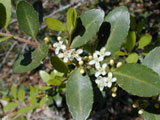
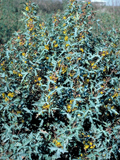
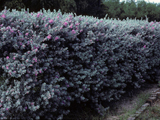
Now, what to do about replacement? First, you need to consider if you still want the "maze," or if you are ready to get into a less water, work and money-intensive solution for landscaping in Central Texas. The three shrubs you mentioned- Ilex vomitoria (Yaupon), Mahonia trifoliolata (Agarita), Leucophyllum frutescens (Cenizo) all are native to this area and will tolerate pruning. A couple of problems we see with that is that pruning into the rather rigid shapes called for in the classic maze arrangement is not particularly liked by any of these shrubs. Also, a large number of the same plant basically constitutes a monoculture. If one plant is not suited to your soils and amount of sun, none of them will be, and a disease or insect problem on one could be shared by all. Furthermore, we would not even consider pruning an agarita, those babies fight back!
Follow each of the plant links above to our webpage on that plant to determine the growing conditions it requires, water and so forth. Most native plants neither like nor need fertilizer, and the cenizo, in particular, should not be fertilized. In terms of how prunable they are, the normal predicted height of a yaupon can be 25 to 40 ft., while the agarita and cenizo average in the 3 to 8 ft. range. There are, indeed, some selections of yaupon that can be called "dwarf." These include: 'Schellings Dwarf,' 'Bordeaux,' and 'Nana'.
Last word, this is NOT the time to be planting woody plants, like trees and shrubs. At this moment, the heat wave seems blunted, but in Texas November to January, while woody plants are mostly dormant, is the best time to plant and avoid transplant shock, which probably kills more plants than any disease.
From the Image Gallery
More Non-Natives Questions
Companion Plants for Texas Mountain Laurel
March 12, 2015 - I am building a garden from scratch and need help. I want to plant a Texas mountain laurel on each front section of my house in front of a window, and I also want to use Thumbelina Leigh English laven...
view the full question and answer
Removing non-native juniperus x pfitzeriana in Arvada CO
June 25, 2009 - We have 200' of large juniper pfitzers (3' tall - 4' wide) that completely enclose our front yard. We want to remove all of them but the estimates to dispose of them have been extremely high. One...
view the full question and answer
Covering dead arborvitae with non-native ivy from Niles MI
April 14, 2013 - I have a severely thinning arborvitae hedge. It is probably too shady, but I want the privacy. I'm thinking of planting something like ivy to fill the gaps. I know it will probably kill the hedge, bu...
view the full question and answer
Mosquito problem from Mesa AZ
April 07, 2014 - We have a mosquito problem in our backyard, I think they're grass Mosquitos. I wanted to get lemongrass for a deterrent but both nurseries were out so I opted for rosemary. They're ALL OVER the rose...
view the full question and answer
Problems with non-native hollyhock in Austin
April 03, 2010 - Our hollyhocks develop small yellow spots on the leaves; these eventually spread into little swellings on the underside; I think of them as lesions. They spread and the leaf turns brown and shrivels ...
view the full question and answer
| Support the Wildflower Center by Donating Online or Becoming a Member today. |